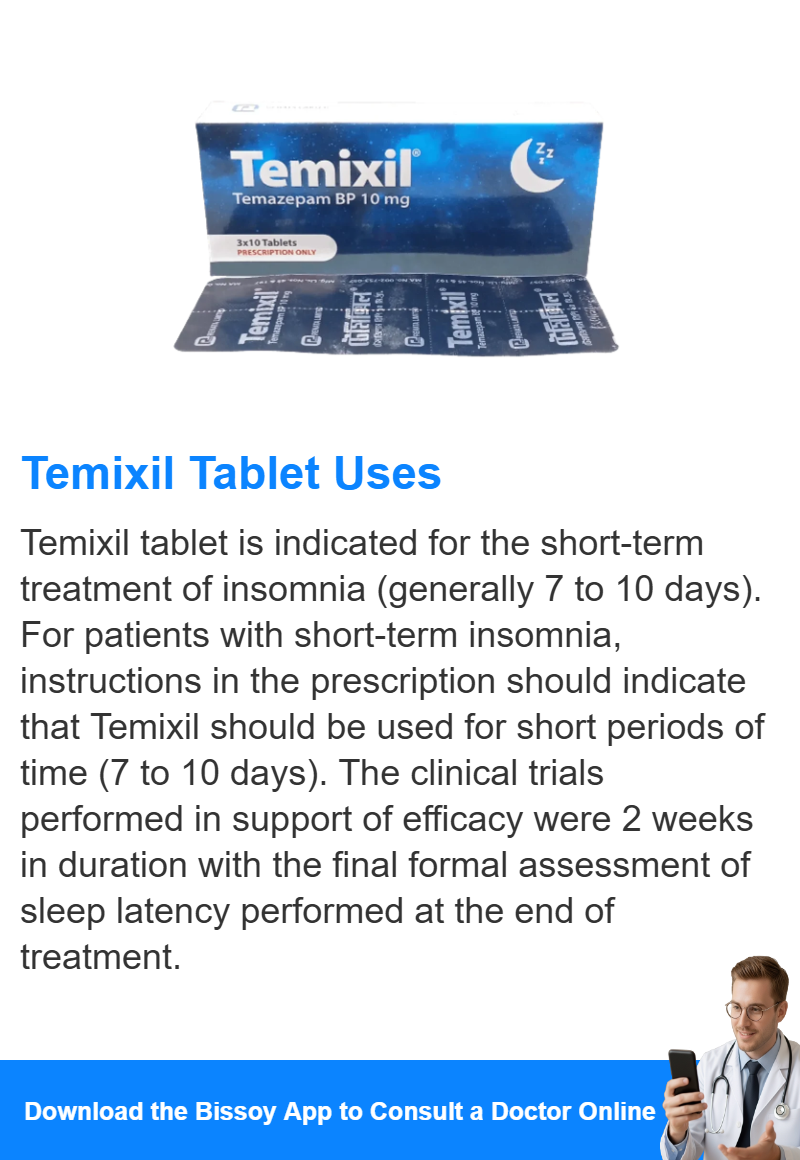
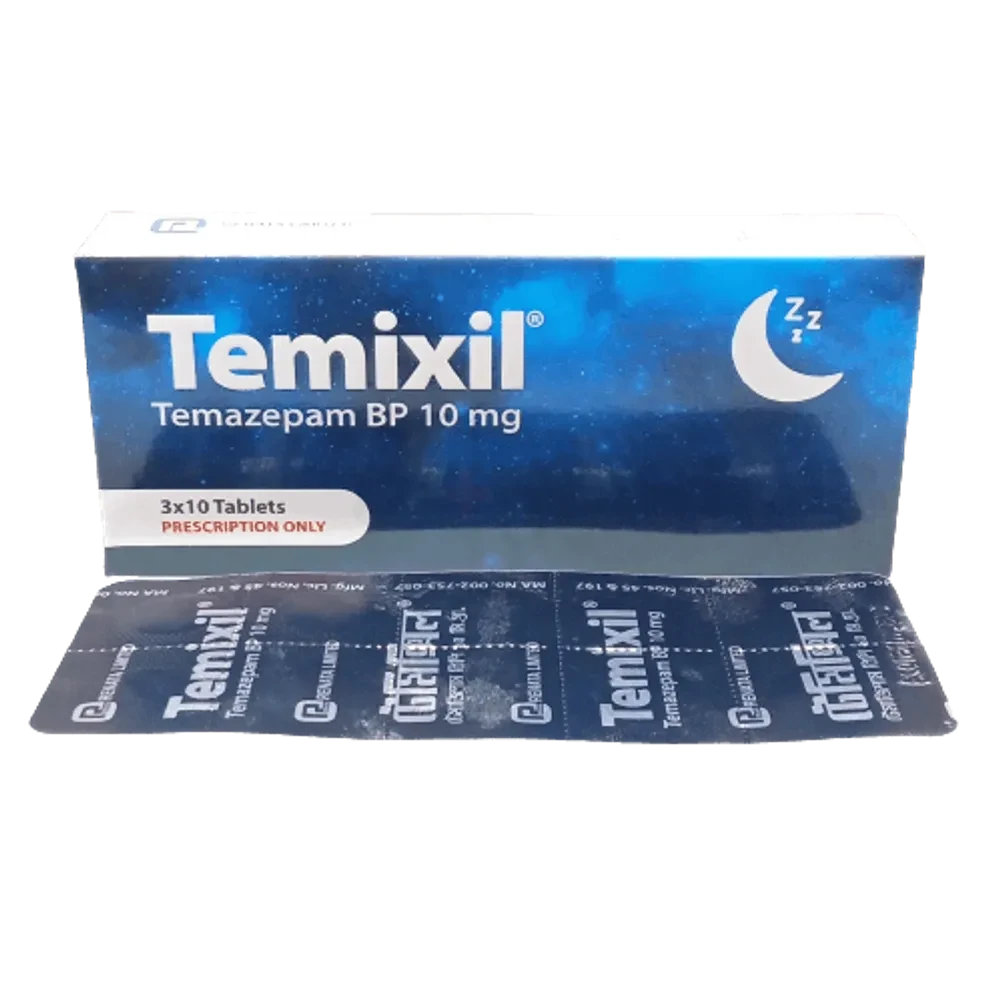
Introduction
Temixil Tablet 10 mg, like many other similar and related benzodiazepines, acts as a gamma-aminobutyric acid (GABA) modulator and is capable of eliciting a variety of actions including sedation, hypnosis, skeletal muscle relaxation, anticonvulsant activity, and anxiolytic action .
Although the chemical synthesis of temazepam was established by 1965 , mainstream contemporary use of the medication did not occur until it's legitimate use as treatment for insomnia was accepted and approved later on. In particular, before temazepam saw regular prescription use in civilians it was - and still is - employed by the US military as a sedative-hypnotic medication to be taken by soldiers, pilots, etc. to obtain the necessary rest required for medical recovery or scheduled maneuvers and operations . Regardless, temazepam has become one of the most frequently prescribed medications internationally and sees millions of prescriptions every year. Unfortunately, however, given its frequent use and the inherent nature of its pharmacological effects, temazepam - like many other benzodiazepines - possesses a high potential for misuse and is genuinely capable of developing drug tolerance, physical dependence, and addiction in users.
Uses
Temixil Tablet 10 mg is a short-acting benzodiazepine commonly used to treat panic disorders, severe anxiety, and insomnia.
Temixil Tablet 10 mg is specifically indicated only for the short-term management of insomnia , . Furthermore, such management is generally predominantly associated with the symptomatic relief of transient and short-term insomnia characterized by difficulty in falling asleep, frequent nocturnal awakenings and/or early morning awakenings . In particular, the official prescribing information for temazepam typically specifies that the instructions issued for dispensed prescriptions of the medication should indicate specifically that patients are only expected to use the therapy for short periods of time - usually 7-10 days in general . Subsequently, treatment with temazepam should usually not exceed 7 to 10 consecutive days and nor should it be prescribed in quantities exceeding a one-month supply .
Some regional prescribing information also notes that temazepam may be used for premedication prior to minor surgery or other related procedures .
Associated Conditions
Pharmacodynamics
Temixil Tablet 10 mg is a benzodiazepine used as a hypnotic agent in the management of insomnia . Temixil Tablet 10 mg produces CNS depression at limbic, thalamic, and hypothalamic levels of the CNS . Temixil Tablet 10 mg increases the affinity of the neurotransmitter gamma-aminobutyric acid (GABA) for GABA receptors by binding to benzodiazepine receptors . Results are sedation, hypnosis, skeletal muscle relaxation, anticonvulsant activity, and anxiolytic action .
In sleep laboratory studies, the effect of temazepam was compared to placebo during a two week period . The studies demonstrated a linear dose-response improvement in total sleep time and sleep latency with substantial drug-placebo differences apparent for total sleep time and for sleep latency at higher doses of temazepam . Regardless, REM sleep was ultimately unchanged but slow wave sleep was decreased .
Moreover, a transient syndrome, known as "rebound insomnia", wherein the symptoms that led to treatment with temazepam in the first place recur in an enhanced form, may happen on withdrawal of temazepam treatment . The possibility of this occurrence is in part why long term use of temazepam is not recommended due to worries over tolerance and dependence wherein patients' bodies become physiologically accustomed to the regular presence and pharmacological effect of higher and higher doses of the benzodiazepine used .
The duration of hypnotic effect and the profile of unwanted adverse effects may be influenced by the distribution and elimination half-lives of the administered temazepam and any active metabolites that may be formed . When such half-lives are long, the drug or its metabolite(s) may accumulate during periods of nightly administration and be associated with impairments of cognitive and motor performance during waking hours . Conversely, if half-lives are short, the drug and metabolites would be cleared before the next dose is ingested, and carry-over effects related to sedation or CNS depression should be minimal or not present at all . However, during nightly use and for an extended period, pharmacodynamic tolerance or adaptation to some effects of benzodiazepine hypnotics may develop - which may also contribute to the possibility of 'rebound insomnia' .
Consequently, if the drug has a very short elimination half-life, it is possible that a relative deficiency (for example, in relation to benzodiazepine GABA(a) receptor sites) may occur at some point in the interval between each night's use . This sequence of events may account for certain clinical findings reported happening after several weeks of nightly use of rapidly eliminated benzodiazepine hypnotics, including increased wakefulness during the last third of the night and the appearance of increased daytime anxiety .
Mechanism of Action
Gamma-Aminobutyric acid (GABA) is considered the principal inhibitory neurotransmitter in the human body . When GABA binds to GABA(a) receptors found in neuron synapses, chloride ions are conducted across neuron cell membranes via an ion channel in the receptors . With enough chloride ions conducted, the local, associated neuron membrane potentials are hyperpolarized - making it more difficult or less likely for action potentials to fire, ultimately resulting in less excitation of the neurons .
Subsequently, benzodiazepines like temazepam can bind to benzodiazepine receptors that are components of various varieties of GABA(a) receptors . This binding acts to enhance the effects of GABA by increasing GABA affinity for the GABA(a) receptor, which ultimately enhances GABA ligand binding at the receptors . This enhanced ligand binding of the inhibitory neurotransmitter GABA to the receptors increases the aforementioned chloride ion conduction (perhaps reportedly via an increase in the frequency of the chloride channel opening), resulting in a hyperpolarized cell membrane that prevents further excitation of the associated neuron cells . Combined with the notion that such benzodiazepine receptor associated GABA(a) receptors exist both peripherally and in the CNS, this activity consequently facilitates various effects like sedation, hypnosis, skeletal muscle relaxation, anticonvulsant activity, and anxiolytic action .
Absorption
Studies demonstrate that between 90 to 100% of an orally administered temazepam dose is absorbed, making the medication very well absorbed . The oral administration of 15 to 45 mg temazepam resulted in rapid absorption with significant blood levels achieved in 30 minutes and peak levels at 2-3 hours . In particular, direct studies following the oral ingestion of 30 mg of temazepam revealed measurable plasma concentrations were obtained 10-20 minutes after dosing with peak plasma levels ranging between 666-982 ng/mL (with a mean of 865 ng/mL) presenting approximately 1.2-1.6 hours (with a mean of 1.5 hours) after the dosing . Finally, a dose-proportional relationship was established for the area under the plasma concentration/time curve over the 15 to 30 mg dose range .
Volume of Distribution
The volume of distribution documented for temazepam is 1.3-1.5 L/kg body weight - and in particular, 43-68 L/kg for the unbound fraction .
Protein Binding
It has been recorded that about 96% of unchanged temazepam is bound to plasma proteins .
Route of Elimination
Following a single dose, 80-90% of the dose appears in the urine, predominantly as the O-conjugate metabolite, and 3-13% of the dose appears in the faeces . Less than 2% of the dose is excreted unchanged or as N-desmethyltemazepam in the urine .
Half Life
The terminal half-life determined for temazepam is recorded as being between 3.5-18 hours, with a mean of 9 hours .
Clearance
Studies regarding the clearance of temazepam have recorded the values of 1.03 ml/min/kg and 31 ml/min/kg for the clearance of total temazepam and the clearance of unbound temazepam, respectively .
Toxicity
Manifestations of acute overdosage of temazepam, as with other benzodiazepines, can be expected to reflect the increasing CNS effects of the drug and include somnolence, confusion, and coma, with reduced or absent reflexes . With large overdoses, respiratory depression, hypotension, and finally coma can occur .
Benzodiazepines like temazepam might cause fetal harm when administered to a pregnant woman. Transplacental distribution has in the past resulted in neonatal CNS depression following the ingestion of therapeutic doses of related benzodiazepine hypnotics like diazepam during the last weeks of pregnancy .
It is not known whether this drug is excreted in human milk . Caution should, therefore, be exercised when temazepam is administered to a nursing woman .
Safety and effectiveness in pediatric patients have not been established .
Lower doses of temazepam, like 7.5 mg is recommended as the initial dosage for patients aged 65 and over since the risk of the development of oversedation, dizziness, confusion, ataxia and/or falls increases substantially with larger doses of benzodiazepines in elderly and debilitated patients .
No evidence of carcinogenicity was observed in animal studies although hyperplastic liver nodules were observed in female mice exposed to the highest doses of temazepam . The clinical significance of this finding is not known .
Fertility in male and female rats was not adversely affected by temazepam toxicity studies .
No mutagenicity tests have been done with temazepam .
Food Interactions
- Avoid alcohol.
- Take with or without food.
Dosage
Pediatric Use: Safety and effectiveness in pediatric patients have not been established.