Introduction
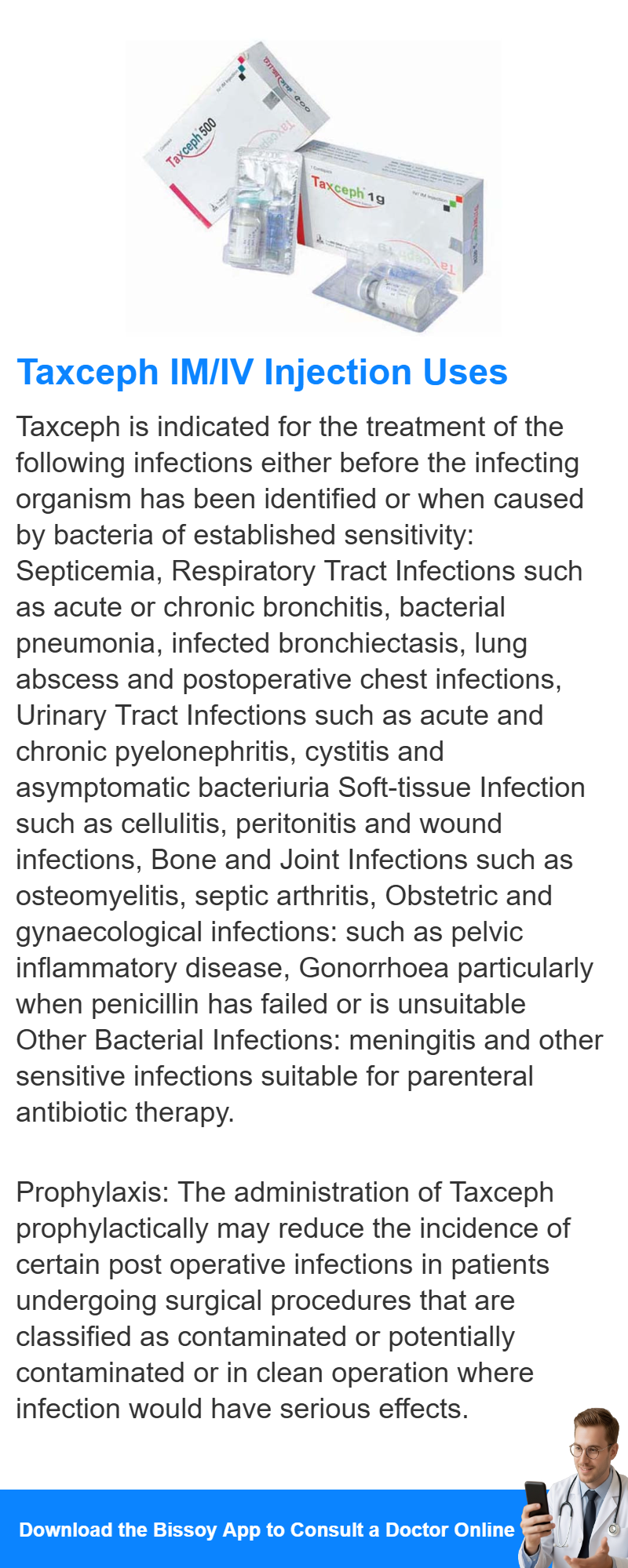
Taxceph IM/IV Injection 500 mg/10 ml is a third-generation cephalosporin antibiotic. Like other third-generation cephalosporins, it has broad spectrum activity against Gram positive and Gram negative bacteria. In most cases, it is considered to be equivalent to ceftriaxone in terms of safety and efficacy.
Uses
Taxceph IM/IV Injection 500 mg/10 ml is a third generation cephalosporin used to treat susceptible Gram negative and Gram positive bacterial infections.
Used to treat gonorrhoea, meningitis, and severe infections including infections of the kidney (pyelonephritis) and urinary system. Also used before an operation to prevent infection after surgery.
Associated Conditions
Pharmacodynamics
Taxceph IM/IV Injection 500 mg/10 ml is a third generation intravenous cephalosporin antibiotic. It has broad spectrum activity against Gram positive and Gram negative bacteria. It does not have activity against Pseudomonas aeruginosa. Taxceph IM/IV Injection 500 mg/10 ml works by inhibiting bacterial cell wall biosynthesis. A positive feature of cefotaxime is that it display a resistance to penicillinases and is useful to treat infections that are resistant to penicillin derivatives.
Mechanism of Action
The bactericidal activity of cefotaxime results from the inhibition of cell wall synthesis via affinity for penicillin-binding proteins (PBPs). Taxceph IM/IV Injection 500 mg/10 ml shows high affinity for penicillin-binding proteins in the cell wall including PBP Ib and PBP III.
Absorption
Rapidly absorbed following intramuscular injection.
Route of Elimination
Approximately 20-36% of an intravenously administered dose of 14C-cefotaxime is excreted by the kidney as unchanged cefotaxime and 15-25% as the desacetyl derivative, the major metabolite.
Half Life
Approximately 1 hour.
Toxicity
Adverse effects following overdosage include nausea, vomiting, epigastric distress, diarrhea, and convulsions. Oral rat LD50 is over 20,000 mg/kg while intravenous rat LD50 is over 7,000 mg/kg.
Food Interactions
No interactions found.
Dosage
Children: The usual dosage range is 100-150 mg/kg/day in 2 to 4 divided doses. However, in very severe infections doses of up to 200 mg/kg/day may be required.
Neonates: The recommended dosage is 50 mg/kg/day in 2 to 4 divided doses. In severe infections 150-200 mg/kg/day, in divided doses, have been given.
Dosage in gonorrhoea: 500 mg as a single dose.