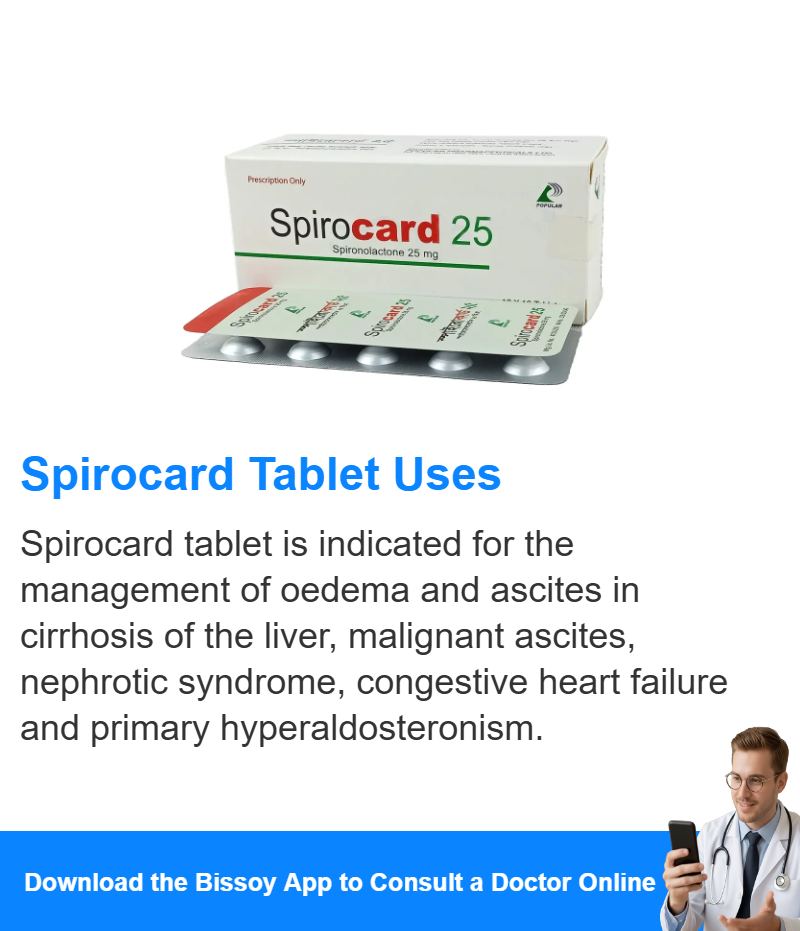
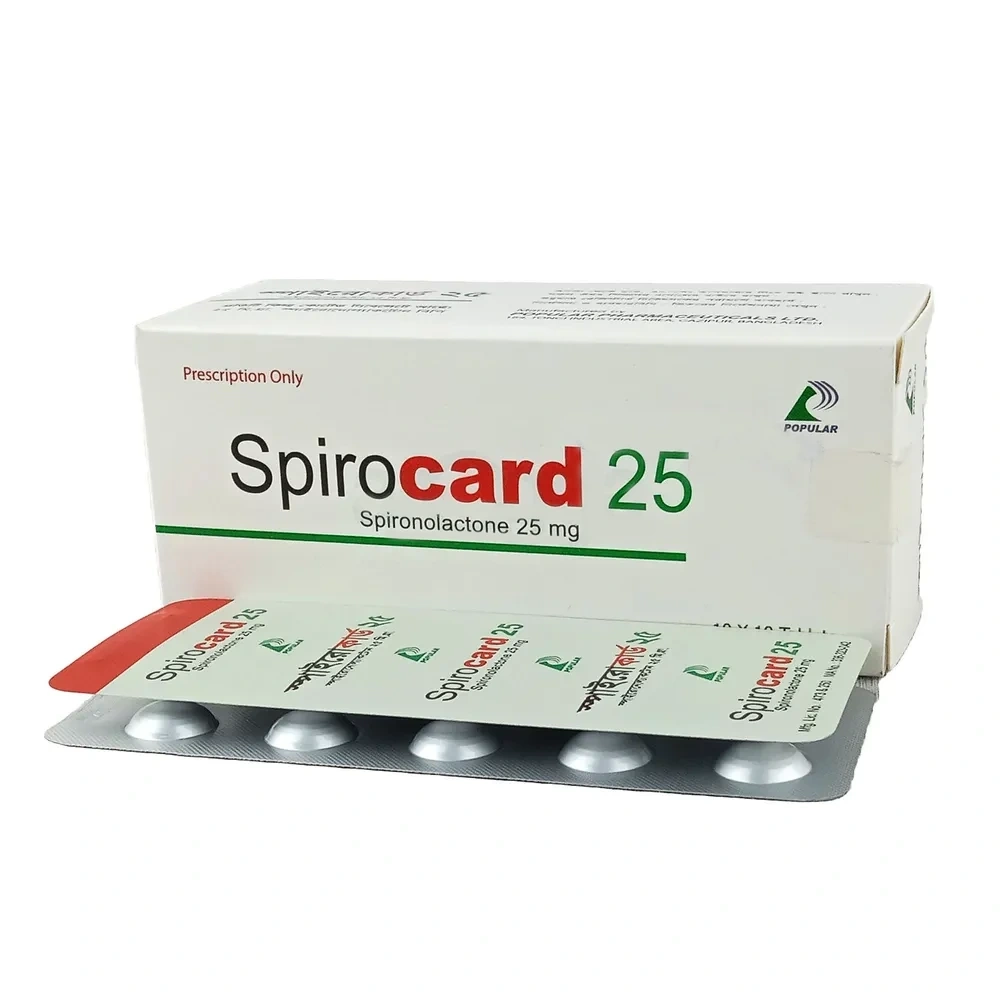
Introduction
Spirocard Tablet 25 mg is a potassium sparing diuretic like eplerenone that competitively inhibits mineralocorticoid receptors in the distal convoluted tubule to promote sodium and water excretion and potassium retention. Spirocard Tablet 25 mg was originally developed purely for this ability before other pharmacodynamic properties of the drug were discovered. It is indicated to treat a number of conditions including heart failure, deem, hyperaldosteronism, adrenal hyperplasia, hypertension, and nephrotic syndrome. Off label uses of spironolactone involving its antiandrogenic activity include hirsutism, female pattern hair loss, and adult acne vulgaris. Spirocard Tablet 25 mg is also frequently used in medical gender transition.
Uses
Spirocard Tablet 25 mg is an aldosterone receptor antagonist used for the treatment of hypertension, hyperaldosteronism, edema due to various conditions, hirsutism (off-label) and hypokalemia.
Spirocard Tablet 25 mg is indicated for the treatment of New York Heart Association Class III-IV heart failure, management of edema in cirrhotic adults not responsive to fluid and sodium restrictions, primary hyperaldosteronism short-term preoperatively, primary hyperaldosteronism long-term in patients with aldosterone producing adrenal adenomas that are not candidates for surgery or patients with bilarteral micro/macronodular adrenal hyperplasia, as an add-on therapy in hypertension, and in nephrotic syndrome when treatment of the disease as well as fluid and sodium restriction with other diuretics is inadequate.
Spirocard Tablet 25 mg has antiandrogenic activity which leads to many of its off label uses. Spirocard Tablet 25 mg is used off label in the treatment of hirsutism, female pattern hair loss, and adult acne vulgaris.
Spirocard Tablet 25 mg is also frequently used for its antiandrogenic effects in transgender female patients due to its low cost and reducing male-pattern hair growth.
Associated Conditions
Pharmacodynamics
Originally spironolactone was only studied for its potassium sparing diuretic effect. Spirocard Tablet 25 mg competitively inhibits mineralocorticoid receptors in the distal convoluted tubule to promote sodium and water excretion and potassium retention.. Inhibition of this receptor leads to increased renin and aldosterone levels.
Spirocard Tablet 25 mg is structurally similar to progesterone and as a result is associated with progestogenic and antiandrogenic effects.
Mechanism of Action
Spirocard Tablet 25 mg competitively inhibits aldosterone dependant sodium potassium exchange channels in the distal convoluted tubule. This action leads to increased sodium and water excretion, but more potassium retention. The increased excretion of water leads to diuretic and also antihypertensive effects.
Absorption
Spirocard Tablet 25 mg reaches a maximum concentration in 2.6 hours and an active metabolite (canrenone) reaches a maximum concentration in 4.3 hours. When taken with food, the bioavailability of spironolactone increases to 95.4%.
Giving spironolactone with food increases the maximum concentration from 209ng/mL to 301ng/mL. The time to maximum concentration also increases from 2.28 hours to 3.05 hours. The area under the curve varies from 2103ng/mL*hr to 4544ng/mL*hr.
Volume of Distribution
Volume of distribution data is not readily available.
Protein Binding
>90%. Canrenone is as much as 98% protein bound.
Route of Elimination
Metabolites of spironolactone are excreted 42-56% in urine, and 14.2-14.6% in the feces. No unmetabolized spironolactone is present in the urine.
Half Life
1.4 hours.
Canrenone has a half life of 16.5 hours, 7-α-thiomethylspirolactone has a half life of 13.8 hours, and 6-ß-hydroxy-7-α-thiomethylspirolactone has a half life of 15 hours.
Clearance
Clearance data is not readily available.
Toxicity
Patients experiencing an overdose may present with drowsiness, mental confusion, maculopapular or erythematous rash, nausea, vomiting, dizziness, or diarrhea. Vomiting is generally induced or a gastric lavage is performed. Supportive treatment involves maintining hydration, electrolyte balance, and vital functions.
The oral LD50 in mice, rats, and rabbits is >1g/kg.
Spirocard Tablet 25 mg should be avoided in pregnancy due to reports of feminization of male fetuses in animal studies. Active metabolites of spironolactone are present in breast milk and levels that are likely inconsequential, though the long term effects have not been studied.
In animal studies, spironolactone slowed follicle development, ovulation, and implantation. Spirocard Tablet 25 mg increased the incidence of benign adenomas in the testes of male rats, benign uterine endometrial stromal polyps in female rats, and thyroid follicular cell adenomas in both sexes of rats. Spirocard Tablet 25 mg and canrenone are generally not considered to be mutagenic in tests but canrenone occasionally tests positive for mutagenicity with metabolic activation and spironolactone has occasionally tested inconclusive though slightly positive for mutagenicity.
Food Interactions
- Avoid alcohol.
- Avoid potassium-containing products. Potassium products increase the risk of hyperkalemia.
- Take with or without food. Food increases the bioavailability of spironolactone by nearly 100%. It should be taken at a consistent time in regards to food.
Dosage
Primary hyperaldosteronism: After the diagnosis of hyperaldosteronism has been established, Spirocard Tablet 25 mg may be administered in doses of 100 to 400 mg daily in preparation for surgery. For patients who are considered unsuitable for surgery, Spirocard Tablet 25 mg may be employed for long-term maintenance therapy at the lowest effective dosage determined for the individual patient.
Essential hypertension: For adults, an initial daily dosage of 50 to 100 mg of Spirocard Tablet 25 mg administered in either single or divided doses is recommended.
Hypokalemia: Spirocard Tablet 25 mg in a dosage ranging from 25 mg to 100 mg daily is useful in treating a diuretic-induced hypokalemia.