Introduction
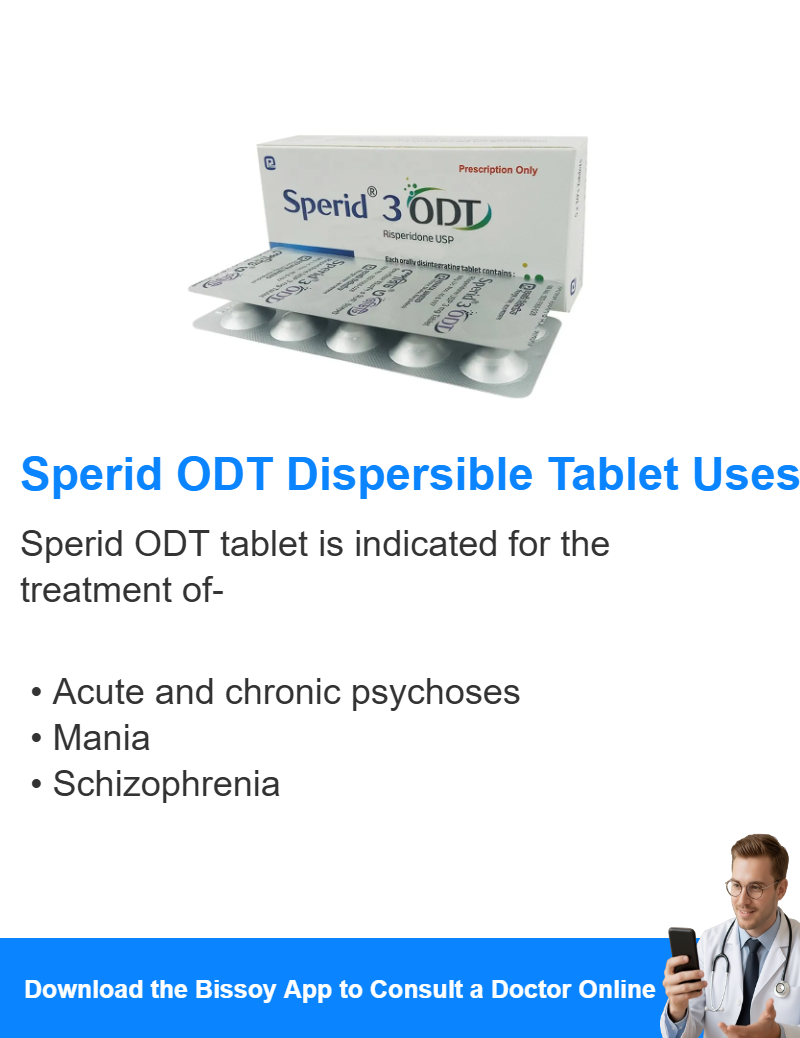
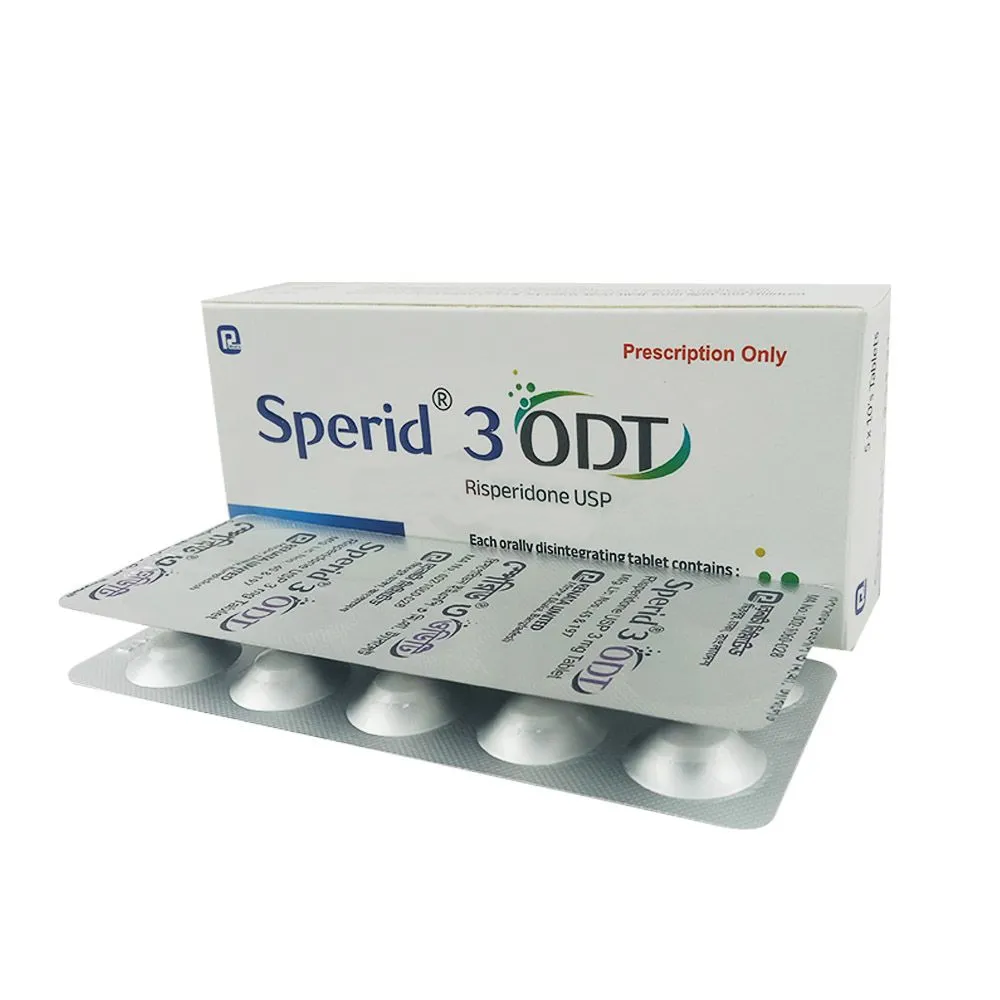
Sperid ODT Dispersible Tablet 3 mg is a second-generation antipsychotic (SGA) medication used in the treatment of a number of mood and mental health conditions including schizophrenia and bipolar disorder. It is one of the most widely used SGAs. Paliperidone, another commonly used SGA, is the primary active metabolite of risperidone (i.e. 9-hydroxyrisperidone).
Schizophrenia and various mood disorders are thought to be caused by an excess of dopaminergic D2 and serotonergic 5-HT2A activity, resulting in overactivity of central mesolimbic pathways and mesocortical pathways, respectively. Sperid ODT Dispersible Tablet 3 mg is thought to reduce this overactivity through inhibition of dopaminergic D2 receptors and serotonergic 5-HT2A receptors in the brain.
Sperid ODT Dispersible Tablet 3 mg binds with a very high affinity to 5-HT2A receptors, approximately 10-20 fold greater than the drug's binding affinity to D2 receptors, and carries lesser activity at several off-targets which may responsible for some of its undesirable effects.
Uses
Sperid ODT Dispersible Tablet 3 mg is a second-generation antipsychotic medication used to treat a number of mental health disorders including schizophrenia, bipolar mania, psychosis, or as an adjunct in severe depression.
Sperid ODT Dispersible Tablet 3 mg is indicated for the treatment of schizophrenia and irritability associated with autistic disorder. It is also indicated as monotherapy, or adjunctly with lithium or valproic acid, for the treatment of acute mania or mixed episodes associated with bipolar I disorder.
Sperid ODT Dispersible Tablet 3 mg is additionally indicated in Canada for the short-term symptomatic management of aggression or psychotic symptoms in patients with severe dementia of the Alzheimer type unresponsive to nonpharmacological approaches.
Sperid ODT Dispersible Tablet 3 mg is also used off-label for a number of conditions including as an adjunct to antidepressants in treatment-resistant depression.
Associated Conditions
Pharmacodynamics
The primary action of risperidone is to decrease dopaminergic and serotonergic pathway activity in the brain, therefore decreasing symptoms of schizophrenia and mood disorders.
Sperid ODT Dispersible Tablet 3 mg has a high binding affinity for serotonergic 5-HT2A receptors when compared to dopaminergic D2 receptors in the brain. Sperid ODT Dispersible Tablet 3 mg binds to D2 receptors with a lower affinity than first-generation antipsychotic drugs, which bind with very high affinity. A reduction in extrapyramidal symptoms with risperidone, when compared to its predecessors, is likely a result of its moderate affinity for dopaminergic D2 receptors.
Mechanism of Action
Though its precise mechanism of action is not fully understood, current focus is on the ability of risperidone to inhibit the D2 dopaminergic receptors and 5-HT2A serotonergic receptors in the brain. Schizophrenia is thought to result from an excess of dopaminergic D2 and serotonergic 5-HT2A activity, resulting in overactivity of central mesolimbic pathways and mesocortical pathways, respectively.
D2 dopaminergic receptors are transiently inhibited by risperidone, reducing dopaminergic neurotransmission, therefore decreasing positive symptoms of schizophrenia, such as delusions and hallucinations. Sperid ODT Dispersible Tablet 3 mg binds transiently and with loose affinity to the dopaminergic D2 receptor, with an ideal receptor occupancy of 60-70% for optimal effect. Rapid dissociation of risperidone from the D2 receptors contributes to decreased risk of extrapyramidal symptoms (EPS), which occur with permanent and high occupancy blockade of D2 dopaminergic receptors. Low-affinity binding and rapid dissociation from the D2 receptor distinguish risperidone from the traditional antipsychotic drugs. A higher occupancy rate of D2 receptors is said to increase the risk of extrapyramidal symptoms and is therefore to be avoided.
Increased serotonergic mesocortical activity in schizophrenia results in negative symptoms, such as depression and decreased motivation. The high-affinity binding of risperidone to 5-HT2A receptors leads to a decrease in serotonergic activity. In addition, 5-HT2A receptor blockade results in decreased risk of extrapyramidal symptoms, likely by increasing dopamine release from the frontal cortex, and not the nigrostriatal tract. Dopamine level is therefore not completely inhibited. Through the above mechanisms, both serotonergic and D2 blockade by risperidone are thought to synergistically work to decrease the risk of extrapyramidal symptoms.
Sperid ODT Dispersible Tablet 3 mg has also been said to be an antagonist of alpha-1 (α1), alpha-2 (α2), and histamine (H1) receptors.[L1212] Blockade of these receptors is thought to improve symptoms of schizophrenia, however the exact mechanism of action on these receptors is not fully understood at this time.
Absorption
Well absorbed. The absolute oral bioavailability of risperidone is 70% (CV=25%). The relative oral bioavailability of risperidone from a tablet is 94% (CV=10%) when compared to a solution.
Volume of Distribution
The volume of distribution of risperidone is approximately 1 to 2 L/kg.
Protein Binding
Sperid ODT Dispersible Tablet 3 mg and its active metabolite, 9-hydroxyrisperidone, are ~88% and ~77% protein-bound in human plasma, respectively. They each bind to both serum albumin and alpha-1-acid glycoprotein.
Route of Elimination
Sperid ODT Dispersible Tablet 3 mg is extensively metabolized in the liver. In healthy elderly subjects, renal clearance of both risperidone and 9-hydroxyrisperidone was decreased, and elimination half-lives are prolonged compared to young healthy subjects.
Half Life
3 hours in extensive metabolizers Up to 20 hours in poor metabolizers
Clearance
Sperid ODT Dispersible Tablet 3 mg is cleared by the kidneys. Clearance is decreased in the elderly and those with a creatinine clearance (ClCr) between 15-59 mL/min, in whom clearance is decreased by approximately 60%.
Toxicity
Symptoms of overdose include lethargy, dystonia/spasm, tachycardia, bradycardia, and seizures. LD50=57.7 mg/kg (rat, oral) and 34 mg/kg (rat, intravenous).
Food Interactions
- Take with or without food. Food does not affect the rate or extent of absorption.
Dosage
- 2 mg in 1-2 divided doses on 1st day then 4 mg in 1-2 divided doses on second day (Slower titration appropriate in some patients);
- Usual dose range 4-6 mg daily; doses above 10 mg daily only if benefit considered to outweigh risk (max. 16 mg daily).
- Elderly (or in hepatic or renal impairment) initially 1 mg daily in two divided doses increased in steps of 1-2 mg twice daily.
- Child under 15 years not recommended.
- Initially, 2 mg once daily increased if necessary in step of 1 mg daily; usual dose range 1-6 mg daily;
- Elderly (or in hepatic or renal impairment) initially 1 mg daily in two divided doses increased in steps of 1-2 mg twice daily.
- Sperid ODT Dispersible Tablet 3 mg should be generally administered at 1 mg BID initially, with increases in increments of 1 mg BID on the second and third day, as tolerated, to a target dose of 3 mg BID by the third day.
- Further dosage adjustments, if indicated, should generally occur at intervals of not less than 1 week. When dosage adjustments are necessary, small dose increments/decrements of 1-2 mg are recommended.