Introduction
An oral retinoid effective in the treatment of psoriasis. It is the major metabolite of etretinate with the advantage of a much shorter half-life when compared with etretinate.
Uses
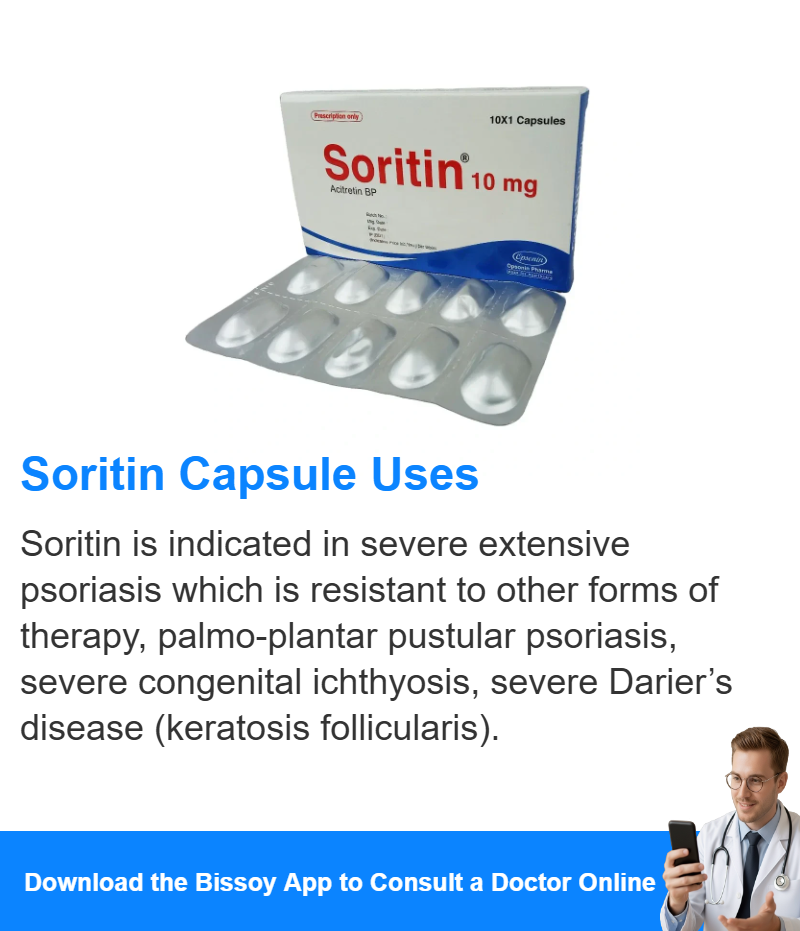
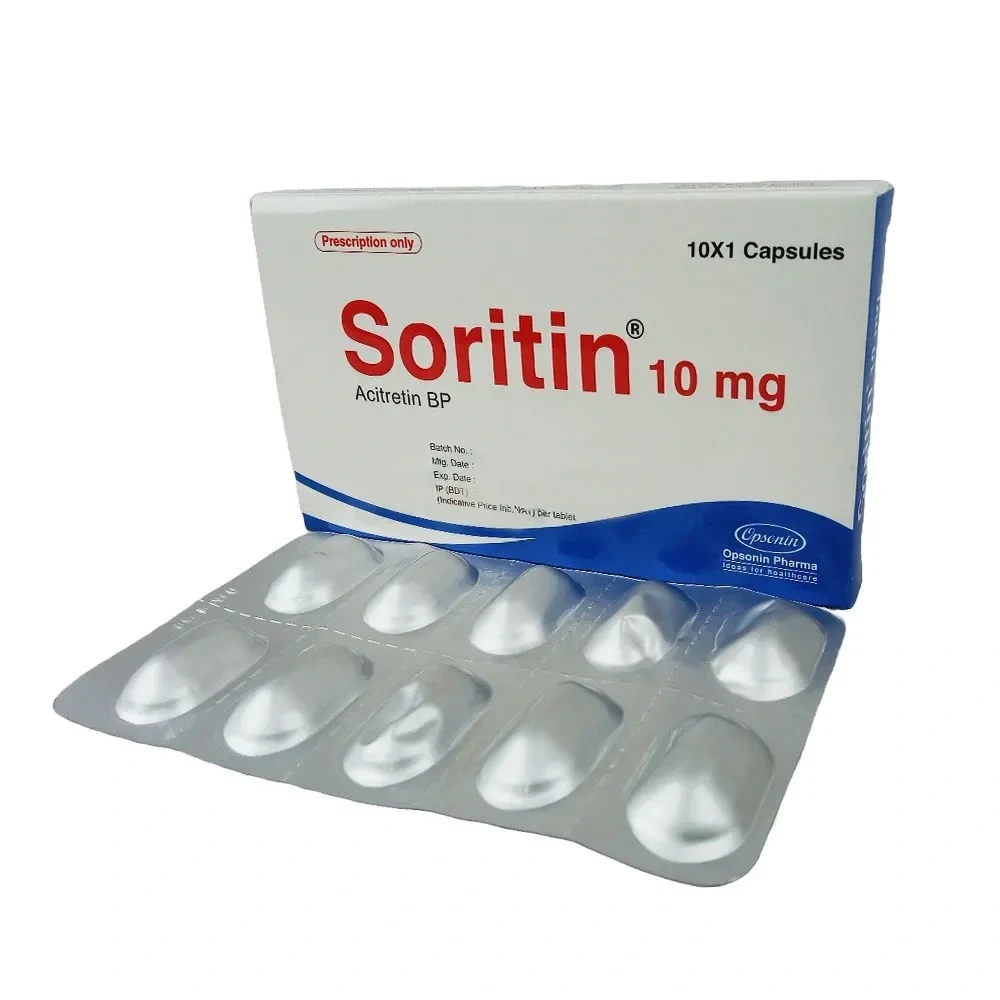
Soritin Capsule 10 mg is an oral retinoid used in the treatment of severe psoriasis.
For the treatment of severe psoriasis in adults.
Associated Conditions
Pharmacodynamics
Soritin Capsule 10 mg is a retinoid. Retinoids have a structure similar to vitamin A and are involved in the normal growth of skin cells. Soritin Capsule 10 mg works by inhibiting the excessive cell growth and keratinisation (process by which skin cells become thickened due to the deposition of a protein within them) seen in psoriasis. It therefore reduces the thickening of the skin, plaque formation and scaling.
Mechanism of Action
The mechanism of action of acitretin is unknown, however it is believed to work by targeting specific receptors (retinoid receptors such as RXR and RAR) in the skin which help normalize the growth cycle of skin cells.
Absorption
Oral absorption of acitretin is optimal when given with food, and is linear and proportional with increasing doses from 25 to 100 mg. Approximately 72% (range 47% to 109%) of the administered dose was absorbed after a single 50 mg dose of acitretin was given to 12 healthy subjects.
Protein Binding
Over 99.9% bound to plasma proteins, primarily albumin.
Route of Elimination
Both parent compound and isomer are further metabolized into chain-shortened breakdown products and conjugates, which are excreted. The chain-shortened metabolites and conjugates of acitretin and cis-acitretin are ultimately excreted in the feces (34% to 54%) and urine (16% to 53%).
Half Life
49 hours (range 33 to 96 hours)
Toxicity
Oral, rat: LD50 = >4000 mg/kg. Symptoms of overdose include headache and vertigo.
Food Interactions
- Avoid alcohol. Women of childbearing age should avoid ingesting any alcohol during treatment and two months after discontinuation of acitretin. Alcohol intake increases the duration of risk for birth defects to beyond three years post acitretin discontinuation.
- Take with food. Taking acitretin with the main meal of the day improves oral absorption.
Dosage
In patients with Darier’s disease a starting dose of 10 mg may be appropriate. The dose should be increased cautiously as isomorphic reactions may occur. Patients with severe congenital ichthyosis and severe Darier’s disease may require therapy beyond 3 months. The lowest effective dosage, not exceeding 50mg/day, should be given. Continuous use beyond 6 months is contra-indicated as only limited clinical data are available on patients treated beyond this length of time.
Children: The daily dosage is about 0.5mg/kg. Higher doses (up to 1mg/kg daily) may be necessary in some cases for limited periods, but only up to a maximum of 35 mg/day.