Introduction
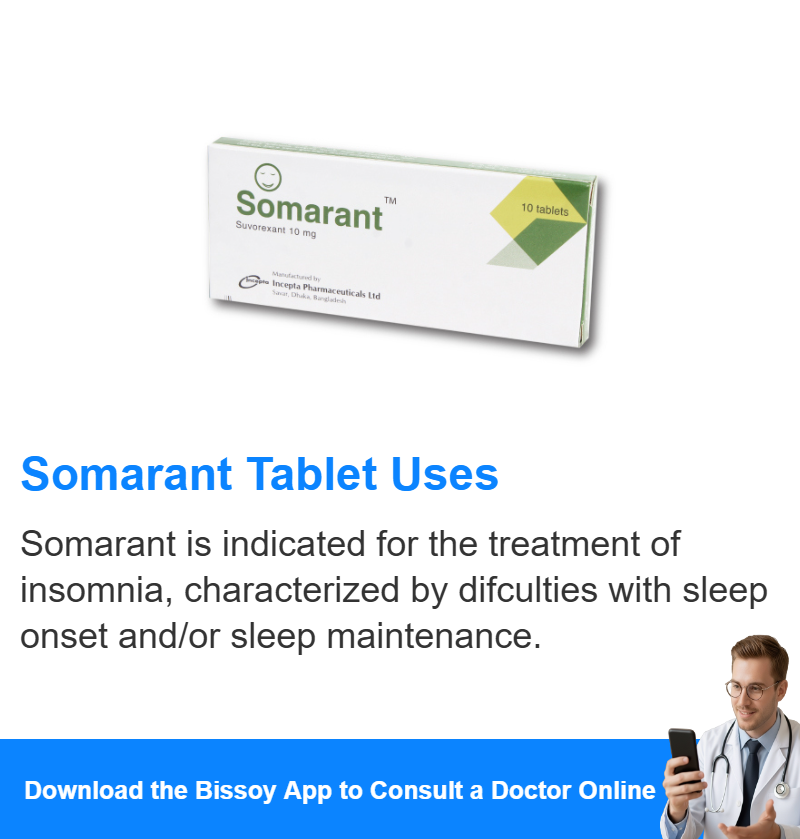
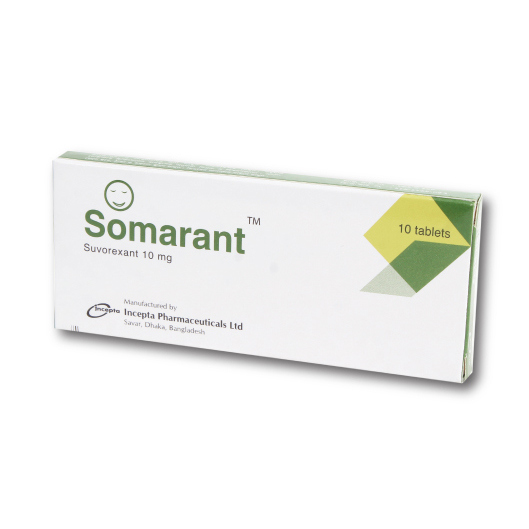
Somarant Tablet 10 mg is a selective dual antagonist of orexin receptors OX1R and OX2R that promotes sleep by reducing wakefulness and arousal. It has been approved for the treatment of insomnia.
Uses
Somarant Tablet 10 mg is a orexin receptor antagonist used to treat insomnia that is characterized by difficulties with sleep onset and/or sleep maintenance.
Somarant Tablet 10 mg is indicated for the treatment of insomnia characterized by difficulties with sleep onset and/or sleep maintenance.
Associated Conditions
Mechanism of Action
Somarant Tablet 10 mg is a dual antagonist of orexin receptors OX1R and OX2R. It exerts its pharmacological effect by inhibiting binding of neuropeptides orexin A and B, also known as hypocretin 1 and 2, that are produced by neurons in the lateral hypothalamus. These neurons control the wake-promoting centers of the brain and are active during wakefulness, especially during motor activities, and stop firing during sleep. By inhibiting the reinforcement of arousal systems, suvorexant use causes a decrease in arousal and wakefulness, rather than having a direct sleep-promoting effect.
Absorption
Peak concentrations occur at a median Tmax of 2 hours under fasted conditions. Ingestion of suvorexant with a high-fat meal has no effect on AUC or Cmax, but may delay Tmax by approximately 1.5 hours. Mean absolute bioavailability of 10 mg is 82%.
Volume of Distribution
Mean volume of distribution is approximately 49 litres.
Protein Binding
Somarant Tablet 10 mg is extensively bound (>99%) to human plasma proteins and does not preferentially distribute into red blood cells. It binds to both human serum albumin and alpha1-acid glycoprotein.
Route of Elimination
Approximately 66% is eliminated in feces and 23% is eliminated in urine.
Half Life
Mean half life is approximately 12 hours.
Toxicity
Dose-related somnolence and CNS depression are the most common adverse effects associated with the use of suvorexant. It has also been shown to impair driving skills and may increase the risk of falling asleep while driving. Next-day impairments are found to be highest if suvorexant is taken with less than a full night of sleep remaining, with higher doses, or if co-administered with other CNS depressants or CYP3A inhibitors. Complex behaviours such as sleep driving, preparing and eating food, and making phone calls have been reported in association with the use of hypnotics such as suvorexant. A dose-dependant increase in suicidal ideation has been observed, especially in patients with a previous diagnosis of depression. Sleep paralysis, hypnagogic/hypnopompic hallucinations including vivid and disturbing perceptions, and mild cataplexy have also been reported. There are no adequate studies in pregnant women to ensure its safety during pregnancy or breast feeding.
Food Interactions
- Avoid grapefruit products.