Serontin Syrup 250 mg/5 ml Introduction
Serontin Syrup 250 mg/5 ml (Zarontin) is an anticonvulsant medication that is primarily used for treating absence seizures (petit mal seizures or Grosso-Lagrave seizures). It is believed to work by targeting a certain type of calcium channel, called T-type calcium channels, that are believed to play a role in seizure activity. Serontin Syrup 250 mg/5 ml is approved for use by children and adults in the United States, and is available as capsules or oral suspension.
Uses for
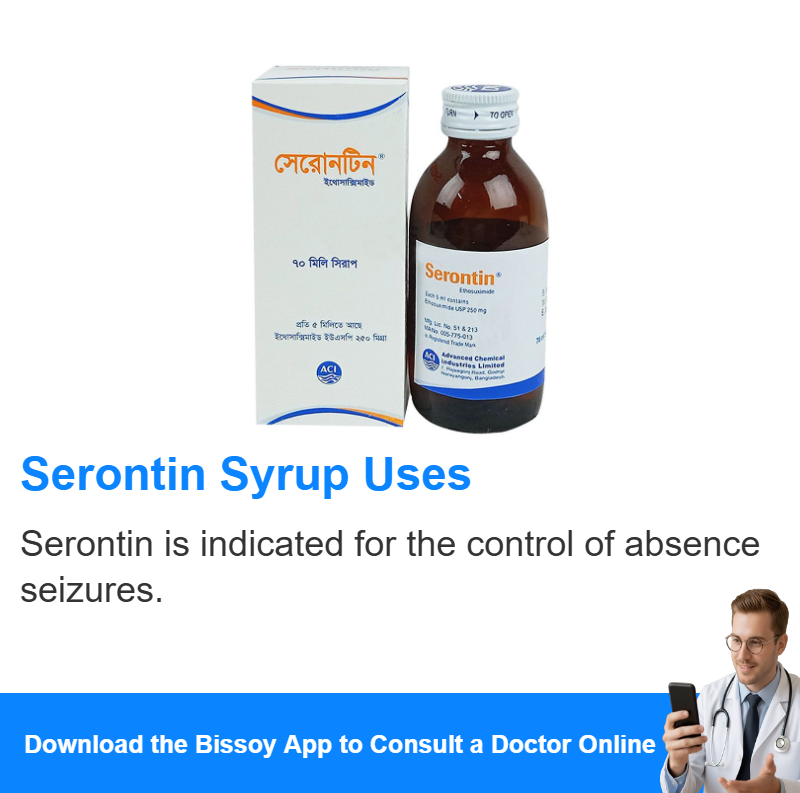
Serontin Syrup 250 mg/5 ml is primarily used as an anticonvulsant for treatment of absence seizures (petit mal seizures or Grosso-Lagrave seizures) or mixed seizure patterns including absence seizures.
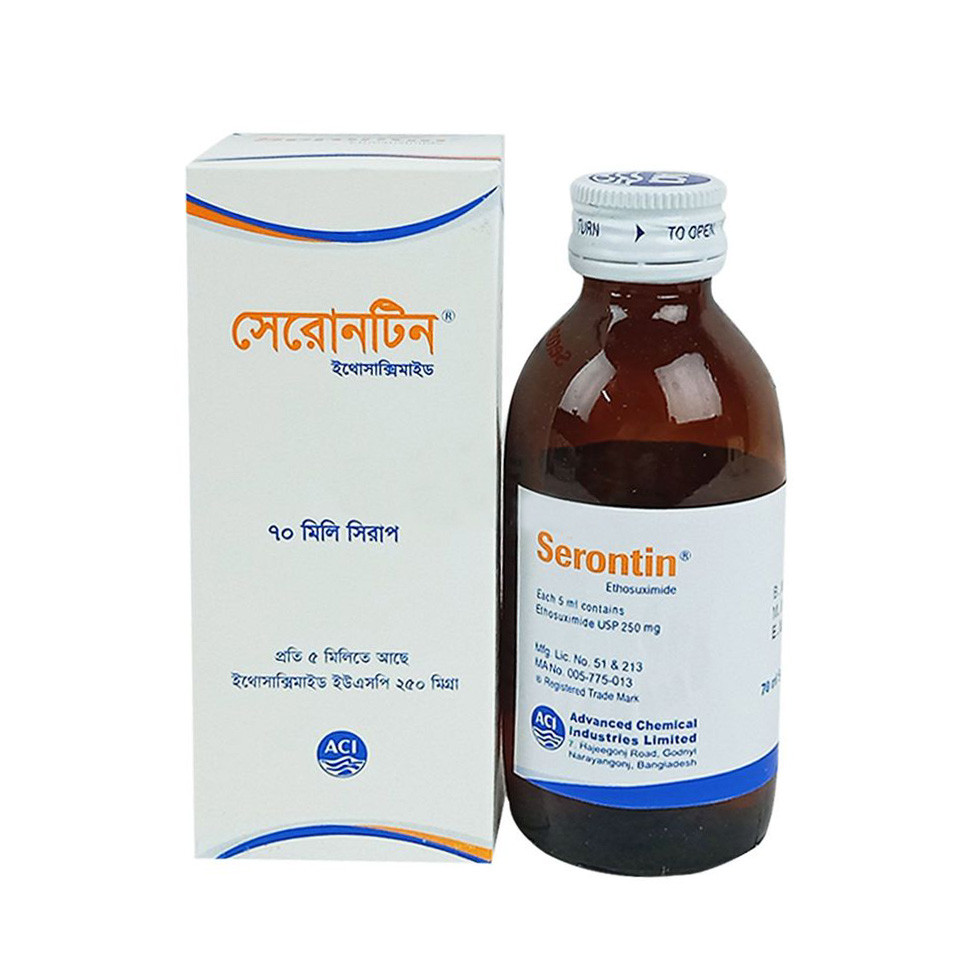
| Brand Name | Serontin |
|---|---|
| Type | Syrup |
| Weight | 250 mg/5 ml |
| Generic | Ethosuximide |
| Manufacturer | ACI Limited |
| Available in | English বাংলা |
Mechanism of Action
Serontin Syrup 250 mg/5 ml works by targeting a certain type of calcium channel, called T-type calcium channels, which are involved in seizure activity.
How Long Does it Take to Work?
The effects of ethosuximide can be seen within one to two weeks of starting treatment. It may take longer in some individuals for the medication to take full effect.
Absorption
Serontin Syrup 250 mg/5 ml is readily absorbed after oral administration with peak plasma concentrations occurring approximately 1.5 to 4.5 hours after dosing.
Route of Elimination
Serontin Syrup 250 mg/5 ml is eliminated primarily by the kidney, with 70 to 80% of the drug being eliminated unchanged in the urine. The remainder is metabolized by the liver.
Dosage
Pediatric Patients-- Children 3 to 6 years of age: Initially 5 ml (250 mg) daily in a single dose
- Children ≥6 years of age: Initially 10 ml (500 mg) daily in a single dose or divided doses
- Dosage should be increased by small increments, by 5 ml (250 mg) every 4–7 days until seizure control is achieved with minimal adverse effects. Dosage usually should not be >30 ml (1.5 g) daily, given in divided doses. If dosage is >1.5 g daily, clinical must closely supervise patients.
- Usual maintenance dosage: 20 mg/kg or 1.2 g/m2 daily
- Initially 10 ml (500 mg) daily in a single dose or divided doses
- Dosage should be increased by small increments, by 5 ml (250 mg) every 4–7 days until seizure control is achieved with minimal adverse effects. Dosage usually should not be >30 ml (1.5 g), given in divided doses.
- Usual maintenance dosage: 20 mg/kg or 1.2 g/m2 daily
The recommended starting dose of ethosuximide is 250-500 mg/day in either one or two divided doses. The total daily dose may be increased by 250-500 mg/day every 3-4 days, up to a maximum of 2 g/day in divided doses. The patient should be monitored closely for adverse effects during dosage titration.
Administration
Serontin Syrup 250 mg/5 ml should be taken with or without food and may be taken with meals to reduce stomach upset. It should be taken at the same time each day in divided doses, as determined by the prescribing health care professional.
Side Effect
Common side effects of ethosuximide include loss of appetite, nausea, vomiting, stomach upset, drowsiness, headache, dizziness, restlessness, and fatigue. Rarely, serious side effects can occur, including depression, agitation, confusion, delusions, hallucinations, unusual behavior, and suicidal thoughts or actions.
Toxicity
Signs of overdose with ethosuximide may include nausea, vomiting, stomach upset, drowsiness, agitation, restlessness, confusion, hallucinations, severe headache, and an uneven heart rate.
Precaution
Serontin Syrup 250 mg/5 ml should not be taken by individuals with hepatic or renal impairment, known hypersensitivity to the drug, or porphyria. Serontin Syrup 250 mg/5 ml can interact with many medications, including anticoagulants, antiarrhythmic drugs, CYP3A4 inhibitors, and other anticonvulsants.
Interaction
Serontin Syrup 250 mg/5 ml may interact with many medications, including anticoagulants, antiarrhythmic drugs, CYP3A4 inhibitors, and other anticonvulsants. Patients should speak with their doctor before taking any medications while taking ethosuximide.
Disease Interaction
Patients with hepatic impairment, renal impairment, known hypersensitivity to the drug, or porphyria should not take ethosuximide. Patients with other medical conditions should speak with their doctor before taking ethosuximide.
Drug Interaction
Serontin Syrup 250 mg/5 ml can interact with many medications, including anticoagulants, antiarrhythmic drugs, CYP3A4 inhibitors, and other anticonvulsants. Patients should speak with their doctor before taking any medications while taking ethosuximide.
Food Interaction
Food does not appear to significantly affect the absorption of ethosuximide.
Pregnancy Use
Serontin Syrup 250 mg/5 ml has not been studied in pregnant women. It should be used during pregnancy only when the potential benefits outweigh the risks.
Lactation Use
It is not known whether ethosuximide is excreted in human milk. Because of the potential for serious adverse reactions in the nursing infant, a decision should be made whether to discontinue nursing or to discontinue the drug, taking into account the importance of the drug to the mother.
Acute Overdose
Signs of overdose with ethosuximide may include nausea, vomiting, stomach upset, drowsiness, agitation, restlessness, confusion, hallucinations, severe headache, and an uneven heart rate. Treatment is symptomatic and supportive.
Contraindication
Serontin Syrup 250 mg/5 ml should not be taken by individuals with hepatic or renal impairment, known hypersensitivity to the drug, or porphyria.
Use Direction
Serontin Syrup 250 mg/5 ml should be taken as prescribed by a doctor, usually once or twice daily with or without food. The total daily dose may be increased by 250-500 mg/day every 3-4 days, up to a maximum of 2 g/day in divided doses. Patients should not take more than the recommended dose.
Storage Condition
Serontin Syrup 250 mg/5 ml should be stored at room temperature, away from heat and moisture. It should be kept out of the reach of children and pets.
Volume of Distribution
The volume of distribution of ethosuximide is 0.8 to 1.3 L/kg.
Half Life
The elimination half-life of ethosuximide is 4 to 6 hours.
Clearance
The clearance of ethosuximide is 0.2 to 0.5 L/hr/kg.
See in details version Serontin Syrup 250 mg/5 ml also Serontin Syrup 250 mg/5 ml in bangla
Social card
Some Frequently Asked Questions About Serontin Syrup 250 mg/5 ml