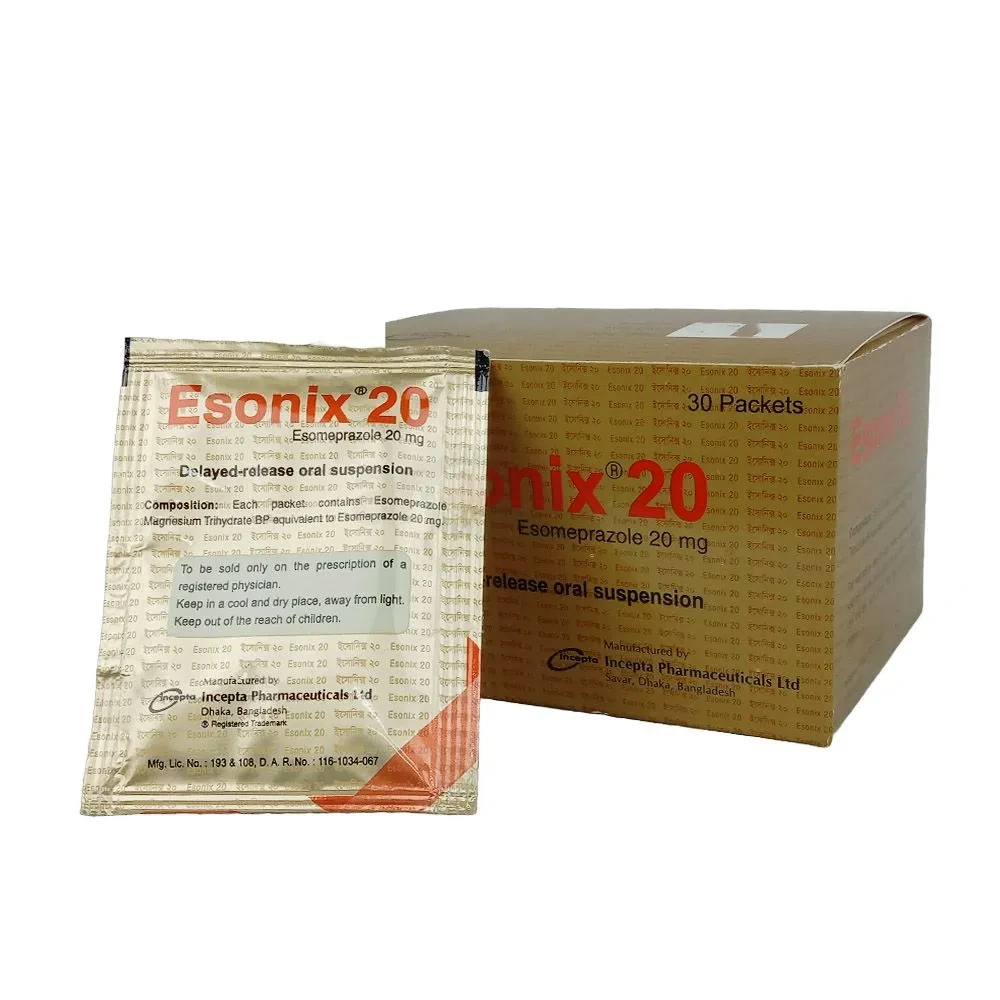
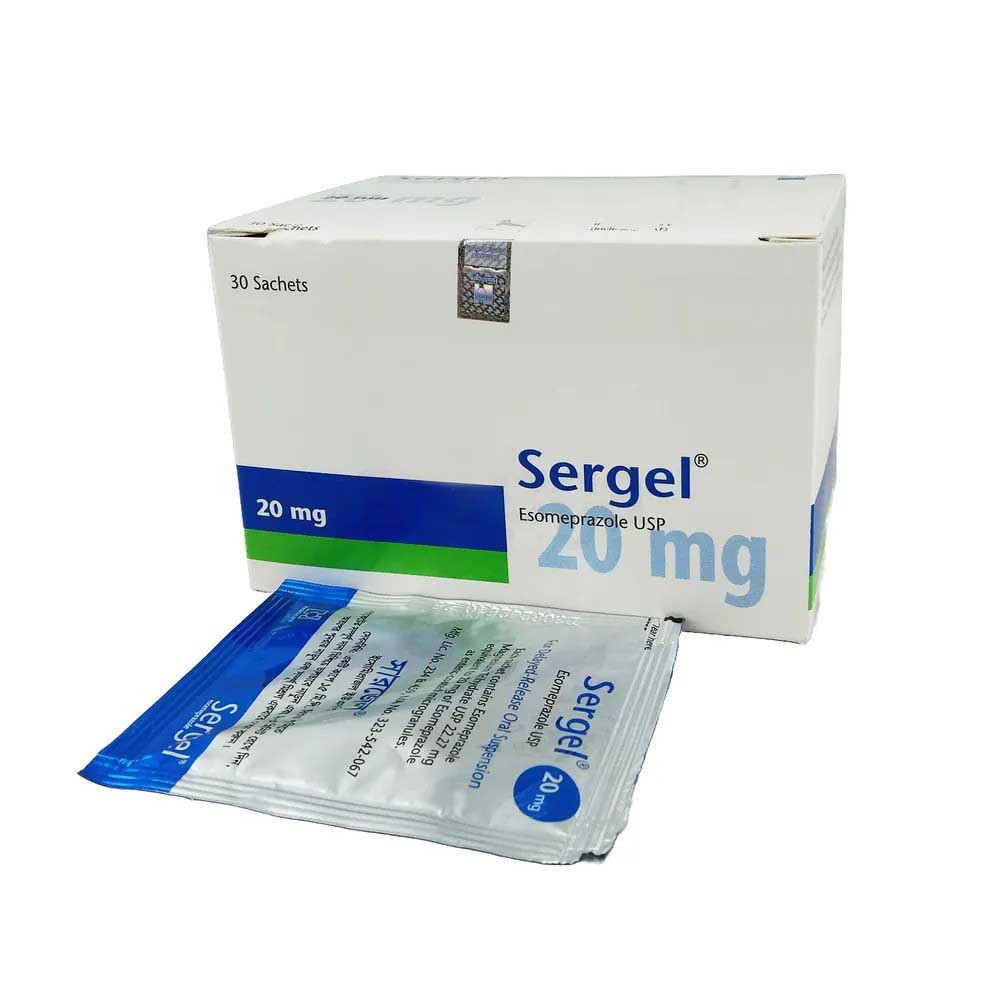
Brand Name Sergel
Type Oral Powder
Weight 20 mg
Generic Esomeprazole Magnesium Trihydrate
Manufacturer Healthcare Pharmaceuticals Ltd.
Price (Bangladesh) 20 mg sachet: ৳ 7.00 (1 x 30: ৳ 210.00)
Available in

About Sergel Oral Powder 20 mg

Sergel Oral Powder 20 mg is a brand medicine manufactured by Healthcare Pharmaceuticals Ltd. containing the generic Esomeprazole Magnesium Trihydrate (20 mg). Current listed price in Bangladesh: 20 mg sachet: ৳ 7.00 (1 x 30: ৳ 210.00).

Medical information for Sergel Oral Powder 20 mg

Uses, dosage, side effects, and safety details below apply to Sergel Oral Powder 20 mg (generic: Esomeprazole Magnesium Trihydrate). This is general information — consult a doctor before use.

Introduction

Esomeprazole, the S-enantiomer of omeprazole, is a proton pump inhibitor (PPI) that provides prolonged suppression of stomach acid by irreversibly binding to $(H^+, K^+)\text{-ATPase}$ enzymes in gastric parietal cells. It is indicated for gastroesophageal reflux disease (GERD), NSAID-associated ulcer prevention, Zollinger-Ellison syndrome, and H. pylori eradication. While generally safe, long-term use can cause nutrient malabsorption (iron, B12, magnesium, calcium), increase bone fracture and C. difficile infection risks, and potentially elevate cardiovascular risk via DDAH enzyme inhibition. To avoid rebound acid hypersecretion, treatment should be gradually tapered rather than stopped abruptly.

Uses

Esomeprazole is a proton pump inhibitor used to treat GERD, reduce the risk of NSAID associated gastric ulcers, eradicate H. pylori, and to treat conditions causing gastric acid hypersecretion.

Esomeprazole is indicated for the treatment of acid-reflux disorders including healing and maintenance of erosive esophagitis, and symptomatic gastroesophageal reflux disease (GERD), peptic ulcer disease, H. pylori eradication, prevention of gastrointestinal bleeds with NSAID use, and for the long-term treatment of pathological hypersecretory conditions including Zollinger-Ellison Syndrome.

Associated Conditions

  • Duodenal Ulcer
  • Erosive Esophagitis
  • Gastro-esophageal Reflux Disease (GERD)
  • Heartburn
  • Helicobacter Pylori Infection
  • NSAID Associated Gastric Ulcers
  • Stress Ulcers
  • Upper Gastrointestinal Hemorrhage
  • Zollinger-Ellison Syndrome
  • Acute benign gastric ulcers
  • Maintenance of healing Erosive esophagitis
  • Postendoscopy Bleeding

Pharmacodynamics

Esomeprazole is a compound that inhibits gastric acid secretion and is indicated in the treatment of gastroesophageal reflux disease (GERD), the healing of erosive esophagitis, and H. pylori eradication to reduce the risk of duodenal ulcer recurrence. Esomeprazole belongs to a new class of antisecretory compounds, the substituted benzimidazoles, that do not exhibit anticholinergic or H2 histamine antagonistic properties, but that suppress gastric acid secretion by specific inhibition of the H+/K+ ATPase at the secretory surface of the gastric parietal cell. By doing so, it inhibits acid secretion into the gsatric lumen. This effect is dose-related and leads to inhibition of both basal and stimulated acid secretion irrespective of the stimulus.

Esomeprazole is the s-isomer of Omeprazole, which is a racemate of the S- and R-enantiomer. Esomeprazole has been shown to inhibit acid secretion to a similar extent as Omeprazole, without any significant differences between the two compounds in vitro.

PPIs such as esomeprazole have also been shown to inhibit the activity of dimethylarginine dimethylaminohydrolase (DDAH), an enzyme necessary for cardiovascular health. DDAH inhibition causes a consequent accumulation of the nitric oxide synthase inhibitor asymmetric dimethylarginie (ADMA), which is thought to cause the association of PPIs with increased risk of cardiovascular events in patients with unstable coronary syndromes.

Due to their good safety profile and as several PPIs are available over the counter without a prescription, their current use in North America is widespread. Long term use of PPIs such as esomeprazole has been associated with possible adverse effects, however, including increased susceptibility to bacterial infections (including gastrointestinal C. difficile), reduced absorption of micronutrients including iron and B12, and an increased risk of developing hypomagnesemia and hypocalcemia which may contribute to osteoporosis and bone fractures later in life.

Mechanism of Action

Esomeprazole exerts its stomach acid-suppressing effects by preventing the final step in gastric acid production by covalently binding to sulfhydryl groups of cysteines found on the (H+, K+)-ATPase enzyme at the secretory surface of gastric parietal cells. This effect leads to inhibition of both basal and stimulated gastric acid secretion, irrespective of the stimulus. As the binding of esomeprazole to the (H+, K+)-ATPase enzyme is irreversible and new enzyme needs to be expressed in order to resume acid secretion, esomeprazole's duration of antisecretory effect that persists longer than 24 hours.

Absorption

After oral administration, peak plasma levels (Cmax) occur at approximately 1.5 hours (Tmax). The Cmax increases proportionally when the dose is increased, and there is a three-fold increase in the area under the plasma concentration-time curve (AUC) from 20 to 40 mg. At repeated once-daily dosing with 40 mg, the systemic bioavailability is approximately 90% compared to 64% after a single dose of 40 mg. The mean exposure (AUC) to esomeprazole increases from 4.32 μmolhr/L on Day 1 to 11.2 μmolhr/L on Day 5 after 40 mg once daily dosing. The AUC after administration of a single 40 mg dose of Esomeprazole is decreased by 43% to 53% after food intake compared to fasting conditions. Esomeprazole should be taken at least one hour before meals.

Combination Therapy with Antimicrobials:

Esomeprazole magnesium 40 mg once daily was given in combination with Clarithromycin 500 mg twice daily and Amoxicillin 1000 mg twice daily for 7 days to 17 healthy male and female subjects. The mean steady state AUC and Cmax of esomeprazole increased by 70% and 18%, respectively during triple combination therapy compared to treatment with esomeprazole alone. The observed increase in esomeprazole exposure during co-administration with clarithromycin and amoxicillin is not expected to produce significant safety concerns.

Volume of Distribution

The apparent volume of distribution at steady state in healthy volunteers is approximately 16 L.

Protein Binding

Esomeprazole is 97% bound to plasma proteins. Plasma protein binding is constant over the concentration range of 2 to 20 µmol/L.

Route of Elimination

The plasma elimination half-life of esomeprazole is approximately 1 to 1.5 hours. Less than 1% of parent drug is excreted in the urine. Approximately 80% of an oral dose of esomeprazole is excreted as inactive metabolites in the urine, and the remainder is found as inactive metabolites in the feces.

Half Life

1-1.5 hours

Toxicity

Blurred vision, confusion, drowsiness, dry mouth, flushing headache, nausea, rapid heartbeat, sweating

Food Interactions

  • Take with or without food. Co-administration with food slightly alters pharmacokinetics, but not to a clinically significant extent.

Frequently Asked Questions About Sergel Oral Powder 20 mg

1. What is esomeprazole magnesium trihydrate?

Esomeprazole magnesium trihydrate is a proton pump inhibitor (PPI) that reduces stomach acid production, used to treat acid-related conditions. It is the magnesium salt form of esomeprazole with three water molecules in its structure.

2. What is esomeprazole magnesium trihydrate used for?

It is used to treat:

  • Gastroesophageal reflux disease (GERD)
  • Peptic ulcers
  • Heartburn
  • Zollinger-Ellison syndrome
  • H. pylori infections (with antibiotics)
  • 3. How does esomeprazole magnesium trihydrate work?

    It inhibits proton pumps in the stomach lining, blocking acid secretion into the stomach.

    4. Is esomeprazole magnesium trihydrate a prescription drug?

    It’s available by prescription and over-the-counter (OTC) in lower doses for heartburn relief.

    5. Who can take esomeprazole magnesium trihydrate?

    It’s suitable for adults and children (with medical supervision), but not for those with severe liver disease or PPI allergies.

    6. How is esomeprazole magnesium trihydrate taken?

    It is taken orally as capsules, tablets, or a suspension, typically before a meal.

    7. What is the typical dosage of esomeprazole magnesium trihydrate?

    Dosage varies:

  • For GERD: 20-40 mg once daily
  • For ulcers: 20-40 mg daily for 4-8 weeks
  • For heartburn (OTC): 20 mg daily for up to 14 days
  • 8. How long does esomeprazole magnesium trihydrate take to work?

    It reduces acid within 1-2 hours, with symptom relief often within 1-4 days.

    9. Can esomeprazole magnesium trihydrate be taken long-term?

    Yes, for chronic conditions like GERD, but long-term use requires monitoring due to risks like nutrient deficiencies.

    10. Does esomeprazole magnesium trihydrate cure ulcers?

    It promotes healing by reducing acid but doesn’t cure ulcers; antibiotics are needed for H. pylori-related cases.

    11. What are the common side effects of esomeprazole magnesium trihydrate?

    Common side effects include:

  • Headache
  • Nausea
  • Diarrhea
  • Abdominal pain
  • 12. Can esomeprazole magnesium trihydrate cause weight gain?

    It’s not directly linked to weight gain, but improved digestion might increase appetite.

    13. Does esomeprazole magnesium trihydrate affect bones?

    Long-term use may increase fracture risk due to reduced calcium absorption.

    14. Can esomeprazole magnesium trihydrate be taken with food?

    It’s best taken 30-60 minutes before a meal for optimal effect.

    15. What happens if I miss a dose of esomeprazole magnesium trihydrate?

    Take it as soon as you remember unless it’s near the next dose; then skip it. Don’t double up.

    16. Can I overdose on esomeprazole magnesium trihydrate?

    Overdose is rare but may cause drowsiness, confusion, or rapid heartbeat. Seek help if suspected.

    17. Is esomeprazole magnesium trihydrate safe during pregnancy?

    It’s Category B; generally safe, but consult a doctor due to limited data.

    18. Can breastfeeding mothers take esomeprazole magnesium trihydrate?

    Yes, it’s considered safe in small amounts in breast milk, but confirm with a doctor.

    19. Does esomeprazole magnesium trihydrate interact with other medications?

    Yes, it interacts with:

  • Clopidogrel (reduces effectiveness)
  • Warfarin (increases bleeding risk)
  • Methotrexate (increases levels)
  • 20. Can I drink alcohol while taking esomeprazole magnesium trihydrate?

    Yes, but alcohol may worsen acid reflux or stomach irritation.

    21. Is esomeprazole magnesium trihydrate safe for people with kidney disease?

    Yes, it’s generally safe, though monitoring is advised in severe cases.

    22. Can esomeprazole magnesium trihydrate be used in liver disease?

    Use with caution in severe liver disease, as it’s metabolized by the liver.

    23. How should esomeprazole magnesium trihydrate be stored?

    Store at room temperature, away from moisture and heat; the trihydrate form is sensitive to humidity.

    24. Does esomeprazole magnesium trihydrate expire?

    Yes, check the expiration date; expired drug may lose potency.

    25. Can esomeprazole magnesium trihydrate cause drowsiness?

    It’s uncommon, but some report fatigue or dizziness.

    26. Is esomeprazole magnesium trihydrate the same as omeprazole?

    No, esomeprazole is the S-isomer of omeprazole, potentially more effective at the same dose.

    27. Can esomeprazole magnesium trihydrate treat heartburn?

    Yes, it’s effective for frequent heartburn, available OTC for this purpose.

    28. Does esomeprazole magnesium trihydrate cause diarrhea?

    Yes, diarrhea is a common side effect, especially initially.

    29. Can esomeprazole magnesium trihydrate help with bloating?

    It doesn’t directly treat bloating but may ease acid-related discomfort.

    30. Is esomeprazole magnesium trihydrate gluten-free?

    Most formulations are gluten-free, but confirm with the manufacturer.

    31. Can esomeprazole magnesium trihydrate capsules be opened?

    Yes, delayed-release capsules can be opened and mixed with applesauce, but don’t crush the granules.

    32. What if I’m allergic to esomeprazole magnesium trihydrate?

    Rare allergic reactions (rash, swelling) may occur. Stop use and seek help.

    33. Can esomeprazole magnesium trihydrate cause vitamin deficiencies?

    Long-term use may reduce absorption of vitamin B12, magnesium, and calcium.

    34. Does esomeprazole magnesium trihydrate affect blood pressure?

    No direct effect on blood pressure is noted.

    35. Can esomeprazole magnesium trihydrate treat gastritis?

    Yes, it reduces acid to help heal gastritis, often with other treatments.

    36. Is esomeprazole magnesium trihydrate safe for children?

    Yes, for children over 1 year with a doctor’s prescription, dosed by weight.

    37. Can esomeprazole magnesium trihydrate cause headaches?

    Yes, headaches are a common, usually mild side effect.

    38. Does esomeprazole magnesium trihydrate need refrigeration?

    No, store at room temperature; suspension forms may vary—check the label.

    39. Can esomeprazole magnesium trihydrate be used for nausea?

    It’s not a nausea treatment but may help if acid reflux causes it.

    40. What’s the difference between esomeprazole magnesium trihydrate and pantoprazole?

    Both are PPIs, but esomeprazole may act faster, and pantoprazole has fewer drug interactions.

    41. Can esomeprazole magnesium trihydrate cause kidney problems?

    Rarely, long-term use has been linked to kidney damage; monitor with a doctor.

    42. Is esomeprazole magnesium trihydrate available as a generic?

    Yes, generic versions exist, alongside brands like Nexium.

    43. Can esomeprazole magnesium trihydrate be taken at night?

    It’s usually taken in the morning, but a doctor may adjust timing for nighttime symptoms.

    44. Does esomeprazole magnesium trihydrate affect the liver?

    Rarely, it may elevate liver enzymes; report yellowing skin to a doctor.

    45. Can esomeprazole magnesium trihydrate be used for acid reflux?

    Yes, it’s a primary treatment for acid reflux and GERD.

    46. What should I do if it doesn’t work?

    Consult your doctor; the dose may need adjustment or another condition may be present.

    47. Can esomeprazole magnesium trihydrate cause constipation?

    Yes, though less common than diarrhea, it’s a possible side effect.

    48. Does esomeprazole magnesium trihydrate interact with caffeine?

    No significant interaction, but caffeine may worsen reflux symptoms.

    49. Can esomeprazole magnesium trihydrate be stopped abruptly?

    Stopping may cause rebound acid production; taper off under medical advice for long-term use.

    Medical review

    Last reviewed: 24 Jul 2026

    Medically reviewed by:

    This is general information, not personal medical advice. Consult a doctor before taking any medicine.

    Social card

    Uses
    Taking medicines without doctor's advice can cause long-term problems.
    Dr. Swapan Kumar Halder

    Dr. Swapan Kumar Halder

    Newborn, Child Diseases & Nutrition Specialist

    Call Doctor
    Dr. Sharmin Sultana

    Dr. Sharmin Sultana

    Gynecology & Obstetrics Specialist

    Call Doctor
    Related Medicines