Introduction
Risedronic acid is a third generation bisphosphonate that is used for the treatment of some forms of osteoperosis and Paget's disease. It functions by preventing resorption of bone.
Uses
Risedronic acid is a bisphosphonate used to treat osteoporosis and Paget's disease.
Risedronic acid is indicated for the treatment of osteoperosis in men, treatment of Paget's disease, treatment and prevention of osteoperosis in postmenopausal women, and treatment and prevention of glucocorticoid-induced osteoperosis.
Associated Conditions
Pharmacodynamics
Risedronate is a pyridine-based bisphosphonate that inhibits bone resorption caused by osteoclasts.
Mechanism of Action
Risedronatic acid binds to bone hydroxyapatite. Bone resorption causes local acidification, releasing risedronic acid which is that taken into osteoclasts by fluid-phase endocytosis. Endocytic vesicles are acidified, releasing risedronic acid to the cytosol of osteoclasts where they induce apoptosis through inhbition of farnesyl pyrophosphate synthase. Inhibition of osteoclasts results in decreased bone resorption.
Absorption
Oral bioavailability is 0.63% and maximum absorption is approximately 1 hour after dosing. Administration half and hour before a meal reduces bioavailability by 55% compared to fasting and dosing 1 hour before a meal reduces bioavailability by 30%.
Volume of Distribution
13.8 L/kg.
Protein Binding
~24%.
Route of Elimination
Risedronate is excreted by the kidneys and the unabsorbed dose is eliminated in the feces.
Half Life
The initial half life of risedronic acid is approximately 1.5 hours, with a terminal half life of 561 hours.
Clearance
Mean renal clearance was 52mL/min and mean total clearance was 73mL/min.
Toxicity
In clinical trials, over 10% of patients experienced back pain, arthralgia, abdominal pain, and dyspepsia. Less commonly, patients experience angioedema, generalized rash, bullous skin reactions, iritis, and uveitis.
Patients experiencing an overdose may experience a decrease in serum calcium and phosphorus. Patients can be given milk or antacids to bind the drug and reduce its absorption. In more severe cases, patients may require gastric lavage and intravenous calcium. A lethal dose in rats is equivalent to 320 to 620 times the human dose based on surface area.
Food Interactions
- Administer vitamin supplements. Patients may require supplemental vitamin D.
- Avoid multivalent ions. Calcium, antacids, and divalent ions may interfere with the absorption of this medication.
- Take on an empty stomach.
- Take with a full glass of water.
Dosage
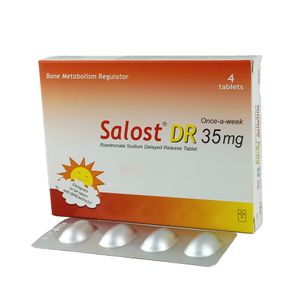
Prevention of osteoporosis in postmenopausal women with increased risk of osteoporosis: The recommended dose is Salost Tablet (Delayed Release) 35 mg 5 mg once daily.
To maintain or increase bone mass in postmenopausal women undergoing long-term (more than 3 months): Systemic corticosteroid treatment at doses 7.5 mg/day prednisone or equivalent. The recommended dose is Salost Tablet (Delayed Release) 35 mg 5 mg once daily.
Treatment of osteoporosis in men at high risk of fractures: The recommended dose is Salost Tablet (Delayed Release) 35 mg 35 mg once weekly. The tablet should be taken on the same day each week.