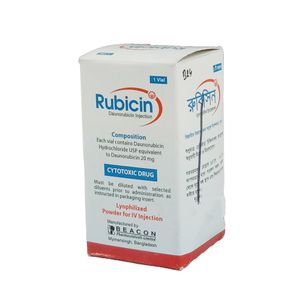
Introduction
A very toxic anthracycline aminoglycoside antineoplastic isolated from Streptomyces peucetius and others, used in treatment of leukemia and other neoplasms.
Uses
Rubicin IV Infusion 20 mg/vial is an anthracycline aminoglycoside used to induce remission of nonlymphocytic leukemia and acute lymphocytic leukemia.
For remission induction in acute nonlymphocytic leukemia (myelogenous, monocytic, erythroid) of adults and for remission induction in acute lymphocytic leukemia of children and adults.
Rubicin IV Infusion 20 mg/vial is indicated in combination with cytarabine for the treatment of newly-diagnosed therapy-related acute myeloid leukemia (t-AML) or AML with myelodysplasia-related changes (AML-MRC) in adults and pediatric patients 1 year and older.
Associated Conditions
Pharmacodynamics
Rubicin IV Infusion 20 mg/vial is an antineoplastic in the anthracycline class. General properties of drugs in this class include: interaction with DNA in a variety of different ways including intercalation (squeezing between the base pairs), DNA strand breakage and inhibition with the enzyme topoisomerase II. Most of these compounds have been isolated from natural sources and antibiotics. However, they lack the specificity of the antimicrobial antibiotics and thus produce significant toxicity. The anthracyclines are among the most important antitumor drugs available. Doxorubicin is widely used for the treatment of several solid tumors while daunorubicin and idarubicin are used exclusively for the treatment of leukemia. Rubicin IV Infusion 20 mg/vial may also inhibit polymerase activity, affect regulation of gene expression, and produce free radical damage to DNA. Rubicin IV Infusion 20 mg/vial possesses an antitumor effect against a wide spectrum of tumors, either grafted or spontaneous. The anthracyclines are cell cycle-nonspecific.
Mechanism of Action
Rubicin IV Infusion 20 mg/vial has antimitotic and cytotoxic activity through a number of proposed mechanisms of action: Rubicin IV Infusion 20 mg/vial forms complexes with DNA by intercalation between base pairs, and it inhibits topoisomerase II activity by stabilizing the DNA-topoisomerase II complex, preventing the religation portion of the ligation-religation reaction that topoisomerase II catalyzes.
Protein Binding
97% binding-albumin
Route of Elimination
Twenty-five percent of an administered dose of daunorubicin hydrochloride is eliminated in an active form by urinary excretion and an estimated 40% by biliary excretion.
Half Life
18.5 hours
Toxicity
LD50=20 mg/kg (mice, IV); LD50=13 mg/kg (rat, IV)
Food Interactions
No interactions found.
Dosage
Representative Dose Schedules and Combination for the Approved Indication of Remission Induction in Adult Acute Nonlymphocytic Leukemia: In Combination: For patients under age 60, Rubicin IV Infusion 20 mg/vial 45 mg/m2/day IV on days 1, 2, and 3 of the first course and on days 1, 2 of subsequent courses AND cytosine arabinoside 100 mg/m2/day IV infusion daily for 7 days for the first course and for 5 days for subsequent courses. For patients 60 years of age and above, Rubicin IV Infusion 20 mg/vial 30 mg/m2/day IV on days 1, 2, and 3 of the first course and on days 1, 2 of subsequent courses AND cytosine arabinoside 100 mg/m2/day IV infusion daily for 7 days for the first course and for 5 days for subsequent courses. This Rubicin IV Infusion 20 mg/vial dose-reduction is based on a single study and may not be appropriate if optimal supportive care is available.
Representative Dose Schedule and Combination for the Approved Indication of Remission Induction in Pediatric Acute Lymphocytic Leukemia: In Combination: Rubicin IV Infusion 20 mg/vial 25 mg/m2 IV on day 1 every week, Vincristine 1.5 mg/m2 IV on day 1 every week, prednisone 40 mg/m2 PO daily. Generally, a complete remission will be obtained within four such courses of therapy; however, if after four courses the patient is in partial remission, an additional one or, if necessary, two courses may be given in an effort to obtain a complete remission. In children less than 2 years of age or below 0.5 m2 body surface area, it has been recommended that the Rubicin IV Infusion 20 mg/vial dosage calculation should be based on weight (1 mg/kg) instead of body surface area.
Representative Dose Schedules and Combination for the Approved Indication of Remission Induction in Adult Acute Lymphocytic Leukemia: In Combination: Rubicin IV Infusion 20 mg/vial 45 mg/m2/day IV on days 1, 2, and 3 and Vincristine 2 mg IV on days 1, 8, and 15; prednisone 40 mg/m2/day PO on days 1 through 22, then tapered between days 22 to 29; L-asparaginase 500 IU/kg/day x 10 days IV on days 22 through 32. Or, as directed by the registered physicians.