Introduction
A benzodiazepine used to treat various seizures, including myotonic or atonic seizures, photosensitive epilepsy, and absence seizures, although tolerance may develop . The agent has also been indicated for treating panic disorder . The mechanism of action appears to involve the enhancement of gamma-aminobutyric acid receptor responses .
Since being first patented in 1960 and then released for sale from Roche in the US in 1975 , clonazepam has experienced a storied history in the treatment of the aforementioned medical conditions. Now available as a generic medication, the agent continues to see exceptionally high use as millions of prescriptions are written for the medication internationally every year. Unfortunately, however, like most benzodiazepines, clonazepam use has also been associated with recreational use and drug abuse .
Uses
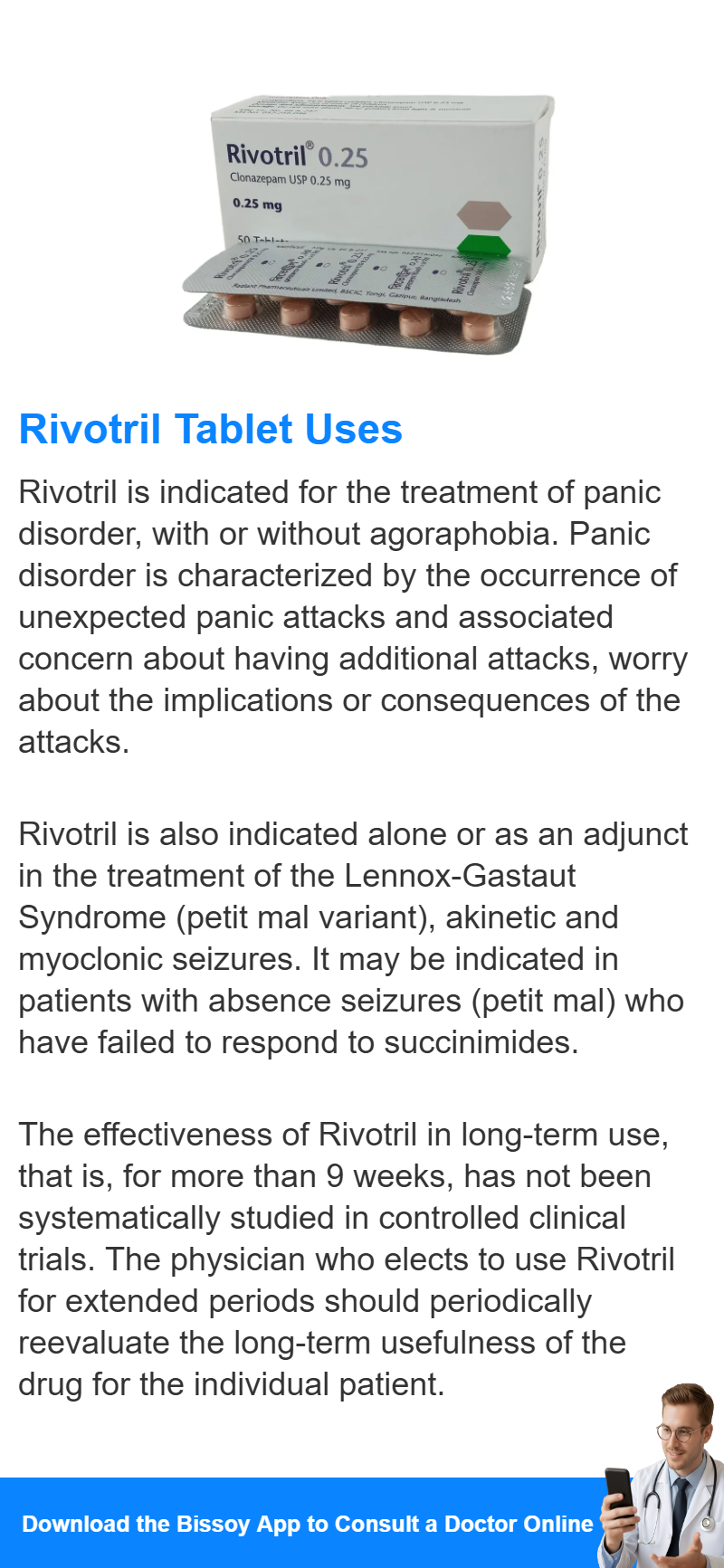
Rivotril Tablet 0.25 mg is a long-acting benzodiazepine with intermediate onset commonly used to treat panic disorders, severe anxiety, and seizures.
Rivotril Tablet 0.25 mg is indicated as monotherapy or as an adjunct in the treatment of Lennox-Gastaut syndrome (petit mal variant), akinetic, and myoclonic seizures . Furthermore, clonazepam may also be of some value in patients with absence spells (petit mal) who have failed to respond to succinimides . Additionally, clonazepam is also indicated for the treatment of panic disorder, with or without agoraphobia, as defined in the DSM-V .
Alternatively, some regional prescribing information note that clonazepam is indicated for all clinical forms of epileptic disease and seizures in adults, especially absence seizures (petit mal) including atypical absence; primary or secondarily generalised tonic-clonic (grand mal), tonic or clonic seizures; partial (focal) seizures with elementary or complex symptomatology; various forms of myoclonic seizures, myoclonus and associated abnormal movements . Such regional label data also has clonazepam indicated for most types of epilepsy in infants and children, especially absences (petit mal), myoclonic seizures and tonic-clonic fits, whether due to primary generalized epilepsy or to secondary generalization of partial epilepsy .
Associated Conditions
Pharmacodynamics
The pharmacodynamic properties of clonazepam are common among benzodiazepines and include anticonvulsive, sedative, muscle relaxing and anxiolytic effects . Animal data and electroencephalographic investigations in man have shown that clonazepam rapidly suppresses many types of paroxysmal activity including the spike and wave discharge in absence seizures (petit mal), slow spike wave, generalized spike wave, spikes with temporal or other locations, as well as irregular spikes and waves . Moreover, the agent can also decrease the frequency, amplitude, duration, and spread of discharge in minor motor seizures .
Generalized EEG abnormalities are more readily suppressed by clonazepam than are focal EEG abnormalities such as focal spikes . Rivotril Tablet 0.25 mg has beneficial effects in generalized and focal epilepsies .
Mechanism of Action
Gamma-Aminobutyric acid (GABA) is considered the principal inhibitory neurotransmitter in the human body . When GABA binds to GABA(a) receptors found in neuron synapses, chloride ions are conducted across neuron cell membranes via an ion channel in the receptors . With enough chloride ions conducted, the local, associated neuron membrane potentials are hyperpolarized - making it more difficult or less likely for action potentials to fire, ultimately resulting in less excitation of the neurons .
Subsequently, benzodiazepines like clonazepam can bind to benzodiazepine receptors that are components of various varieties of GABA(a) receptors . This binding acts to enhance the effects of GABA by increasing GABA affinity for the GABA(a) receptor, which ultimately enhances GABA ligand binding at the receptors . This enhanced ligand binding of the inhibitory neurotransmitter GABA to the receptors increases the aforementioned chloride ion conduction (perhaps reportedly via an increase in the frequency of the chloride channel opening), resulting in a hyperpolarized cell membrane that prevents further excitation of the associated neuron cells . Combined with the notion that such benzodiazepine receptor associated GABA(a) receptors exist both peripherally and in the CNS, this activity consequently facilitates various effects like sedation, hypnosis, skeletal muscle relaxation, anticonvulsant activity, and anxiolytic action .
In particular, when out of the ordinary rapid and repetitive electrical signals are released in the CNS, it is proposed that the brain can become over-stimulated and ordinary functions are disrupted - resulting in seizure activity . By enhancing the neuro-inhibitory activity of GABA, it is believed that clonazepam can facilitate in decreasing any excessive electrical nerve activity in the CNS that might be contributing to seizures . Concurrently, it is also believed that clonazepam's actions in enhancing GABA effects may inhibit neuronal activity proposed to occur in amygdala-centered fear circuits - therefore assisting in the management of anxiety or panic .
Absorption
Rivotril Tablet 0.25 mg is rapidly and almost entirely absorbed after oral administration as tablets . Peak plasma concentrations of clonazepam administered by the oral route are reached within 1-4 hours and the associated absorption half-life is about 25 minutes . The absolute bioavailability is approximately 90% - but with substantially large differences between individuals .
Volume of Distribution
Rivotril Tablet 0.25 mg distributes very rapidly to various organs and body tissues with preferential uptake by brain structures . The apparent volume of distribution has been documented as approximately 3 L/kg .
Protein Binding
The recorded plasma protein binding of clonazepam ranges between 82–86% .
Route of Elimination
Approximately 50-70% of a clonazepam dose is excreted in the urine and 10-30% is excreted in the feces as metabolites . The excretion of unchanged clonazepam in the urine is typically less than 2% of the administered dose . Metabolites of clonazepam are present in urine as both free and conjugated (glucuronide and sulfate) compounds .
Half Life
The mean elimination half-life determined for clonazepam is independent of the dose given and has been documented as being about 30-40 hours .
Clearance
The documented clearance for clonazepam is approximately 55 ml/min regardless of gender . Nevertheless, clearance values normalized by weight decline with increasing body weight .
Toxicity
Benzodiazepines like clonazepam commonly cause drowsiness, ataxia, dysarthria, and nystagmus. Overdose with clonazepam is generally not life-threatening if the drug is taken alone, but may lead to areflexia, apnea, hypotension, cardiorespiratory depression, and coma. Coma, if it does occur, usually lasts a few hours but it can become more protracted and cyclical, especially in elderly patients. Increased frequency of seizures may occur in patients at supratherapeutic plasma concentrations. Benzodiazepine respiratory depressant effects are more serious when compounded in patients with respiratory disease.
An increased risk of congenital malformations associated with the use of benzodiazepine drugs like clonazepam has been suggested in several studies . There may also be non-teratogenic risks associated with the use of benzodiazepines during pregnancy . There have been reports of neonatal flaccidity, respiratory and feeding difficulties, and hypothermia in children born to mothers who have been receiving benzodiazepines late in pregnancy . In addition, children born to mothers receiving benzodiazepines late in pregnancy may be at some risk of experiencing withdrawal symptoms during the postnatal period . In general, it is best for patients who are of childbearing potential and also use benzodiazepines like clonazepam to discuss such matters with their health care professionals as careful consideration must be undertaken regarding the intersection of the risks of untreated seizure potential in the patient and any possible toxicity to the fetus .
Although the active ingredient of clonazepam has been found to pass into the maternal milk in small amounts only, mothers receiving clonazepam should not breast-feed their infants .
Since the possibility that adverse effects on the physical or mental development of the child could become apparent only after a number of years, the risk-benefit consideration of the long-term use of clonazepam in pediatric patients younger than five years of age is important .
The pharmacological effects of benzodiazepines like clonazepam appear to be greater in elderly patients than in younger patients even at similar plasma benzodiazepine concentrations, possibly because of age-related changes in drug-receptor interactions, post-receptor mechanisms, and organ function . In general elderly patients should be started on the lowest possible dose of clonazepam and observed closely . There is an increased risk for falls and fractures among elderly and debilitated benzodiazepine users . The risk is increased in those taking concomitant sedatives, including substances like benzodiazepines, alcoholic beverages, and so on .
Some oral LD50 values documented are >4000 mg/kg for the mouse model, >4000 mg/kg for the adult rat model, and >2000 mg/kg for the rabbit model .
Food Interactions
- Avoid alcohol.
- Limit caffeine intake.
- Take with or without food. The absorption is unaffected by food.
Dosage
- Adults: The initial dose for adults with seizure disorders should not exceed 1.5 mg/day divided into three doses. Dosage may be increased in increments of 0.5 to 1 mg every 3 days until seizures are adequately controlled or until side effects preclude any further increase. Maintenance dosage must be individualized for each patient depending upon response. Maximum recommended daily dose is 20 mg.
- The initial dose for adults with panic disorder is 0.25 mg given in two divided dose. An increase to the target dose for most patients of 1 mg/day may be made after 3 days.
- Pediatric Patients: In order to minimize drowsiness, the initial dose for infants and children (up to 10 years of age or 30 kg of body weight) should be between 0.01 and 0.03 mg/kg/day but not to exceed 0.05 mg/kg/day given in two or three divided doses.
Injection:
- Infants and children: half of a vial (0.5 mg) by slow IV injection or by IV infusion.
- Adults: 1 vial (1 mg) by slow IV injection or by IV infusion. This dose can be repeated as required (1-4 mg are usually sufficient to reverse the status). In adults, the rate of injection must not exceed 0.25 - 0.5 mg per minute (0.5-1.0 ml of the prepared solution) and a total dose of 10 mg should not be exceeded.