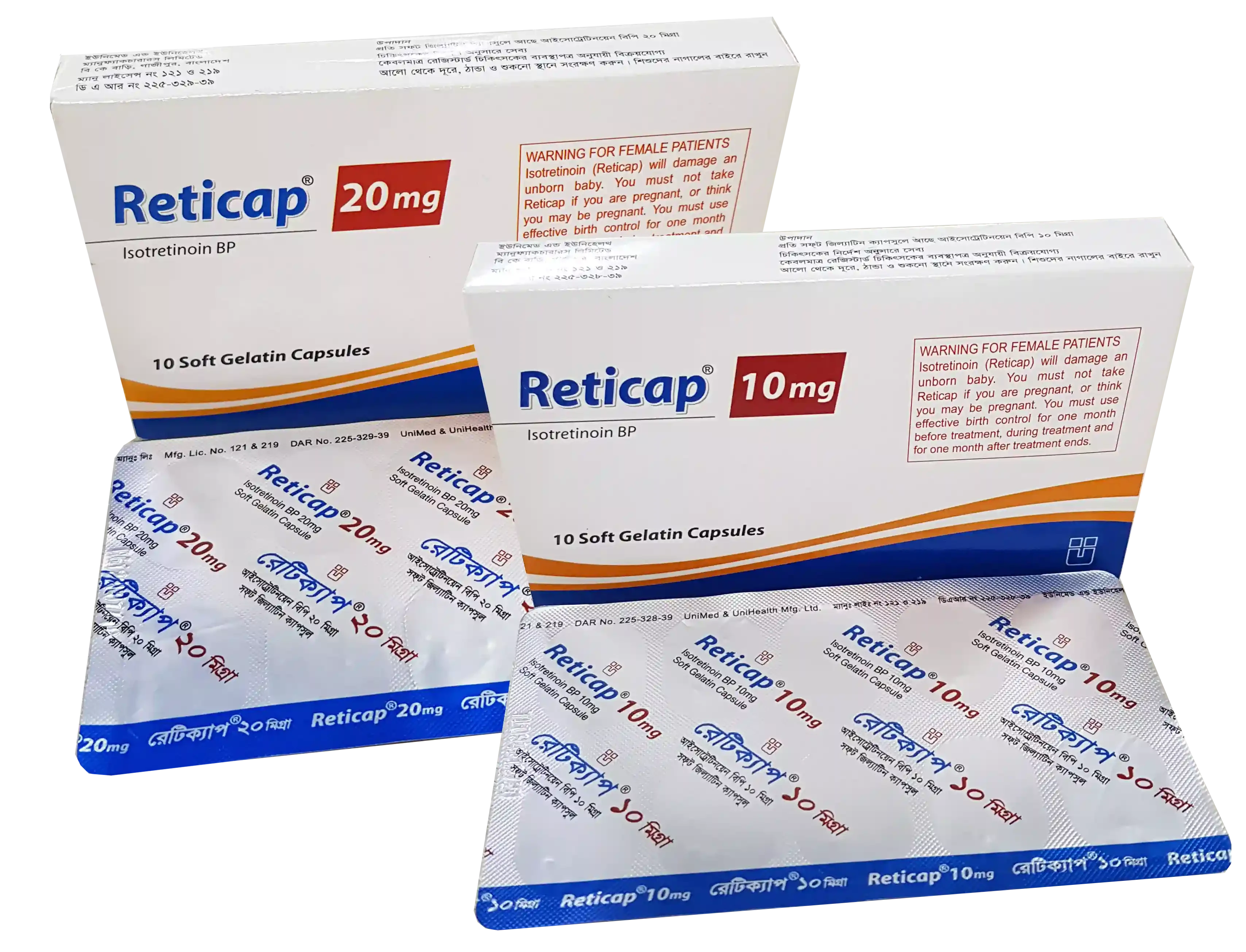
Introduction
Isotretinoin is an oral retinoid, a derivative of vitamin A, used to treat severe, treatment-resistant acne. It works by markedly reducing sebum production, shrinking sebaceous glands, inhibiting the growth of Cutibacterium acnes, and reducing inflammation and abnormal keratinization, thereby preventing acne lesion formation. Due to its high teratogenic potential, isotretinoin requires strict pregnancy prevention measures and careful patient monitoring during treatment.
Uses
Isotretinoin is a retinoid used to treat severe recalcitrant acne.
Isotretinoin is indicated to treat severe recalcitrant nodular acne and patients ≥12 years enrolled in the iPLEDGE program.
Associated Conditions
Pharmacodynamics
The pharmacodynamics of isotretinoin are poorly understood.
Mechanism of Action
Isotretinoin produces its effects through altering progress through the cell cycle, cell differentiation, survival, and apoptosis. These actions reduce sebum production, preventing the blockage of pores, and growth of acne causing bacteria. Isotretinoin and 4-oxo-isotretinoin both significantly reduce the production of sebum. Isotretinoin has little to no affinity for retinol binding proteins (RBPs) and retinoic acid nuclear receptors (RARs). Tretinoin and 4-oxo-tretinion bind to the RAR-γ receptor, which is suspected to be part of the action of acne treatment by isotretinoin. Isotretinoin induces apoptosis in sebocytes, leading to a decrease in sebum production. Isotretinoin also reduces the formation of comedones by reducing hyperkeratinization through an unknown mechanism. Isotretinoin does not directly kill bacteria but it does reduce the size of sebum ducts and makes the microenvironment less hospitable to acne causing bacteria. It may also increase immune mechanisms and alter chemotaxis of monocytes to reduce inflammation.
There is preliminary evidence suggesting isotretinoin may interact with FoxO1, which may explain a substantial number of isotretinoin's unexplained actions.
Absorption
Patients reach a maximum concentration of 74-511ng/mL after 1-4 hours following a 100mg oral dose. Isotretinoin is better absorbed with a high fat meal and bioavailability may change from one brand to another.
Following a 40mg oral dose, fasted subjects reached a maximum concentration of 314ng/mL in 2.9 hours with an area under the curve of 4055ng/mL*hr. Subjects given a high fat meal and a 40mg oral doses reached a maximum concentration of 395ng/mL in 6.4 hours with an area under the curve of 6095ng/mL*mL.
Volume of Distribution
The volume of distribution in humans is unknown because there is no intravenous preparation. In a study of pediatric patients with neuroblastoma the volume of distribution was found to be 85L. The volume of distribution was also found to be 2432mL/kg in guinea pigs and 1716mL/kg in obese rats.
Protein Binding
Isotretinoin is >99.9% protein bound, mainly to serum albumin.
Route of Elimination
Isotretinoin and its metabolites are conjugated and excreted in the urine and feces in similar amounts. 53-74% of an oral dose is eliminated as unchanged isotretinoin in the feces.
Half Life
The half life ranges from 7-39 hours with a mean elimination half life of 20 hours. The half life of 4-oxo-13-cis-retinoic acid ranges from 17-50 hours with a mean elimination half life of 25 hours.
Clearance
The clearance of isotretinoin is 15.9L/h in pediatric patients with neuroblastoma. Clearance is also 21.3mL/min/kg in guinea pigs and 7.2mL/min/kg in obese rats.
Toxicity
Patients experiencing an overdose may present with vomiting, facial flushing, cheilosis, abdominal pain, headache, dizziness, and ataxia. These symptoms may rapidly resolve. Generally no treatment is required for these overdoses.
The oral lowest dose causing toxic effect (TDLO) for children is 30mg/kg/21W, oral TDLO for men is 24mg/kg/4W, oral TDLO for women is 56mg/kg/8W. The intraperitoneal LD50 for rats is 901mg/kg, oral LD50 for mice is 3389mg/kg, oral LD50 for rats is >4000mg/kg.
Isotretinoin is associated with major congenital malformations, spontaneous abortion, and premature birth. It is unknown if isotretinoin is expressed in breast milk but due to the associated hazards a decision should be made to either stop nursing or stop taking isotretinoin.
In animal studies, isotretinoin was associated with an increased risk of pheochromocytoma and adrenal medullary hyperplasia at doses above the recommended clinical dose. Isotretinoin was negative for the Ames test of mutagenicity once and weakly positive a second time. It has not been shown to be clastogenic. A study in dogs noted testicular atrophy after doses of 10-30 times the recommended clinical dose for 30 weeks. In trials with men there were no effects seen on sperm count, motility, morphology, ejaculate volume, and seminal plasma fructose.
Food Interactions
- Avoid alcohol. Alcohol with isotretinoin can lead to inflammation of the liver.
- Avoid vitamin A supplements.
- Take with food. High-fat food increases drug absorption.
Dosage
Adults including adolescents and the elderly: Isotretinoin therapy should be started at a dose of 0.5 mg/kg daily. The therapeutic response to Isotretinoin and some of the adverse effects are dose-related and vary between patients. This necessitates individual dosage adjustment during therapy. For most patients, the dose ranges from 0.5-1.0 mg/kg per day. Long-term remission and relapse rates are more closely related to the total dose administered than to either duration of treatment or daily dose. It has been shown that no substantial additional benefit is to be expected beyond a cumulative treatment dose of 120-150 mg/kg. The duration of treatment will depend on the individual daily dose. A treatment course of 16-24 weeks is normally sufficient to achieve remission. In the majority of patients, complete clearing of the acne is obtained with a single treatment course. In the event of a definite relapse a further course of Isotretinoin therapy may be considered using the same daily dose and cumulative treatment dose. As further improvement of the acne can be observed up to 8 weeks after discontinuation of treatment, a further course of treatment should not be considered until at least this period has elapsed.
Patients with severe renal insufficiency: In patients with severe renal insufficiency treatment should be started at a lower dose (e.g. 10 mg/day). The dose should then be increased up to 1 mg/kg/day or until the patient is receiving the maximum tolerated dose.
Children: Isotretinoin is not indicated for the treatment of prepubertal acne and is not recommended in patients less than 12 years of age due to a lack of data on efficacy and safety.
Patients with intolerance: In patients who show severe intolerance to the recommended dose, treatment may be continued at a lower dose with the consequences of a longer therapy duration and a higher risk of relapse. In order to achieve the maximum possible efficacy in these patients the dose should normally be continued at the highest tolerated dose.