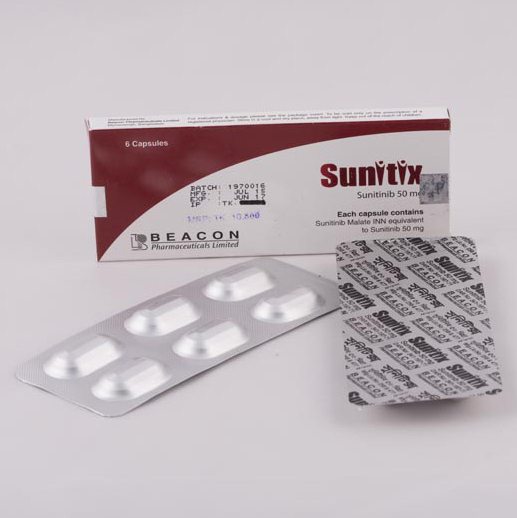
Introduction
Resinib Capsule 50 mg is a small-molecule multi-targeted receptor tyrosine kinase (RTK) inhibitor. Resinib Capsule 50 mg inhibits cellular signaling by targeting multiple RTKs. These include all platelet-derived growth factor receptors (PDGF-R) and vascular endothelial growth factor receptors (VEGF-R). Resinib Capsule 50 mg also inhibits KIT (CD117), the RTK that drives the majority of GISTs. In addition, sunitinib inhibits other RTKs including RET, CSF-1R, and flt3.
Uses
Resinib Capsule 50 mg is a receptor tyrosine kinase inhibitor and chemotherapeutic agent used for the treatment of renal cell carcinoma (RCC) and imatinib-resistant gastrointestinal stromal tumor (GIST).
For the treatment of advanced renal cell carcinoma as well as the treatment of gastrointestinal stromal tumor after disease progression on or intolerance to imatinib mesylate.
Associated Conditions
Pharmacodynamics
Resinib Capsule 50 mg is an oral, small-molecule, multi-targeted receptor tyrosine kinase (RTK) inhibitor that was approved by the FDA on January 26, 2006.
Mechanism of Action
Resinib Capsule 50 mg is a small molecule that inhibits multiple RTKs, some of which are implicated in tumor growth, pathologic angiogenesis, and metastatic progression of cancer. Resinib Capsule 50 mg was evaluated for its inhibitory activity against a variety of kinases (>80 kinases) and was identified as an inhibitor of platelet-derived growth factor receptors (PDGFRa and PDGFRb), vascular endothelial growth factor receptors (VEGFR1, VEGFR2 and VEGFR3), stem cell factor receptor (KIT), Fms-like tyrosine kinase-3 (FLT3), colony stimulating factor receptor Type 1 (CSF-1R), and the glial cell-line derived neurotrophic factor receptor (RET). Resinib Capsule 50 mg inhibition of the activity of these RTKs has been demonstrated in biochemical and cellular assays, and inhibition of function has been demonstrated in cell proliferation assays. The primary metabolite exhibits similar potency compared to sunitinib in biochemical and cellular assays.
Absorption
Maximum plasma concentrations (Cmax) of sunitinib are generally observed between 6 and 12 hours (Tmax) following oral administration. Food has no effect on the bioavailability of sunitinib. Resinib Capsule 50 mg may be taken with or without food. The pharmacokinetics were similar in healthy volunteers and in the solid tumor patient populations tested, including patients with GIST and RCC.
Volume of Distribution
- 2230 L (apparent volume of distribution, Vd/F)
Protein Binding
Binding of sunitinib and its primary metabolite to human plasma protein in vitro was 95% and 90%, respectively.
Route of Elimination
Resinib Capsule 50 mg is metabolized primarily by the cytochrome P450 enzyme, CYP3A4, to produce its primary active metabolite, which is further metabolized by CYP3A4. Elimination is primarily via feces. In a human mass balance study of [14C]sunitinib, 61% of the dose was eliminated in feces, with renal elimination accounting for 16% of the administered dose.
Half Life
Following administration of a single oral dose in healthy volunteers, the terminal half-lives of sunitinib and its primary active metabolite are approximately 40 to 60 hours and 80 to 110 hours, respectively.
Clearance
- 34 - 62 L/h [Total oral clearance]
Toxicity
The maximally tolerated dose for rat, mouse, and dog when given orally is greater than 500 mg/kg. The maximally tolerated dose of a non-human primate is greater 1200 mg/kg.
Food Interactions
- Avoid grapefruit products. Grapefruit may reduce the CYP3A4 metabolism of sunitinib.
- Avoid St. John's Wort. This herb induces CYP3A4 metabolism, which may reduce the serum concentration of sunitinib.
- Take with or without food.
Dosage
Recommended Dose for Adjuvant Treatment of RCC: The recommended dose of Sutinib for the adjuvant treatment of RCC is 50 mg taken orally once daily, on a schedule of 4 weeks on treatment followed by 2 weeks off (Schedule 4/2), for nine 6-week cycles. It may be taken with or without food.
Recommended Dose for pNET: The recommended dose of Sutinib for pancreatic neuroendocrine tumors (pNET) is 37.5 mg taken orally once daily continuously without a scheduled off-treatment period. It may be taken with or without food.