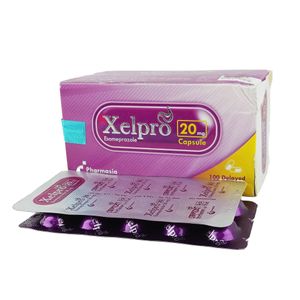
Pronex Capsule (Enteric Coated Pellets) 20 mg Introduction

Pronex Capsule (Enteric Coated Pellets) 20 mg (Nexium) is a proton-pump inhibitor (PPI) drug and a member of the Protonix drug group. It is used to treat gastroesophageal reflux disease (GERD), ulcers, certain bacteria in the stomach, and inflammation of the esophagus. It works by decreasing the amount of acid produced by the stomach.

Uses for

Pronex Capsule (Enteric Coated Pellets) 20 mg is used to treat symptoms of gastroesophageal reflux disease (GERD) and other conditions involving excessive stomach acid, such as Zollinger-Ellison syndrome. It is also used to promote healing of erosive esophagitis (damage to your esophagus caused by stomach acid). Additionally, it is used to prevent upper gastrointestinal tract bleeding in very ill patients.

Brand Name Pronex
Type Capsule (Enteric Coated Pellets)
Weight 20 mg
Generic Esomeprazole
Manufacturer Drug International Ltd.
Available in English বাংলা

Mechanism of Action

Pronex Capsule (Enteric Coated Pellets) 20 mg works by reducing the amount of acid produced in the stomach. It belongs to a class of drugs called proton pump inhibitors (PPIs). When taken as directed, Pronex Capsule (Enteric Coated Pellets) 20 mg works by blocking the enzyme H+/K+-ATPase, which is responsible for producing acid in the stomach. This leads to a reduction in the levels of acidity in the stomach and a decrease in the symptoms caused by excess stomach acid.

How Long Does It Take to Work?

Pronex Capsule (Enteric Coated Pellets) 20 mg usually begins to work within one hour of taking it. The full effect is usually seen within four hours. It is important to follow the instructions given by your doctor when taking this medication, and to take it for the recommended amount of time.

Absorption

Pronex Capsule (Enteric Coated Pellets) 20 mg is readily absorbed from the gastrointestinal tract and has a bioavailability of greater than 90%. It undergoes extensive first-pass metabolism and is metabolized mainly to two active metabolites in the liver.

Route of Elimination

Pronex Capsule (Enteric Coated Pellets) 20 mg is excreted mainly by the kidneys, with approximately 70% of a dose being excreted in the urine as its metabolite, 5-hydroxyesomeprazole. The rest is excreted in the feces as the parent compound.

Dosage

Oral dosage form-
  • Healing of Erosive Esophagitis: 20 mg or 40 mg Once Daily for 4-8 Weeks. The majority of patients are healed within 4 to 8 weeks. For patients who don't heal after 4-8 weeks, an additional 4-8 weeks of treatment may be considered. Maintenance of Healing of Erosive
  • Esophagitis: 20 mg Once Daily (Clinical studies did not extend 6 months).
  • Symptomatic GERD: 20 mg Once Daily for 4 Weeks. If symptoms do not resolve completely after 4 weeks, an additional 4 weeks of treatment may be considered.
  • Helicobacter Pylori eradication: Triple Therapy to reduce the risk of Duodenal Ulcer recurrence-Esomeprazole 40 mg Once Daily for 10 days, Amoxicillin 1000 mg Twice Daily for 10 days, Clarithromycin 500 mg Twice Daily for 10 days.
  • Zollinger-Ellison Syndrome: The dose is 20-80 mg once daily. The dosage should be adjusted individually and treatment continued as long as clinically indicated.
  • Acid-related Dyspepsia: 20-40 mg once daily for 2-4 weeks according to the response.
  • Duodenal ulcer: 20 mg once daily for 2-4 weeks. Gastric ulcer: 20-40 mg once daily for 4-8 weeks.

IV Injection or IV infusion:

GERD with Erosive Esophagitis-
Adult Patients (≥18 years):
  • 20 mg or 40 mg once daily
  • IV Injection: >3 Minutes, IV Infusion: 10-30 minutes
Pediatric Patients (1 year to 17 years)
  • Body weight <55 kg: 10 mg Once daily
  • Body Weight ≥55 kg: 20 once daily
  • 1 month to <1 year: 0.5 mg/kg once daily
  • IV Infusion: 10-30 minutes
Risk reduction of rebleeding of Gastric or Duodenal Ulcers following therapeutic endoscopy in adults-
Adult Patients (≥18 years)
  • 80 mg
  • IV Infusion: 30 minutes, followed by a continuous infusion of 8 mg/h for a total treatment duration of 72 hours.

The recommended adult dose of esomeprazole ranges from 20 mg to 40 mg once daily. In patients with serious disorders, or undergoing certain medical procedures, lower dosages may be more appropriate. The exact dosage and frequency should be determined by your doctor.

Administration

Pronex Capsule (Enteric Coated Pellets) 20 mg is typically taken orally as a delayed-release capsule or tablet. It may also be administered intravenously in cases of severe GI bleeding. It should be taken as directed by your doctor, usually once daily in the morning, with or without food.

Side Effects

Common side effects of esomeprazole include nausea, headache, diarrhea, and abdominal pain. More serious side effects, such as kidney problems and allergic reactions, are rare but have been reported. If you experience any severe side effects, contact your doctor immediately.

Toxicity

Pronex Capsule (Enteric Coated Pellets) 20 mg is not considered to be toxic when ingested in normal therapeutic doses. It is not known to have any effect on the central nervous system. However, overdoses of esomeprazole can lead to gastrointestinal problems, as well as damage to the kidneys and other organs.

Precaution

Before taking esomeprazole, inform your doctor if you have any known allergies, have liver or kidney problems, or have had heartburn or acid reflux around the clock. Be sure to tell your doctor if you are pregnant, may become pregnant, or are breastfeeding. Make sure to tell your doctor and pharmacist about all the medications you are taking, including prescription, nonprescription, and any herbal supplements, in order to avoid any dangerous drug interactions.

Interaction

Pronex Capsule (Enteric Coated Pellets) 20 mg may interact with other medications such as antifungals, aspirin, antibiotics, and other proton pump inhibitors. It is important to check with your doctor before combining esomeprazole with any of these medications. Additionally, alcohol may increase the risk of side effects when combined with esomeprazole.

Disease Interactions

Pronex Capsule (Enteric Coated Pellets) 20 mg may interact with certain diseases, such as liver and kidney disease, and it may worsen certain conditions, such as Lupus. Make sure to inform your doctor if you are suffering from any chronic disease before taking esomeprazole.

Drug Interactions

Pronex Capsule (Enteric Coated Pellets) 20 mg may interact with certain drugs, such as warfarin, clopidogrel, and methotrexate. Additionally, it may interact with certain medications such as aspirin, calcium channel blockers, and certain antibiotics. It is important to check with your doctor before taking any other medications while you are taking esomeprazole.

Food Interactions

Pronex Capsule (Enteric Coated Pellets) 20 mg should not be taken with food. Taking it with food may reduce the medication’s effectiveness. Additionally, certain foods, such as antacids, may bind to esomeprazole and decrease its absorption.

Pregnancy Use

Pronex Capsule (Enteric Coated Pellets) 20 mg should not be used during pregnancy unless it is clearly necessary. If you are pregnant and taking esomeprazole, inform your doctor immediately. Your doctor can help you decide if the benefits of taking esomeprazole outweigh the potential risks.

Lactation Use

Pronex Capsule (Enteric Coated Pellets) 20 mg should be used with caution in breast-feeding women. Consult your doctor before taking the medication if you are breast-feeding. Your doctor can help you decide if the benefits of taking esomeprazole outweigh the potential risks.

Acute Overdose

Taking too much esomeprazole can lead to symptoms such as nausea, vomiting, diarrhea, and abdominal pain. If an overdose is suspected, contact emergency services or poison control. Do not take more than the recommended dose of esomeprazole.

Contraindication

Pronex Capsule (Enteric Coated Pellets) 20 mg is contraindicated in patients with known hypersensitivity to the drug or any of its ingredients. It should not be used in patients with moderate or severe liver impairment. Additionally, esomeprazole is not recommended for the treatment of duodenal ulcers.

Use Direction

Pronex Capsule (Enteric Coated Pellets) 20 mg should be taken as directed by your doctor, usually once daily in the morning, with or without food. Do not take a double dose and do not take more than the recommended dose. Contact your doctor if you experience any side effects.

Storage Conditions

Pronex Capsule (Enteric Coated Pellets) 20 mg should be stored at room temperature, away from light and moisture. Do not keep esomeprazole in a bathroom or other damp area. Keep it out of reach of children and pets.

Volume of Distribution

The volume of distribution (Vd) of esomeprazole is 0.3 L/kg, indicating that it is distributed primarily in the extracellular space.

Half-Life

The half-life (t1/2) of esomeprazole is 0.5-1.2 hours, with a mean elimination half-life of 0.7 hours. Its active metabolites have much longer half-lives of 1.3 and 0.6 days.

Clearance

The clearance (CL) of esomeprazole is 11.5 L/h, indicating that it is rapidly eliminated from the body. Its active metabolites are eliminated with much lower speed.

Dosage Information

  • The recommended adult dose of esomeprazole ranges from 20 mg to 40 mg once daily.
  • It may also be administered intravenously in cases of severe GI bleeding.
  • It should be taken as directed by your doctor, usually once daily in the morning, with or without food.
  • Do not take a double dose and do not take more than the recommended dose.

See in details version Pronex Capsule (Enteric Coated Pellets) 20 mg also Pronex Capsule (Enteric Coated Pellets) 20 mg in bangla

Social card

Uses

Some Frequently Asked Questions About Pronex Capsule (Enteric Coated Pellets) 20 mg

1. What is esomeprazole?

Pronex Capsule (Enteric Coated Pellets) 20 mg is a proton pump inhibitor (PPI) that decreases stomach acid production to treat acid-related conditions.

2. What is esomeprazole used for?

It is used to treat:

  • Gastroesophageal reflux disease (GERD)
  • Peptic ulcers
  • Heartburn
  • Zollinger-Ellison syndrome
  • *H. pylori* infections (with antibiotics)
  • 3. How does esomeprazole work?

    It blocks proton pumps in the stomach lining, reducing acid secretion into the stomach.

    4. Is esomeprazole a prescription drug?

    It’s available by prescription and over-the-counter (OTC) in lower doses for heartburn relief.

    5. Who can take esomeprazole?

    It’s suitable for adults and children (with medical supervision), but not for those with severe liver disease or PPI allergies.

    6. How is esomeprazole taken?

    It is taken orally as capsules, tablets, or a suspension, typically before a meal.

    7. What is the typical dosage of esomeprazole?

    Dosage varies:

  • For GERD: 20-40 mg once daily
  • For ulcers: 20-40 mg daily for 4-8 weeks
  • For heartburn (OTC): 20 mg daily for up to 14 days
  • 8. How long does esomeprazole take to work?

    It reduces acid within 1-2 hours, with symptom relief often within 1-4 days.

    9. Can esomeprazole be taken long-term?

    Yes, for chronic conditions like GERD, but long-term use requires monitoring due to risks like nutrient deficiencies.

    10. Does esomeprazole cure ulcers?

    It promotes healing by reducing acid but doesn’t cure ulcers; antibiotics are needed for *H. pylori*-related cases.

    11. What are the common side effects of esomeprazole?

    Common side effects include:

  • Headache
  • Nausea
  • Diarrhea
  • Abdominal pain
  • 12. Can esomeprazole cause weight gain?

    It’s not directly linked to weight gain, but improved digestion might increase appetite.

    13. Does esomeprazole affect bones?

    Long-term use may increase fracture risk due to reduced calcium absorption.

    14. Can esomeprazole be taken with food?

    It’s best taken 30-60 minutes before a meal for optimal effect.

    15. What happens if I miss a dose of esomeprazole?

    Take it as soon as you remember unless it’s near the next dose; then skip it. Don’t double up.

    16. Can I overdose on esomeprazole?

    Overdose is rare but may cause drowsiness, confusion, or rapid heartbeat. Seek help if suspected.

    17. Is esomeprazole safe during pregnancy?

    It’s Category B; generally safe, but consult a doctor due to limited data.

    18. Can breastfeeding mothers take esomeprazole?

    Yes, it’s considered safe in small amounts in breast milk, but confirm with a doctor.

    19. Does esomeprazole interact with other medications?

    Yes, it interacts with:

  • Clopidogrel (reduces effectiveness)
  • Warfarin (increases bleeding risk)
  • Methotrexate (increases levels)
  • 20. Can I drink alcohol while taking esomeprazole?

    Yes, but alcohol may worsen acid reflux or stomach irritation.

    21. Is esomeprazole safe for people with kidney disease?

    Yes, it’s generally safe, though monitoring is advised in severe cases.

    22. Can esomeprazole be used in liver disease?

    Use with caution in severe liver disease, as it’s metabolized by the liver.

    23. How should esomeprazole be stored?

    Store at room temperature, away from moisture and heat.

    24. Does esomeprazole expire?

    Yes, check the expiration date; expired esomeprazole may lose potency.

    25. Can esomeprazole cause drowsiness?

    It’s uncommon, but some report fatigue or dizziness.

    26. Is esomeprazole the same as omeprazole?

    No, esomeprazole is the S-isomer of omeprazole, potentially more effective at the same dose.

    27. Can esomeprazole treat heartburn?

    Yes, it’s effective for frequent heartburn, available OTC for this purpose.

    28. Does esomeprazole cause diarrhea?

    Yes, diarrhea is a common side effect, especially initially.

    29. Can esomeprazole help with bloating?

    It doesn’t directly treat bloating but may ease acid-related discomfort.

    30. Is esomeprazole gluten-free?

    Most formulations are gluten-free, but confirm with the manufacturer.

    31. Can esomeprazole capsules be opened?

    Yes, delayed-release capsules can be opened and mixed with applesauce, but don’t crush the granules.

    32. What if I’m allergic to esomeprazole?

    Rare allergic reactions (rash, swelling) may occur. Stop use and seek help.

    33. Can esomeprazole cause vitamin deficiencies?

    Long-term use may reduce absorption of vitamin B12, magnesium, and calcium.

    34. Does esomeprazole affect blood pressure?

    No direct effect on blood pressure is noted.

    35. Can esomeprazole treat gastritis?

    Yes, it reduces acid to help heal gastritis, often with other treatments.

    36. Is esomeprazole safe for children?

    Yes, for children over 1 year with a doctor’s prescription, dosed by weight.

    37. Can esomeprazole cause headaches?

    Yes, headaches are a common, usually mild side effect.

    38. Does esomeprazole need refrigeration?

    No, store at room temperature; suspension forms may vary—check the label.

    39. Can esomeprazole be used for nausea?

    It’s not a nausea treatment but may help if acid reflux causes it.

    40. What’s the difference between esomeprazole and pantoprazole?

    Both are PPIs, but esomeprazole may act faster, and pantoprazole has fewer drug interactions.

    41. Can esomeprazole cause kidney problems?

    Rarely, long-term use has been linked to kidney damage; monitor with a doctor.

    42. Is esomeprazole available as a generic?

    Yes, generic esomeprazole is widely available, alongside brands like Nexium.

    43. Can esomeprazole be taken at night?

    It’s usually taken in the morning, but a doctor may adjust timing for nighttime symptoms.

    44. Does esomeprazole affect the liver?

    Rarely, it may elevate liver enzymes; report yellowing skin to a doctor.

    45. Can esomeprazole be used for acid reflux?

    Yes, it’s a primary treatment for acid reflux and GERD.

    46. What should I do if it doesn’t work?

    Consult your doctor; the dose may need adjustment or another condition may be present.

    47. Can esomeprazole cause constipation?

    Yes, though less common than diarrhea, it’s a possible side effect.

    48. Does esomeprazole interact with caffeine?

    No significant interaction, but caffeine may worsen reflux symptoms.

    49. Can esomeprazole be stopped abruptly?

    Stopping may cause rebound acid production; taper off under medical advice for long-term use.

    *** Taking medicines without doctor's advice can cause long-term problems.
    Dr. Marjana Siddique Moury

    Dr. Marjana Siddique Moury

    Oral, Dental & Maxillofacial Surgery Specialist

    Dentist in Sylhet
    Call Doctor
    Dr. Khan Ishrat Jahan

    Dr. Khan Ishrat Jahan

    Neonatal, Adolescent & Child Diseases Specialist

    Child Specialist Doctor in Rajshahi
    Call Doctor
    Related Medicines