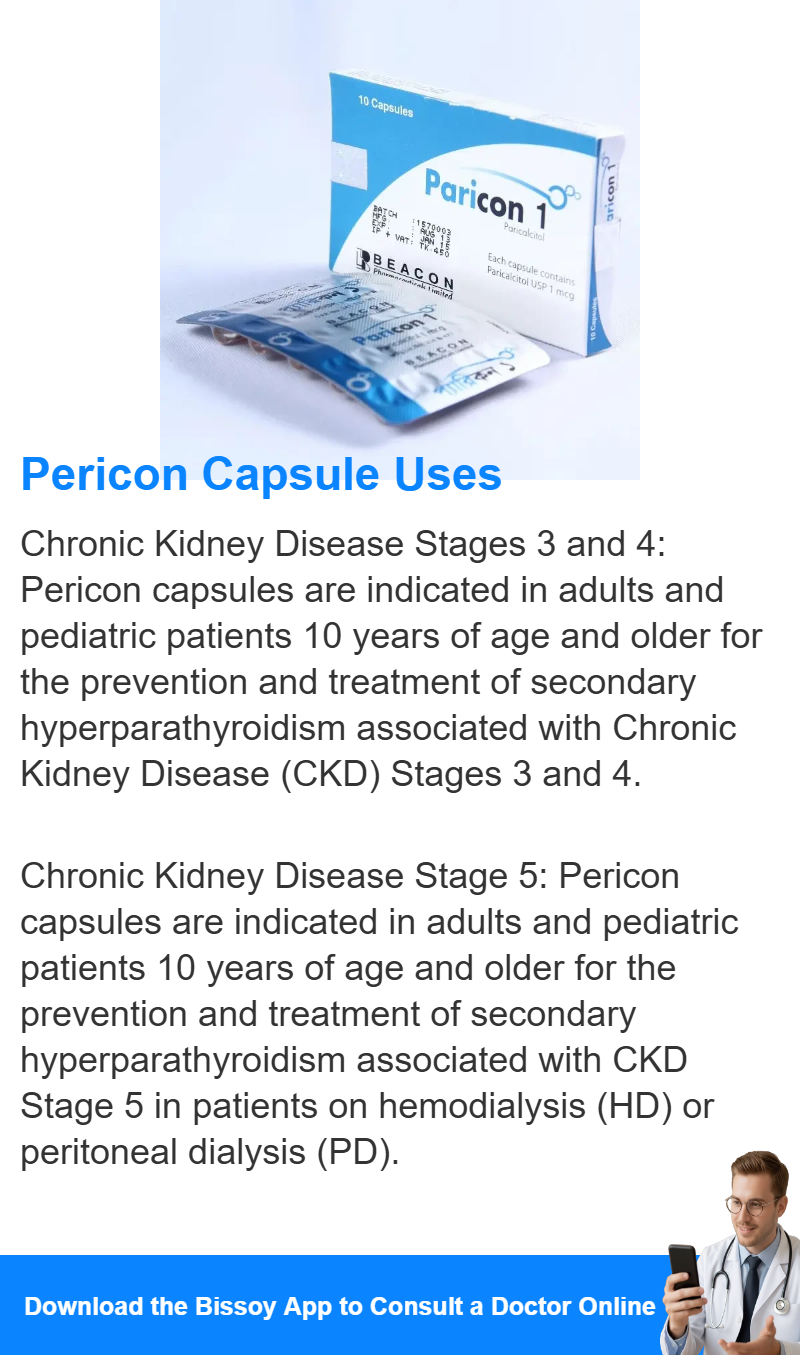
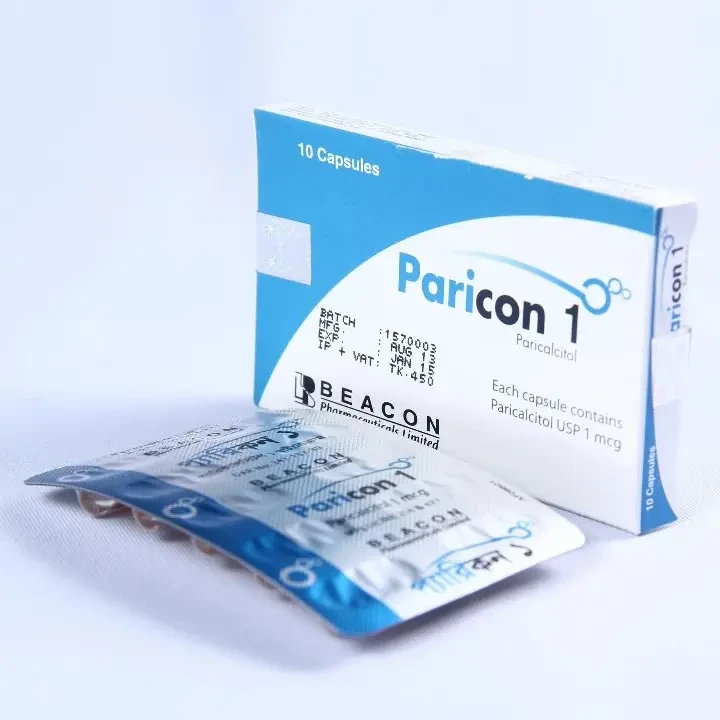
Pericon Capsule 1 mcg
Pericon Capsule 1 mcg is a medication used to help balance calcium and phosphorus levels in the blood. It is commonly prescribed to treat complications that arise from chronic kidney disease, such as hyperphosphatemia, secondary hyperparathyroidism, and vitamin D deficiency. Pericon Capsule 1 mcg works by activating vitamin D receptors, which stimulate the production of proteins that cause phosphorus and calcium to be removed from the bloodstream and deposited into the bones.
Uses of Pericon Capsule 1 mcg
Pericon Capsule 1 mcg is used to treat complications of chronic kidney disease, such as elevated levels of phosphorus in the blood (hyperphosphatemia), high calcium levels in the blood (hypercalcemia), and low levels of vitamin D (vitamin D deficiency). Pericon Capsule 1 mcg can also help to lower the activity of the body’s parathyroid hormone (PTH), which helps to regulate the balance of calcium and phosphorus in the body.
| Brand Name | Pericon |
|---|---|
| Type | Capsule |
| Weight | 1 mcg |
| Generic | Paricalcitol |
| Manufacturer | Beacon Pharmaceuticals Ltd. |
| Available in | English বাংলা |
Mechanism of Action
Pericon Capsule 1 mcg works by activating vitamin D receptors, which stimulates the production of proteins that cause calcium and phosphorus to be removed from the bloodstream and deposited into the bones. This helps to regulate the balance of calcium and phosphorus in the body and reduce the level of active parathyroid hormone (PTH).
How Long Does it Take to Work?
The effects of Pericon Capsule 1 mcg are usually seen within the first few days of treatment. It may take several weeks for the full effects to be noticed.
Absorption
Pericon Capsule 1 mcg is rapidly and almost completely absorbed following oral administration.
Route of Elimination
Pericon Capsule 1 mcg is eliminated mainly through the kidneys and is not metabolized in the body.
Dosage
Paricalcitol capsules may be taken without regard to food. Chronic Kidney Disease (CKD) Stages 3 and 4 in Adults: Administration of Paricalcitol soft gel capsules orally once daily or three times a week. When dosing three times weekly, do not administer more frequently than every other day.Initial Dose: Recommended Paricalcitol Starting Dose Based Upon Baseline PTH Level-
Baseline intact parathyroid hormone (IPTH) Level: <500 pg/ml
- Daily Dose: 1 mcg
- Three Times a Week Dose*: 2 mcg
- Daily Dose: 2 mcg
- Three Times a Week Dose*: 4 mcg
IPTH Level Relative to Baseline: The same, increased or decreased by less than 30%
- Daily Dose: Increase dose by 1 mcg
- Three Times a Week Dose*: Increase dose by 2 mcg
- Daily Dose: Maintain dose
- Three Times a Week Dose*: Maintain dose
- Daily Dose: Decrease dose by 1 mcg
- Three Times a Week Dose*: Decrease dose by 2 mcg
If a patient is taking the lowest dose, 1 mcg, on the daily regimen and a dose reduction is needed, the dose can be decreased to 1 mcg three times a week. If a further dose reduction is required, the drug should be withheld as needed and restarted at a lower dosing frequency.
Chronic Kidney Disease Stage 5 in Adults:
Initial Dose: Administer the dose of Paricalcitol capsules orally three times a week, no more frequently than every other day based upon the following formula: Dose (micrograms) baseline PTH (Pg/ml) divided by 80. Treat patients only after their baseline serum calcium has been adjusted to 9.5 mg/dL or lower to minimize the risk of hypercalcemia.
Dose Titration: Individualize and titrate Paricalcitol dose based on iPTH, serum calcium and phosphorus levels to maintain an iPTH level within target range. Every 4 weeks, each administered Paricalcitol dose may be increased in 1 mcg increments, maintaining the three times per week regimen (e.g., Increase from 1 mcg three times per week to 2 mcg three times per week), At any time, each administered dose may be decreased by 1 mcg. Paricalcitol may be stopped if the patient requires reduction while receiving 1 mcg three times per week, resuming when appropriate.
CKD Stage 5 Initial Dose-
Administer the dose of Paricalcitol capsules orally three times a week, no more frequently than every other day based upon the following formula:Dose* (micrograms) = baseline iPTH (pg/mL) divided by 120 ( Round down to the nearest whole number )
Dose Titration: Subsequent dosing should be individualized and based on IPTH, serum calcium and phosphorus levels to maintain an iPTH level within target range. Every 4 weeks, each administered Paricalcitol dose may be increased in 1 mcg increments, maintaining the three times per week regimen (e.g., increase from 1 mcg three times per week to 2 mcg three times per week). At any time, each administered dose may be decreased by 2 meg. Paricalcitol may be stopped if the patient requires reduction while receiving 2 mcg three times per week or 1 mcg three times per week, resuming when appropriate.
Monitoring: Monitor serum calcium and phosphorus levels closely after initiation of Paricalcitol, during dose titration periods and during co-administration with strong CYP3A inhibitors. If hypercalcemia is observed, the dose of Paricalcitol should be reduced or withheld until these parameters are normalized.
The usual starting dose of Pericon Capsule 1 mcg is 0.04-0.06 mcg/kg/day. The individual’s condition should be closely monitored and the dosage adjusted to achieve the desired effect. It is important to take Pericon Capsule 1 mcg exactly as prescribed by the physician and not to alter the dosage in any way.
Administration
Pericon Capsule 1 mcg should be taken orally, ideally once daily or as directed by the physician. The tablet should be taken with or without food. Pericon Capsule 1 mcg should not be split, crushed or chewed.
Side-Effect
Common side effects of Pericon Capsule 1 mcg include upset stomach, vomiting, diarrhea, constipation, headaches, dizziness and rash. Less common side effects include fluid retention, difficulty breathing, chest pain, and muscle/ joint pain.
Toxicity
Pericon Capsule 1 mcg is generally well tolerated and has a low risk of toxicity. Mild side effects may occur but usually go away with continued use of the medication.
Precaution
Patients with kidney disease, liver disease, and certain allergies should be monitored closely while using Pericon Capsule 1 mcg, as it can cause an allergic reaction in some people. Additionally, patients with low levels of calcium in their blood or those taking other drugs that can interact with Pericon Capsule 1 mcg should also be monitored closely. It is important to tell the doctor about all other medications you are taking so that potential interactions can be avoided.
Interaction
Pericon Capsule 1 mcg may interact with certain other medications, such as diuretics, non-steroidal anti-inflammatory drugs, and certain antibiotics. Additionally, it may interact with certain supplements such as calcium and vitamin D. It is important to tell the doctor about all other medications and supplements you are taking so that potential interactions can be avoided.
Disease Interactions
Pericon Capsule 1 mcg may interact with diseases such as kidney and liver disease, as well as certain allergies, so it is important to tell the doctor if you are suffering from any of these diseases so that potential interactions can be avoided.
Drug Interactions
Pericon Capsule 1 mcg may interact with other drugs such as diuretics, non-steroidal anti-inflammatory drugs, and certain antibiotics. It is important to tell the doctor all other medications you are taking, so that potential interactions can be avoided.
Food Interactions
Pericon Capsule 1 mcg does not interact with food. It is usually taken with or without food.
Pregnancy Use
- Pericon Capsule 1 mcg is not recommended for use in pregnant women unless the potential benefit to the mother outweighs the potential risk to the fetus.
- It is important to tell the doctor if you are pregnant or planning to become pregnant before taking Pericon Capsule 1 mcg.
Lactation Use
Pericon Capsule 1 mcg is not recommended for use in breastfeeding women due to the potential risk to the baby. It is important to tell the doctor if you are breastfeeding or plan to breastfeed before taking Pericon Capsule 1 mcg.
Acute Overdose
An overdose of Pericon Capsule 1 mcg may cause symptoms such as nausea, vomiting, and headache. It is important to seek immediate medical attention if you or someone you know has taken an overdose of Pericon Capsule 1 mcg.
Contraindication
Pericon Capsule 1 mcg should not be used to treat patients with primary hyperparathyroidism. It should also not be used in patients who are allergic to Pericon Capsule 1 mcg or any of its ingredients.
Use Direction
Pericon Capsule 1 mcg should be taken as prescribed by the doctor. Do not alter the dosage and do not stop taking the medication without consulting the doctor.
Storage Condition
Pericon Capsule 1 mcg should be stored at room temperature, away from light and moisture. Keep out of reach of children and pets.
Volume of Distribution
The volume of distribution for Pericon Capsule 1 mcg is unknown.
Half Life
The half-life of Pericon Capsule 1 mcg is approximately one hour.
Clearance
The clearance of Pericon Capsule 1 mcg is approximately 20L/h.
See in details version Pericon Capsule 1 mcg also Pericon Capsule 1 mcg in bangla
Social card