Introduction
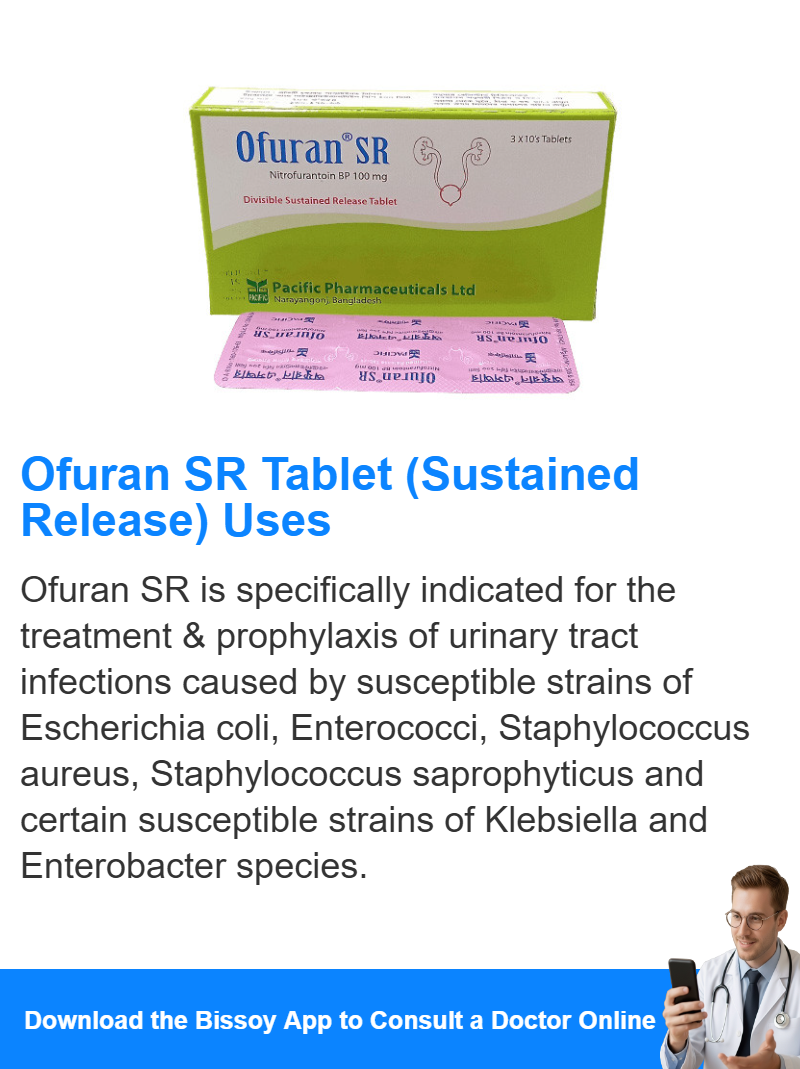
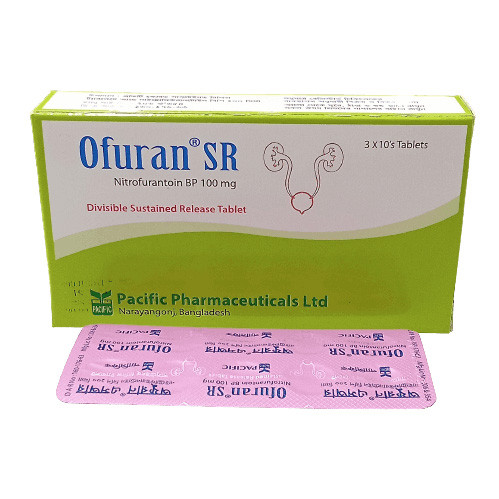
Ofuran SR Tablet (Sustained Release) 100 mg is a nitrofuran antibiotic used to treat uncomplicated urinary tract infections. Ofuran SR Tablet (Sustained Release) 100 mg is converted by bacterial nitroreductases to electrophilic intermediates which inhibit the citric acid cycle as well as synthesis of DNA, RNA, and protein. This drug is more resistant to the development of bacterial resistance because it acts on many targets at once. Ofuran SR Tablet (Sustained Release) 100 mg is a second line treatment to trimethoprim/sulfamethoxazole.
Ofuran SR Tablet (Sustained Release) 100 mg was granted FDA approval on 6 February 1953.
Uses
Ofuran SR Tablet (Sustained Release) 100 mg is an antibiotic used to treat urinary tract infections.
Ofuran SR Tablet (Sustained Release) 100 mg is indicated to treat acute uncomplicated urinary tract infections.
Associated Conditions
Pharmacodynamics
Ofuran SR Tablet (Sustained Release) 100 mg interferes with vital processes in bacteria, which leads to their death. Ofuran SR Tablet (Sustained Release) 100 mg rapidly reaches therapeutic concentrations in the urine and is also cleared rapidly.
Mechanism of Action
Ofuran SR Tablet (Sustained Release) 100 mg is converted by bacterial nitroreductases to electrophilic intermediates which inhibit the citric acid cycle as well as synthesis of DNA, RNA, and protein.
Absorption
Ofuran SR Tablet (Sustained Release) 100 mg reaches a Cmax of 0.875-0.963mg/L with an AUC of 2.21-2.42mg*h/L. It is 38.8-44.3% bioavailable. Taking nitrofurantoin with food increases the absorption and duration of therapeutic concentrations in the urine.
Volume of Distribution
Data regarding the volume of distribution in humans is scarce but it has been reported as 0.46L/kg in dogs.
Protein Binding
Ofuran SR Tablet (Sustained Release) 100 mg could be up to 90% protein bound in plasma.
Route of Elimination
27-50% of an oral dose is excreted in the urine as unchanged nitrofurantoin. 90% of the total dose is eliminated in the urine.
Half Life
The half life of nitrofurantoin is 0.72-0.78h.
Clearance
The clearance of nitrofurantoin is 16.7-19.4L/h.
Toxicity
Symptoms of overdose include vomiting. In case of overdose, induce vomiting if it has not already occurred and increase fluid intake to promote urination. In extreme cases, nitrofurantoin can be removed from circulation by dialysis.
Food Interactions
- Take with food. Food decreases irritation and increases bioavailability.
Dosage
- Uncomplicated urinary tract infections: 50-100 mg four times a day- the lower dosage level is recommended. Therapy should be continued for one week or for at least 3 days after sterility of the urine is obtained.
- For long-term suppressive therapy: In adults, a reduction of dosage to 50-100 mg at bedtime may be adequate.
- Acute Uncomplicated Urinary Tract Infections (UTIs): 50 mg four times daily for 7 days.
- Long term suppression: 50-100 mg once a day.
- Prophylaxis: 50 mg four times daily for the duration of procedure and for three days thereafter.
- Adults and Children over 12 years: One 100 mg capsule every 12 hours for seven days.
- Genito-urinary surgical prophylaxis: One capsule twice daily on day of procedure and for next 3 days.
- 7 to 11 kg: ½ (2.5 ml) teaspoonfuls 4 times daily.
- 12 to 21 kg: 1 (5 ml) teaspoonfuls 4 times daily.
- 22 to 30 kg: 1½ (7.5 ml) teaspoonfuls 4 times daily.
- 31 to 41 kg: 2 (10 ml) teaspoonfuls 4 times daily.