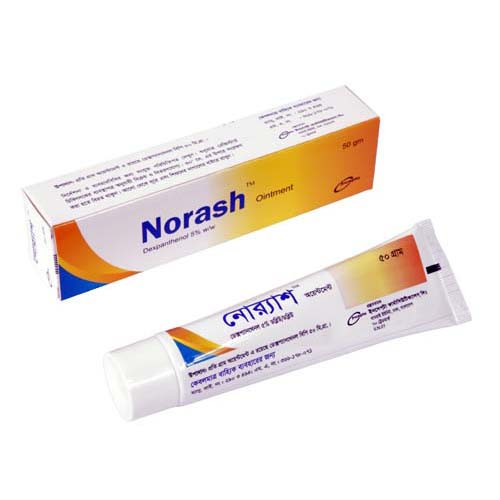
Introduction
Norash Ointment 5% is an alcohol derivative of pantothenic acid, a component of the B complex vitamins and an essential component of a normally functioning epithelium. Norash Ointment 5% is enzymatically cleaved to form pantothenic acid, which is an essential component of Coenzyme A, which acts as a cofactor in many enzymatic reactions that are important for protein metabolism in the epithelium.
Due to its good penetration and high local concentrations, dexpanthanol is used in many topical products, such as ointments and lotions for treatment of dermatological conditions to relieve itching or promote healing. Dermatological effects of the topical use of dexpanthenol include increased fibroblast proliferation and accelerated re-epithelialization in wound healing. Furthermore, it acts as a topical protectant, moisturizer, and has demonstrated anti-inflammatory properties .
Norash Ointment 5% is also available as a racemic mixture containing both the dextrorotatory form (dexpanthenol) and the levorotatory form (levopanthenol) as Panthenol. While pantothenic acid is optically active, only the dextrorotatory form (dexpanthenol) is biologically active.
Uses
Norash Ointment 5% is an alcoholic analogue of D-pantothenic acid that is used as a supplement or application to support a healthy epithelium and is also used to prevent vitamin deficiency in patients receiving total parenteral nutrition (TPN).
Injection: Prophylactic use immediately after major abdominal surgery to minimize the possibility of paralytic ileus. Intestinal atony causing abdominal distention; postoperative or postpartum retention of flatus, or postoperative delay in resumption of intestinal motility; paralytic ileus.
Topical: This medication is used as a moisturizer to treat or prevent dry, rough, scaly, itchy skin and minor skin irritations (e.g., diaper rash, skin burns from radiation therapy).
Associated Conditions
Pharmacodynamics
Pantothenic acid is a precursor of coenzyme A, which serves as a cofactor for a variety of enzyme-catalyzed reactions involving transfer of acetyl groups. The final step in the synthesis of acetylcholine consists of the choline acetylase transfer of acetyl group from acetylcoenzyme A to choline. Acetylcholine is the neurohumoral transmitter in the parasympathetic system and as such maintains the normal functions of the intestine. Decrease in acetylcholine content would result in decreased peristalsis and in extreme cases adynamic ileus.
Mechanism of Action
Norash Ointment 5% is an alcohol derivative of pantothenic acid, a component of the B complex vitamins and an essential component of a normally functioning epithelium. Norash Ointment 5% is enzymatically cleaved to form pantothenic acid, which is an essential component of Coenzyme A, which acts as a cofactor in many enzymatic reactions that are important for protein metabolism in the epithelium.
Dermatological effects of the topical use of dexpanthenol include increased fibroblast proliferation and accelerated re-epithelialization in wound healing. Furthermore, it acts as a topical protectant, moisturizer, and has demonstrated anti-inflammatory properties .
Absorption
Norash Ointment 5% is soluble in water and alcohol, although insoluble in fats and oil based substances. With the appropriate vehicle, Norash Ointment 5% is easily penetrated into the skin. Rate of penetration and absorption is reduced when Norash Ointment 5% is administered as an oil/water formula.
Volume of Distribution
Norash Ointment 5% is readily converted to pantothenic acid which is widely distributed into body tissues, mainly as coenzyme A. Highest concentrations are found in the liver, adrenal glands, heart, and kidneys.
Protein Binding
Plasma protein binding have not been reported.
Route of Elimination
Milk of nursing mothers receiving a normal diet contains about 2 ug of pantothenic acid per mL. About 70% of an oral dose of pantothenic acid is excreted unchanged in urine and about 30% in feces.
Half Life
Half life have not been reported
Toxicity
Mouse LD50 : 9gm/kg (Intraperitoneal) Mouse: LD50 7gm/kg (Intravenous) Mouse: LD50 15gm/kg (Oral) Rabbit LD50 4gm/kg (Oral)
Food Interactions
No interactions found.
Dosage
The usual dosage is generally:
- Diaper rash: Apply a thin layer on the baby’s bottom at every diaper change.
- Nipples: Apply a thin layer on the nipples after each nursing session. Wash the nipples thoroughly before the next nursing session.
- Dry/cracked skin or light wounds and chafed skin: Apply to the dry areas and/or to the wound up to 3 times a day.