Introduction
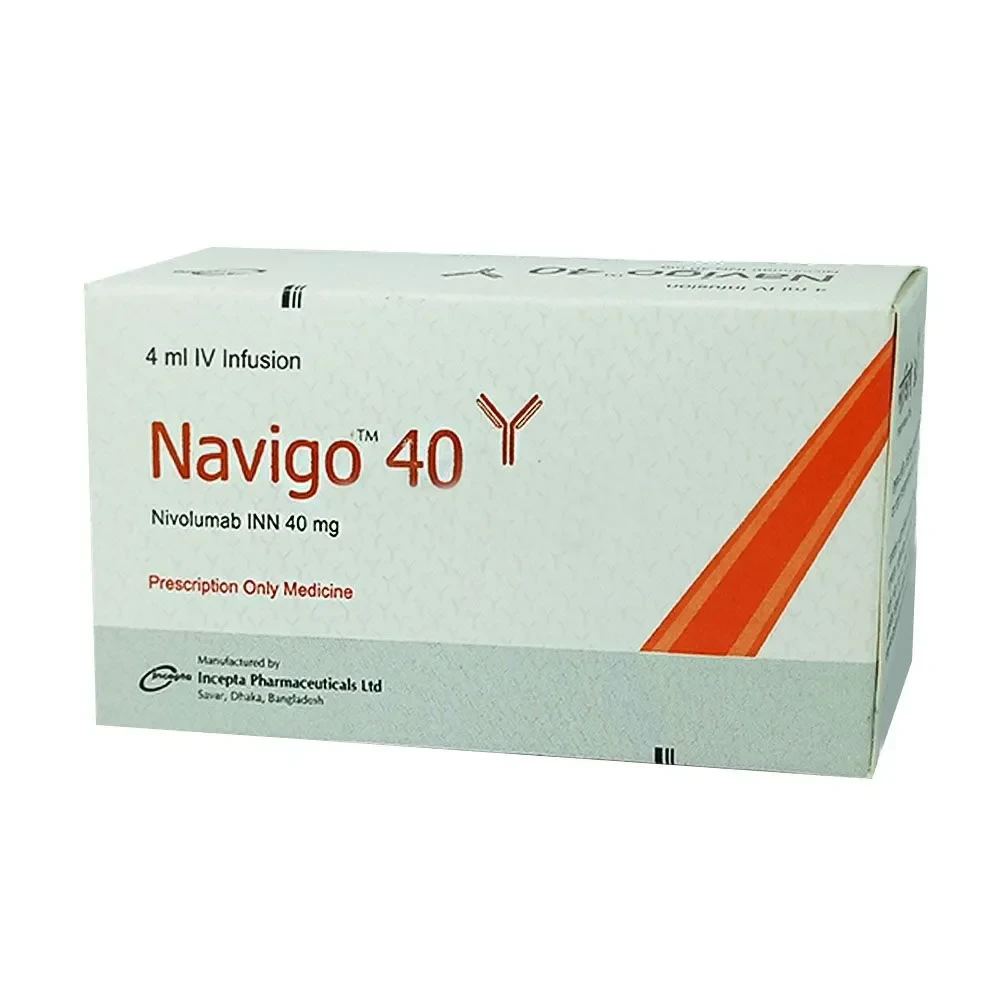
Nivomab IV Infusion 40 mg/4 ml is a fully human IgG4 monoclonal antibody that targets the programmed cell death-1 (PD-1) receptor. By blocking the PD-1 immune checkpoint, it enhances T-cell activity and strengthens the immune system's ability to recognize and destroy cancer cells.
Nivomab IV Infusion 40 mg/4 ml is used to treat a variety of advanced and metastatic cancers, including melanoma, non-small cell lung cancer, renal cell carcinoma, Hodgkin lymphoma, head and neck squamous cell carcinoma, urothelial carcinoma, and hepatocellular carcinoma. It is widely used as an immune checkpoint inhibitor in modern cancer immunotherapy.
Uses
Nivomab IV Infusion 40 mg/4 ml is a PD-1 blocking antibody used to treat melanoma, non small-cell lung cancer, renal cell cancer, head and neck cancer, and Hodgkin lymphoma.
Nivomab IV Infusion 40 mg/4 ml is indicated to treat unresectable or metastatic melanoma, adjuvant treatment of melanoma, metastatic non-small cell lung cancer, small cell lung cancer, advanced renal cell carcinoma, classical Hodgkin lymphoma, squamous cell carcinoma of the head and neck, urothelial carcinoma, microsatellite instability-high or mismatch repair deficient metastatic colorectal cancer, and hepatocellular carcinoma.
Associated Conditions
Pharmacodynamics
Nivomab IV Infusion 40 mg/4 ml blocks PD-1 inhibitory signalling to T-cells. It has a long duration of action as it is administered every 2-4 weeks. Patients should be counselled regarding the risk of immune-mediated adverse effects, infusion-related adverse effects, complications of allogenic hematopoietic stem cell transplants, embryo-fetal toxicity.
Mechanism of Action
The ligands PD-L1 and PD-L2 bind to the PD-1 receptor on T-cells, inhibiting the action of these cells. Tumor cells express PD-L1 and PD-L2. Nivomab IV Infusion 40 mg/4 ml binds to PD-1, preventing PD-L1 and PD-L2 from inhibiting the action of T-cells, restoring a patient's tumor-specific T-cell response.
Absorption
Pharmacokinetic studies have suggested that nivolumab presents linear pharmacokinetics with a dose-proportional increase in peak concentration and AUC. The time to peak plasma concentration ranges between 1-4 hours. The absorption pharmacokinetic properties respective to the administration of a dose of 10 mg/kg are reported to be Cmax, Tmax and AUC of 242 µg/kg, 2.99 hours and 68100 µg*h/mL respectively.
Volume of Distribution
The volume of distribution at steady state when a dose of 10 mg/kg of nivolumab is administered is reported to be 91.1 mL/kg. At doses ranging from 0.1 to 20 mg/kg the volume of distribution is reported to be 8L.
Protein Binding
There is no information regarding the plasma protein binding of nivolumab.
Route of Elimination
There have not been studies regarding the specific route of elimination of nivolumab.
Half Life
The serum half life of nivolumab is approximately 20 days with an elimination half life of 26.7 days.
Clearance
The estimated clearance rate of nivolumab is 9.4 mL/h. The clearance rate seems to be increased according to body weight.
Toxicity
Data regarding overdoses of nivolumab are not readily available. Common adverse effects include Rash, pruritus, cough, upper respiratory tract infection, and peripheral edema.
Food Interactions
No interactions found.
Dosage
Unresectable or metastatic melanoma:
- 240 mg every 2 weeks or 480 mg every 4 weeks.
- 1 mg/kg followed by ipilimumab 3 mg/kg on the same day every 3 weeks for 4 doses, then 240 mg every 2 weeks or 480 mg every 4 weeks.
Metastatic non-small-cell lung cancer:
- 3 mg/kg every 2 weeks with ipilimumab 1 mg/kg every 6 weeks.
- 360 mg every 3 weeks with ipilimumab 1 mg/kg every 6 weeks and 2 cycles of platinum-doublet chemotherapy.
- 240 mg every 2 weeks or 480 mg every 4 weeks.
Advanced renal cell carcinoma:
- 3 mg/kg followed by ipilimumab 1 mg/kg on the same day every 3 weeks for 4 doses, then 240 mg every 2 weeks or 480 mg every 4 weeks.
- 240 mg every 2 weeks or 480 mg every 4 weeks administered in combination with cabozantinib 40 mg once daily without food.
- 240 mg every 2 weeks or 480 mg every 4 weeks.
Recurrent or metastatic squamous cell carcinoma of the head and neck: 240 mg every 2 weeks or 480 mg every 4 weeks.
Locally advanced or metastatic urothelial carcinoma: 240 mg every 2 weeks or 480 mg every 4 weeks.
Microsatellite instability-high (MSI-H) or mismatch repair deficient (dMMR) metastatic colorectal cancer:
- Adult and pediatric patients ≥40 kg: 240 mg every 2 weeks or 480 mg every 4 weeks.
- Pediatric patients <40 kg: 3 mg/kg every 2 weeks.
- Adult and pediatric patients ≥40 kg: 3 mg/kg followed by ipilimumab 1 mg/kg on the same day every 3 weeks for 4 doses, then 240 mg every 2 weeks or 480 mg every 4 weeks.
- 240 mg every 2 weeks or 480 mg every 4 weeks.
- 1 mg/kg followed by ipilimumab 3 mg/kg on the same day every 3 weeks for 4 doses, then 240 mg every 2 weeks or 480 mg every 4 weeks.
Gastric cancer, gastroesophageal junction cancer, and esophageal adenocarcinoma (GC, GEJC, or EAC):
- 360 mg every 3 weeks with fluoropyrimidine- and platinum-containing chemotherapy every 3 weeks.
- 240 mg every 2 weeks with fluoropyrimidine- and platinum-containing chemotherapy every 2 weeks.