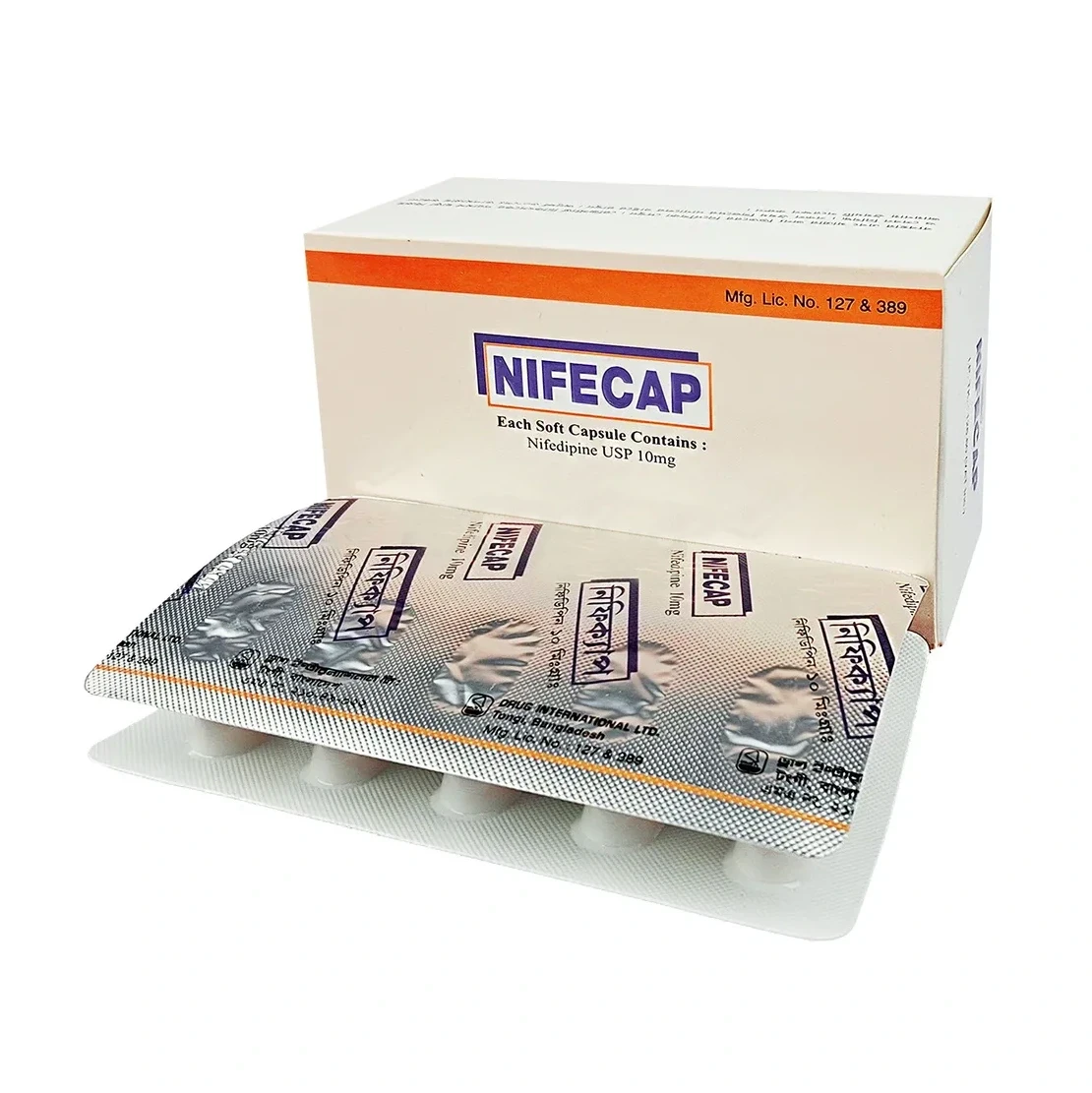
Introduction
Nifecap Capsule 10 mg, or BAY a 1040, is a first generation dihydropyridine L-type calcium channel blocker, similar to nicardipine. Nifecap Capsule 10 mg was developed by Bayer and first described in the literature, along with other dihydropyridines, in 1972. Since nifedipine's development, second and third generation dihydropyridines have been developed with slower onsets and longer durations of action. The most popular of the third generation dihydropyridines is amlodipine.
Nifecap Capsule 10 mg was granted FDA approval on 31 December 1981.
Uses
Nifecap Capsule 10 mg is a dihydropyridine calcium channel blocker indicated for the management of several subtypes of angina pectoris, and hypertension.
Nifecap Capsule 10 mg capsules are indicated to treat vasospastic angina and chronic stable angina. Extended release tablets are indicated to treat vasospastic angina, chronic stable angina, and hypertension.
Associated Conditions
Pharmacodynamics
Nifecap Capsule 10 mg is an inhibitor of L-type voltage gated calcium channels that reduces blood pressure and increases oxygen supply to the heart. Immediate release nifedipine's duration of action requires dosing 3 times daily. Nifecap Capsule 10 mg dosing is generally 10-120mg daily. Patients should be counselled regarding the risk of excessive hypotension, angina, and myocardial infarction.
Mechanism of Action
Nifecap Capsule 10 mg blocks voltage gated L-type calcium channels in vascular smooth muscle and myocardial cells. This blockage prevents the entry of calcium ions into cells during depolarization, reducing peripheral arterial vascular resistance and dilating coronary arteries. These actions reduce blood pressure and increase the supply of oxygen to the heart, alleviating angina.
Absorption
Sublingual dosing leads to a Cmax of 10ng/mL, with a Tmax of 50min, and an AUC of 25ng*h/mL. Oral dosing leads to a Cmax of 82ng/mL, with a Tmax of 28min, and an AUC of 152ng*h/mL.
Nifecap Capsule 10 mg is a Biopharmaceutics Classification System Class II drug, meaning it has low solubility and high intestinal permeability. It is almost completely absorbed in the gastrointestinal tract but has a bioavilability of 45-68%, partly due to first pass metabolism.
Volume of Distribution
The steady state volume of distribution of nifedipine is 0.62-0.77L/kg and the volume of distribution of the central compartment is 0.25-0.29L/kg.
Protein Binding
Nifecap Capsule 10 mg is 92-98% protein bound in serum. Nifecap Capsule 10 mg is 97±12% bound in a 40g/L solution of pure albumin. Nifecap Capsule 10 mg is 51.4±5.9% protein bound in a 50mg/100mL solution of alpha-1-acid glycoprotein, and 75.5±3.5% protein bound in a 150mg/mL solution.
Route of Elimination
Nifecap Capsule 10 mg is 60-80% recovered in the urine as inactive water soluble metabolites, and the rest is eliminated in the feces as metabolites.
Half Life
The terminal elimination half life of nifedipine is approximately 2 hours.
Clearance
The total body clearance of nifedipine is 450-700mL/min.
Toxicity
The oral LD50 in rats is 1022mg/kg and in mice is 202mg/kg.
Patients experiencing an overdose may present with hypotension, sinus node dysfunction, atrioventricular node dysfunction, and reflex tachycardia. Overdose may be managed by monitoring cardiovascular and respiratory function; elevating extremities; and administering vasopressors, fluids, and calcium infusions.
Food Interactions
- Avoid excessive or chronic alcohol consumption.
- Avoid grapefruit products. Grapefruit down-regulates post-translational expression of CYP3A4, the major metabolizing enzyme of nifedipine. Grapefruit, in all forms (e.g. whole fruit, juice and rind), can significantly increase serum levels of nifedipine and may cause toxicity. Avoid grapefruit products while on this medication.
- Avoid natural licorice.
- Take with or without food.
Dosage
- Angina: Initially 10 mg 3 times daily with food increased to 20 mg 3 times daily if necessary, in elderly patients, initially 5 mg 3 times daily.
- Raynaud's Phenomenon: 10 mg 3 times daily; maximum 60 mg daily. In urgent cases, the tablet should be dissolved under the tongue like a sublingual tablet. The effect occurs within some minutes.
Patients with liver dysfunction should commence therapy with 10 mg twice daily with careful monitoring.
Patients with renal impairment do not require adjustment of dosage.