Introduction
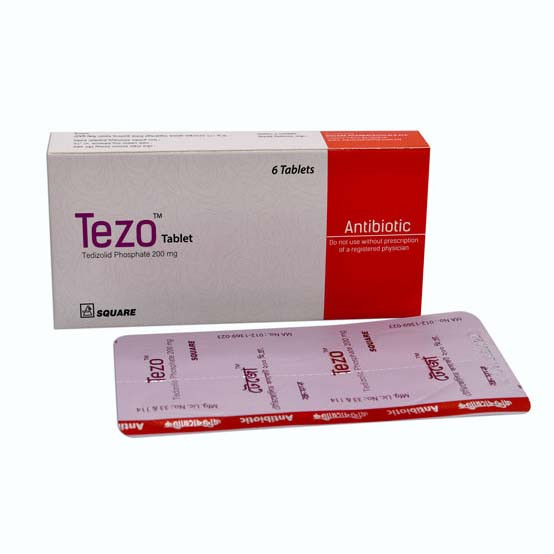
Drug-resistant bacteria, such as methicillin-resistant Staphylococcus aureus, vancomycin-resistant Enterococcus faecium, and penicillin-resistant Streptococcus penumoniae, represent a massive public health threat. Tedizolid is a member of the oxazolidinone class of antibiotics, which includes the previously approved linezolid and is generally effective against multidrug-resistant Gram-positive bacteria. Tedizolid is indicated for the treatment of acute bacterial skin and skin structure infections (ABSSSI) and is generally more effective and more tolerable than linezolid.
Uses
Tedizolid phosphate is an oxazolidinone class antibiotic that inhibits bacterial protein synthesis and is proven to be effective in the treatment of certain Gram-positive bacterial infections.
Tedizolid is indicated for the treatment of acute bacterial infections of the skin and skin structure (ABSSSI). To prevent drug resistance, tedizolid should only be used for infections that are caused by susceptible bacteria.
Associated Conditions
Pharmacodynamics
Tedizolid is an oxazolidinone antibiotic that works by inhibiting protein synthesis by bacterial ribosomes. However, oxazolidinone antibiotics can also bind to human mitochondrial, but not cytoplasmic, ribosomes. Mitochondrial protein synthesis inhibition is associated with adverse patient effects such as neurological, hematological, and gastrointestinal toxicity, although tedizolid is tolerated better than the related linezolid. Alternative therapies should be considered when treating neutropenic patients with ABSSSI. Clostridium difficile-associated diarrhea has been reported in patients treated with tedizolid.
Mechanism of Action
Despite renewed efforts to combat the spread of antimicrobial resistance, multidrug-resistant organisms, including gram-positive bacteria such as methicillin-resistant Staphylococcus aureus, remain a threat. Oxazolidinones represent a relatively new class of antibacterials inhibiting protein synthesis that is generally capable of overcoming resistance to other bacterial protein synthesis inhibitors.
Protein synthesis involves the action of ribosomes, multi-subunit complexes composed of both protein and ribosomal RNA (rRNA) substituents. Translocation along the length of a messenger RNA and concomitant protein synthesis involves the action of the A, P, and E sites of the peptidyltransferase centre (PTC), which accepts charged aminoacyl-tRNAs and catalyzes the formation of peptide bonds between them. The bacterial 70S ribosome comprises a small (30S) and a large (50S) subunit.
Early studies into the mechanism of action of oxazolidinone antibiotics suggested that they inhibit a step in the initiation of protein synthesis. However, this mechanism was inconsistent with mapped resistance mutations, and later studies involving cross-linking and direct structural determination of the binding site revealed that oxazolidinones, including both linezolid and tedizolid, bind in the A site of the PTC by interacting with the 23S rRNA component. The structural studies also revealed that oxazolidinone binding alters the conformation of a conserved nucleotide in the 23S rRNA (U2585 in Escherichia coli), which renders the PTC non-productive for peptide bond formation. Hence, tedizolid exerts its effect through inhibiting bacterial protein synthesis.
Absorption
Tedizolid reaches peak plasma concentrations within three hours for oral administration and within one hour following intravenous administration; the absolute oral bioavailability is approximately 91%. Food has no effect on absorption. When given once daily, either orally or intravenously, tedizolid reaches steady-state concentrations in approximately three days.
The Cmax for tedizolid after a single dose/at steady-state is 2.0 ± 0.7/2.2 ± 0.6 mcg/mL for oral administration, and 2.3 ± 0.6/3.0 ± 0.7 mcg/mL for intravenous administration, respectively. Similarly, the Tmax has a median (range) of 2.5 (1.0 - 8.0)/3.5 (1.0 - 6.0) hrs for the oral route and 1.1 (0.9 - 1.5)/1.2 (0.9 - 1.5) hrs when given intravenous. The AUC is 23.8 ± 6.8/25.6 ± 8.4 mcg*hr/mL for oral and 26.6 ± 5.2/29.2 ± 6.2 mcg*hr/mL for intravenous.
Volume of Distribution
The volume of distribution for tedizolid following a single intravenous dose of 200 mg is between 67 and 80 L. In a study involving oral administration of 200 mg tedizolid to steady-state, the volume of distribution was 108 ± 21 L, while a single 600 mg oral dose resulted in an apparent volume of distribution of 113.3 ± 19.3 L. Tedizolid has been observed to penetrate the interstitial space of both adipose and skeletal muscle tissue and is also found in the epithelial lining fluid as well as in alveolar macrophages.
Protein Binding
Approximately 70 to 90% of tedizolid is bound to human plasma proteins.
Route of Elimination
When given as a single oral dose, approximately 82% of tedizolid is excreted via the feces and 18% in urine. The majority is found as the inactive sulphate conjugate, with only 3% recovered unchanged. Over 85% of the elimination occurs within 96 hours.
Half Life
Tedizolid has a half-life of approximately 12 hours.
Clearance
Tedizolid has an apparent oral clearance of 6.9 ± 1.7 L/hr for a single dose and 8.4 ± 2.1 L/hr at steady-state. The systemic clearance is 6.4 ± 1.2 L/hr for a single dose and 5.9 ± 1.4 L/hr at steady-state.
Toxicity
Toxicity information regarding tedizolid is not readily available. Patients experiencing an overdose are at an increased risk of severe adverse effects such as nausea, headache, dizziness, diarrhea, and vomiting. Symptomatic and supportive measures are recommended.
Food Interactions
- Take at the same time every day.
- Take with or without food.
Dosage
- Intravenous: 200 mg Once daily 1 hour (Infusion Time) for 6 days
- Oral: 200 mg Once daily for 6 days