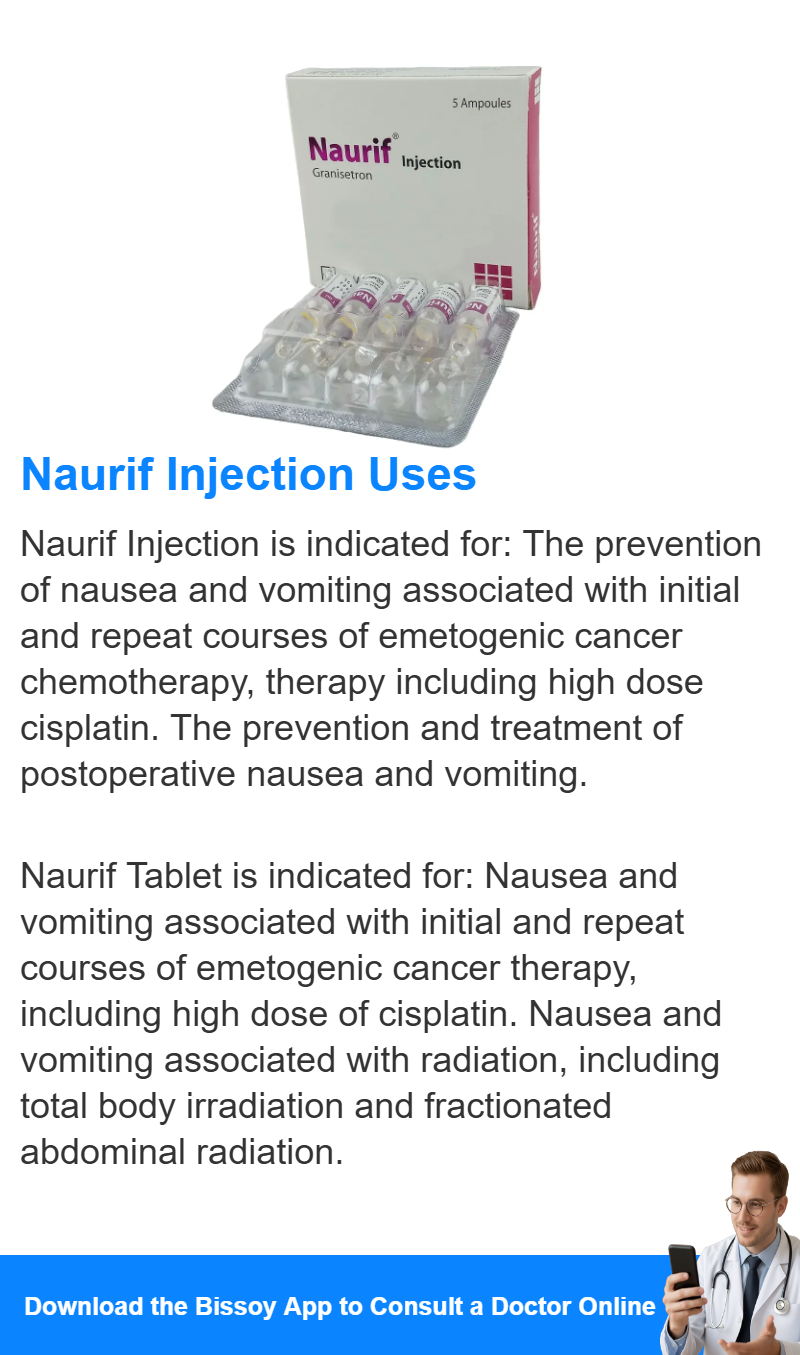
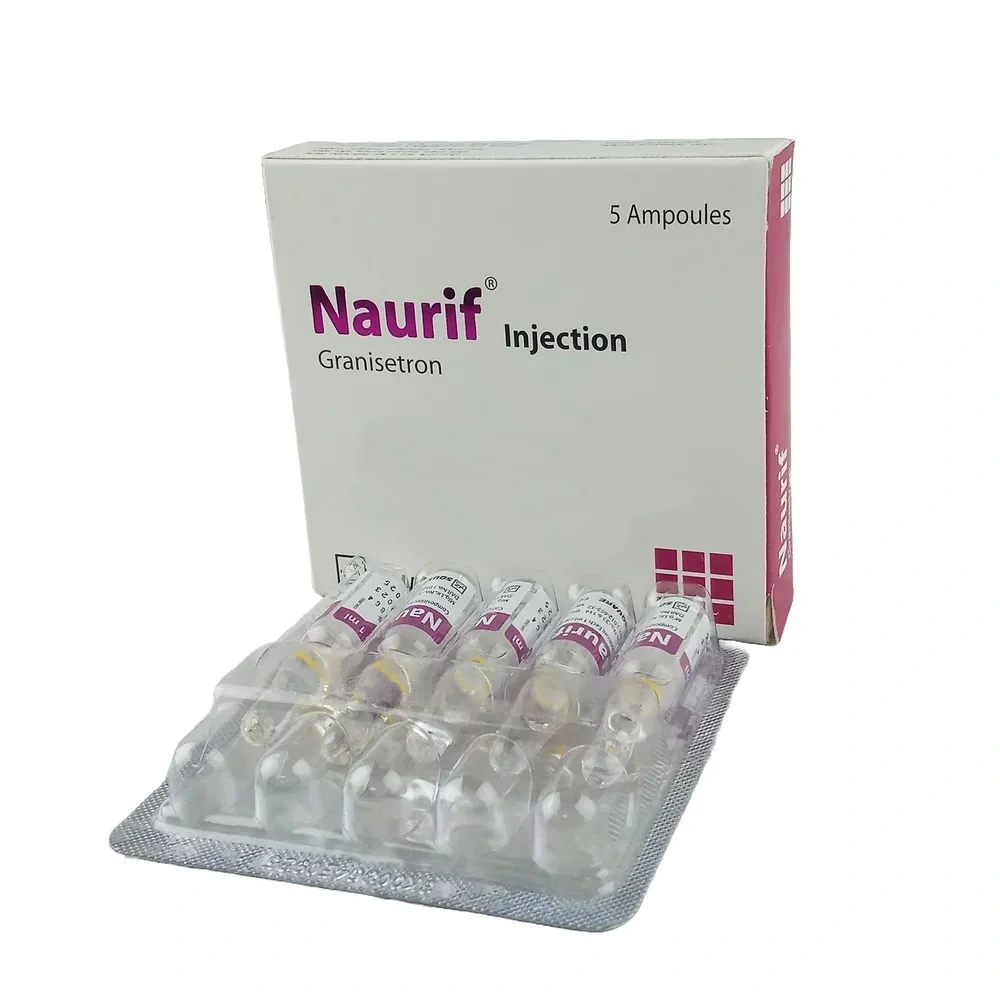
Naurif Injection 1 mg/ml
Naurif Injection 1 mg/ml is an antiemetic prescription medication used to prevent nausea and vomiting caused by cancer treatments, such as chemotherapy and radiation therapy. It is available in oral and injectable formulations.
Uses
Naurif Injection 1 mg/ml is commonly used for the prevention of nausea and vomiting in patients receiving chemotherapy or radiation therapy. It can also be used to prevent and treat postoperative nausea and vomiting.
| Brand Name | Naurif |
|---|---|
| Type | Injection |
| Weight | 1 mg/ml |
| Generic | Granisetron |
| Manufacturer | Square Pharmaceuticals Ltd. |
| Available in | English বাংলা |
Mechanism of Action
Naurif Injection 1 mg/ml works by blocking the action of the hormone serotonin on the cells in the stomach and intestine, which helps to reduce nausea and vomiting. Serotonin is a natural occurring substance in the body that is associated with the stimulation of vomiting.
How Long Does it Take to Work?
Naurif Injection 1 mg/ml takes approximately 30 minutes to begin working. The effects of the medication can last up to 24 hours.
Absorption
Naurif Injection 1 mg/ml is highly soluble in water and is quickly and completely absorbed after oral administration.
Route of Elimination
Naurif Injection 1 mg/ml is mainly metabolized in the liver and then excreted by the kidneys.
Dosage
Granisetron Injection:Chemotherapy-induced nausea and vomiting:
- Adults: The recommended dosage for Granisetron Injection is 10mcg/kg administered intravenously within 30 minutes before initiation of chemotherapy and only on the day(s) chemotherapy is given. Granisetron Injection may be administered intravenously either undiluted over 30 seconds or diluted with 0.9% Sodium Chloride or 5% Dextrose and infused over 5 minutes. As a general precaution, Granisetron Injection should not be mixed in solution with other drugs.
- Pediatric Patients: The recommended dose in pediatric patients 2 to 16 years of age is 10mcg/kg.
- Pediatric patients under 2 years of age: Have not been studied.
- Geriatric Patients, Renal Failure Patients or Hepatically Impaired Patients: No dosage adjustment is required.
- Adults: The recommended dosage for prevention of postoperative nausea and vomiting is, a single dose of 1 mg of Granisetron should be diluted to 5 ml and administered as a slow intravenous injection (over 30 seconds).Administration should be completed prior to induction of anesthesia. The recommended dosage for the treatment of nausea and vomiting after surgery is 1 mg of Granisetron undiluted, administered intravenously over 30 seconds.
- Paediatric Patients: The safety and effectiveness of Granisetron Injection have not been established in pediatric patients for the prevention or treatment of postoperative nausea or vomiting.
- Geriatric patients, Renal Failure Patients or Hepatically Impaired Patients: No dosage adjustment is required.
- Emetogenic chemotherapy: The recommended adult dosage of oral Granisetron is 2 mg once daily or 1 mg twice daily. In the 2 mg once-daily regimen, two 1 mg tablets are given up to one hour before chemotherapy. In the 1 mg twice-daily regimen, the first 1 mg tablet is given up to one hour before chemotherapy, and the second tablet, 12 hours after the first. Either regimen is administered only on the days(s) chemotherapy is given.
- Use in the Elderly, Renal Failure Patients or Hepatically Impaired Patients: No dosage adjustment is required. Radiation (either total body irradiation or fractionated abdominal radiation): The recommended adult dosage of oral Granisetron is 2 mg once daily. Two 1 mg tablets are taken within one hour of irradiation.
- Pediatric use: There is no experience with oral Granisetron in the prevention of radiation-induced nausea and vomiting in pediatric patients.
Naurif Injection 1 mg/ml is available as an oral solution, injection, and suppository. The dosage will depend on the condition being treated, the type of formulation, the patient's age, and any other medical conditions. General adult dosing for the oral solution is 2 mg twice a day, while for the injection it is 1 mg once a day. For the suppository, the dose is 2 mg once a day at least 30 minutes prior to harvesting.
Administration
For oral administration, Naurif Injection 1 mg/ml should be taken with food or milk. Naurif Injection 1 mg/ml injections may be given intravenously or intramuscularly. The suppository should be inserted high into the rectum and no additional lubrication should be used. Do not use hot water.
Side Effects
Side effects with Naurif Injection 1 mg/ml can include headache, constipation, dizziness, fatigue, and dry mouth. More serious side effects may include difficulty breathing, fast heartbeat, fainting, or seizures.
Toxicity
Naurif Injection 1 mg/ml is generally well tolerated with few serious side effects. Overdose of Naurif Injection 1 mg/ml can cause severe drowsiness and difficulty breathing. Call 911 or go to the nearest emergency room if you have taken an overdose of Naurif Injection 1 mg/ml.
Precaution
Naurif Injection 1 mg/ml should not be taken by people who are hypersensitive to the medication or who have severe kidney or liver disease.
Interactions
Naurif Injection 1 mg/ml may interact with other medications, including cancer treatments, antibiotics, antifungals, and blood thinners. Be sure to tell your doctor about all medications and supplements you are taking before starting Naurif Injection 1 mg/ml.
Disease Interaction
Naurif Injection 1 mg/ml can interact with certain medical conditions, such as kidney or liver disease, a history of seizures, or a personal or family history of long QT syndrome. Be sure to tell your doctor about any medical condition that you have before taking Naurif Injection 1 mg/ml.
Drug Interactions
Naurif Injection 1 mg/ml can interact with certain medications, such as cancer treatments, antibiotics, antifungal agents, and blood thinners. Be sure to tell your doctor about all medications and supplements you are taking before starting Naurif Injection 1 mg/ml.
Food Interactions
Naurif Injection 1 mg/ml should be taken with food or milk to help reduce acid reflux. Grapefruit or grapefruit juice should be avoided while taking this medication as it may interact with Naurif Injection 1 mg/ml.
Pregnancy Use
Naurif Injection 1 mg/ml is considered OB category B, meaning it is not expected to be harmful to an unborn baby. However, Naurif Injection 1 mg/ml should therefore be avoided in pregnancy unless clearly needed.
Lactation Use
Naurif Injection 1 mg/ml should not be used during breastfeeding because the drug could pass into breastmilk and harm the infant.
Acute Overdose
If an overdose of Naurif Injection 1 mg/ml is suspected, contact a poison control center immediately or seek medical attention. An overdose of Naurif Injection 1 mg/ml can cause drowsiness, difficulty breathing, and loss of consciousness.
Contraindication
Naurif Injection 1 mg/ml should not be used in patients who are allergic to the medication or have severe kidney or liver disease.
Use Direction
Always follow your doctor's instructions when taking Naurif Injection 1 mg/ml. Do not exceed the recommended dose of the medication or take it for a longer period of time than prescribed.
Storage Condition
Store Naurif Injection 1 mg/ml at room temperature and avoid exposing it to moisture and direct sunlight.
Volume of Distribution
Naurif Injection 1 mg/ml has a volume of distribution of 1.2 L/kg.
Half Life
Naurif Injection 1 mg/ml has an elimination half-life of 8.8 hours.
Clearance
Naurif Injection 1 mg/ml has a clearance mehtod of 1.7 mL/min/kg.
See in details version Naurif Injection 1 mg/ml also Naurif Injection 1 mg/ml in bangla
Social card
Some Frequently Asked Questions About Naurif Injection 1 mg/ml