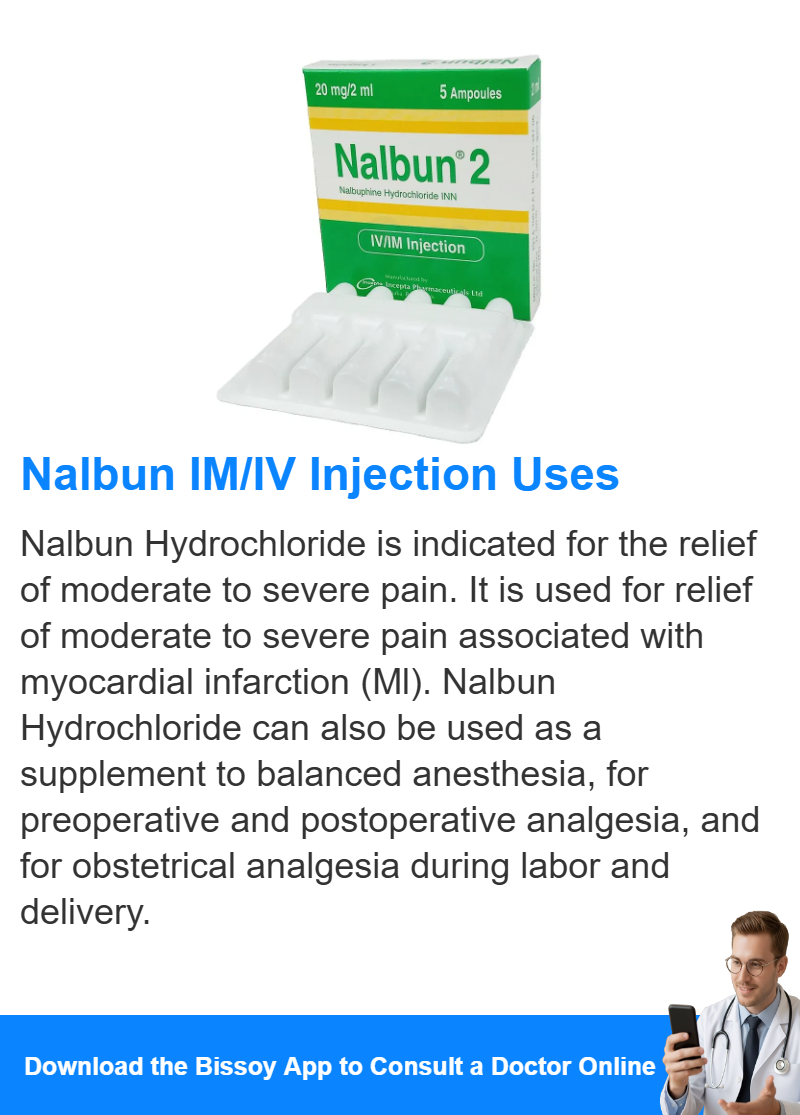
Introduction
A narcotic used as a pain medication. It appears to be an agonist at kappa opioid receptors and an antagonist or partial agonist at mu opioid receptors. Nalbun IM/IV Injection 20 mg/2 ml is the only opioid analgesic that is not a controlled substance in the United States.
Uses
Nalbun IM/IV Injection 20 mg/2 ml is an opioid agonist-antagonist used to treat pain, for pre and postoperative analgesia, and for analgesia in labor and delivery.
For the relief of moderate to severe pain.
Associated Conditions
Pharmacodynamics
Nalbun IM/IV Injection 20 mg/2 ml is a synthetic opioid agonist-antagonist analgesic of the phenanthrene series. Nalbun IM/IV Injection 20 mg/2 ml's analgesic potency is essentially equivalent to that of morphine on a milligram basis. The opoioid antagonist activity of nalbuphine is about one-fourth to that of nalorphine and 10 times to that of pentazocine. Nalbun IM/IV Injection 20 mg/2 ml by itself has potent opioid antagonist activity at doses equal to or lower than its analgesic dose. When administered following or concurrent with mu agonist opioid analgesics (e.g., morphine, oxymorphone, fentanyl), nalbuphine may partially reverse or block opioid-induced respiratory depression from the mu agonist analgesic. Nalbun IM/IV Injection 20 mg/2 ml may precipitate withdrawal in patients dependent on opioid drugs. Nalbun IM/IV Injection 20 mg/2 ml should be used with caution in patients who have been receiving mu opioid analgesics on a regular basis.
Mechanism of Action
The exact mechanism of action is unknown, but is believed to interact with an opiate receptor site in the CNS (probably in or associated with the limbic system). The opiate antagonistic effect may result from competitive inhibition at the opiate receptor, but may also be a result of other mechanisms. Nalbun IM/IV Injection 20 mg/2 ml is thought primarily to be a kappa agonist. It is also a partial mu antagonist analgesic, with some binding to the delta receptor and minimal agonist activity at the sigma receptor.
Absorption
The mean absolute bioavailability was 81% and 83% for the 10 and 20 mg intramuscular doses, respectively, and 79% and 76% following 10 and 20 mg of subcutaneous nalbuphine. Clinical studies show that the duration of analgesic activity of the drug can range from 3 to 6 hours.
Protein Binding
Not appreciably bound.
Half Life
The plasma half-life of nalbuphine is about 5 hours.
Toxicity
Oral, acute LD50 is 1100 mg/kg in dog. Symptoms of overdose include primarily sleepiness and mild dysphoria.
Food Interactions
- Avoid alcohol. Ingesting alcohol may increase the sedative and CNS depressant effects of nalbuphine.
Dosage
Moderate to severe pain: by intravenous or intramuscular injection 10-20 mg for 70 kg patient, adjusted as required; child up to 0.3 mg/kg repeated once or twice as necessary.
Preoperative anesthesia: by intravenous or intramuscular injection 0.1-0.2 mg/kg.
Obstetrical analgesia during labor & delivery: by intravenous injection 0.3-1 mg/kg over 10-15 minutes with maintenance doses of 0.25-0.5 mg/kg in single intravenous administration as required.
Intraoperative analgesia: by intravenous injection 0.25 - 0.5 mg/kg at 30 minutes intervals.
Myocardial infarction: By slow intravenous injection 10-20 mg, repeated after 30 minutes if necessary. Larger dose is required when used as supplement of anesthesia than that required for analgesia.
Children from 18 months to 15 years old: usually 0.2mg/kg body weight, given preferably by intravenous or intramuscular injection. Maintenance doses may be given at intervals of 4 to 6 hours or the dose must be determined by the physician.