Introduction
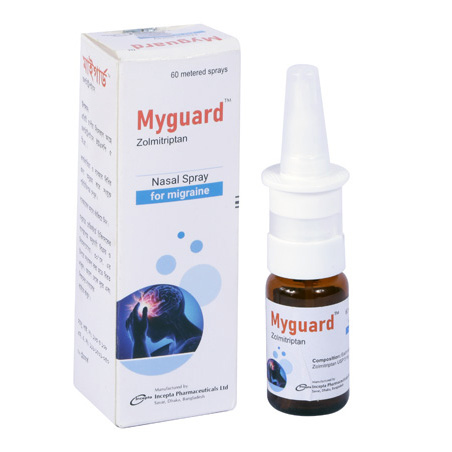
Myguard Nasal Spray 5 mg/spray is a member of the triptan class of 5-hydroxytryptamine(5-HT)1B/1D/(1F) receptor agonists used to treat acute migraine. Sumatriptan was the first triptan to be developed, but had poor oral bioavailability and lipophilicity. This led to the development of second-generation triptans, including almotriptan, eletriptan, frovatriptan, naratriptan, rizatriptan, and zolmitriptan. Triptans can be administered alone or in combination with an NSAID like naproxen, and represent the current "gold standard" for acute migraine treatment.
Myguard Nasal Spray 5 mg/spray was first approved by the FDA for sale by Zeneca Pharmaceuticals under the trade name Zomig® on November 25, 1997. It is currently available in both tablet and nasal spray forms.
Uses
Myguard Nasal Spray 5 mg/spray is a member of the triptan class of 5-HT(1B/1D/1F) receptor agonist drugs used for the acute treatment of migraine with or without aura in adults.
Myguard Nasal Spray 5 mg/spray is indicated for the acute treatment of migraine with or without auras in patients aged 18 and over.
Associated Conditions
Pharmacodynamics
Myguard Nasal Spray 5 mg/spray, like other triptans, is a serotonin (5-hydroxytryptamine; 5-HT) receptor agonist, with enhanced specificity for the 5-HT1B and 5-HT1D receptor subtypes. It is through the downstream effects of 5-HT1B/1D activation that triptans are proposed to provide acute relief of migraines. Myguard Nasal Spray 5 mg/spray is also a vasoconstrictor, leading to possible adverse cardiovascular effects such as myocardial ischemia/infarction, arrhythmias, cerebral and subarachnoid hemorrhage, stroke, gastrointestinal ischemia, and peripheral vasospastic reactions. In addition, chest/throat/neck/jaw pain, tightness, and/or pressure has been reported, along with the possibility of medication overuse headaches and serotonin syndrome. Patients with phenylketonuria should be advised that ZOMIG-ZMT contains phenylalanine.
Mechanism of Action
Migraines are complex physiological events characterized by unilateral throbbing headaches combined with photophobia and other aversions to sensory input. Migraine attacks are generally divided into phases: the premonitory phase, which typically involves irritability, fatigue, yawning, and stiff neck; the headache phase, which lasts for between four and 72 hours; and the postdrome phase, which lasts for up to a day following resolution of pain and whose symptoms are similar to those of the premonitory phase. In addition, neurological deficits, collectively termed migraine aura, may precede the headache phase.
The underlying pathophysiology of migraines is a matter of active research but involves both neurological and vascular components. The head pain associated with migraine is thought to be a consequence of activation of the nociceptive nerves comprising the trigeminocervical complex (TCC). Terminals of nociceptive nerves that innervate the dura matter release vasoactive peptides, such as calcitonin gene-related peptide (CGRP), resulting in cranial vasodilation. Finally, when present, migraine aura appears to correlate with a transient wave(s) of cortical depolarization, termed cortical spreading depression (CSD).
Triptans, including zolmitriptan, are proposed to act in three ways. The main mechanism is through modulation of nociceptive nerve signalling in the central nervous system through 5-HT1B/1D receptors throughout the TCC and associated areas of the brain. In addition, triptans can enhance vasoconstriction, both through direct 5-HT1B-mediated dilation of cranial blood vessels, as well as through 5-HT1D-mediated suppression of CGRP release.
Although triptans are classically described solely in terms of their effects on 5-HT1B/1D receptors, they also act as 5-HT1F agonists as well. This 5-HT subtype is also found throughout the TCC, but is not present appreciably in cerebral vasculature; the significance of triptan-mediated 5-HT1F activation is currently not well described. Additionally, CSD that initiates in the ipsilateral parietal region may exert its effects in a manner that relies on 5-HT1B/1D receptor activation, suggesting that triptans may have some effect on CSD-mediated symptoms.
Absorption
Myguard Nasal Spray 5 mg/spray tablets have a mean absolute oral bioavailability of approximately 40%, with food having no effect on the rate or extent of absorption. The dosing kinetics are linear over a range of 2.5 to 50 mg with 75% of the eventual Cmax being attained within 1 hour of dosing. The median Tmax for the tablet form is 1.5 hours, while for the orally disintegrating tablet form, it is 3 hours. The AUC across studies was in the range of 84.4-173.8 ng/mL*h while the Cmax was between 16 and 25.2 ng/mL.
Myguard Nasal Spray 5 mg/spray administered as a nasal spray is detected in the plasma within 2-5 minutes, compared to 10-15 minutes for the tablet form; the faster kinetics likely reflect fast absorption across the nasal mucosa. The bioavailability compared to the tablet is 102%, and plasma zolmitriptan concentration is maintained for 4-6 hours after intranasal delivery.
The active N-desmethyl metabolite of zolmitriptan has a mean plasma concentration that is roughly two-thirds of zolmitriptan, regardless of dosage route or concentration.
Volume of Distribution
Myguard Nasal Spray 5 mg/spray has a volume of distribution between 7 and 8.4 L/kg.
Protein Binding
Myguard Nasal Spray 5 mg/spray and its active N-desmethyl metabolite remain approximately 25% bound to plasma proteins over a concentration range of 10-1000 ng/mL.
Route of Elimination
Myguard Nasal Spray 5 mg/spray is primarily excreted in urine (approximately 65%) and feces (approximately 30%). Within urine, the most common form is the indole acetic acid metabolite (31%), followed by the N-oxide (7%), and N-desmethyl (4%) metabolites; the majority of zolmitriptan recovered in feces remains unchanged.
Half Life
Myguard Nasal Spray 5 mg/spray has a mean elimination half-life of approximately three hours, while its active N-desmethyl metabolite has a slightly longer (approximately 3.5 hours) half-life.
Clearance
Myguard Nasal Spray 5 mg/spray has a clearance of 31.5 mL/min/kg for oral tablets and 25.9 mL/min/kg for nasal administration; one-sixth of the clearance is renal.
Toxicity
Toxicity information regarding zolmitriptan is not readily available. Patients experiencing an overdose are at an increased risk of severe adverse effects such as cardiovascular symptoms due to excessive vasoconstriction and activation of serotonergic receptors. Patients receiving a single 50 mg oral dose of zolmitriptan often experienced sedation. Symptomatic and supportive measures are recommended.
Food Interactions
- Take with or without food. Food does not significantly impact the oral bioavalibility of zolmitriptan.
Dosage
Nasal Spray: Administer one dose of Myguard Nasal Spray 5 mg/spray Nasal Spray 5 mg for the treatment of acute migraine. If the headache returns the dose may be repeated after 2 hours. The maximum daily dose should not exceed 10 mg in any 24-hour period. In controlled clinical trials, single doses of 5 mg zolmitriptan nasal spray were administered into one nostril and were effective for the treatment of acute migraines in adults. Individuals may vary in response to Myguard Nasal Spray 5 mg/spray Nasal Spray. The pharmacokinetics of a 5 mg nasal spray dose is similar to the 5 mg oral formulations. Doses lower than 5 mg can only be achieved through the use of an oral formulation. The choice of dose, and route of administration should therefore be made on an individual basis. The effectiveness of a second dose has not been established in placebo-controlled trials. The safety of treating an average of more than four headaches in a 30 day period has not been established.