Introduction
Fosfomycin was discovered in 1969 by scientists at the Spanish Penicillin and Antibiotics Company and is produced by Streptomyces fradiae. It may also be produced synthetically and is commercially available as the disodium salt for intravenous administration and as the calcium or trometamol salt for oral administration. In terms of chemical structure, fosfomycin is a phosphoenolpyruvate analog and contains a phosphonic group and an epoxide ring.
Due to its ease of administration as a single 3-gram oral dose and desirable safety profile, fosfomycin has largely become a first-line therapeutic option for the treatment of uncomplicated urinary tract infections (UTIs) in females. Despite being FDA approved only for urinary tract infections, fosfomycin actually has a broad spectrum of activity and is active against both gram-positive and gram-negative bacteria. As such there is great interest in exploring the usefulness of fosfomycin for indications beyond the treatment of UTIs.
Uses
Fosfomycin is a broad spectrum antibiotic used to treat uncomplicated urinary tract infections.
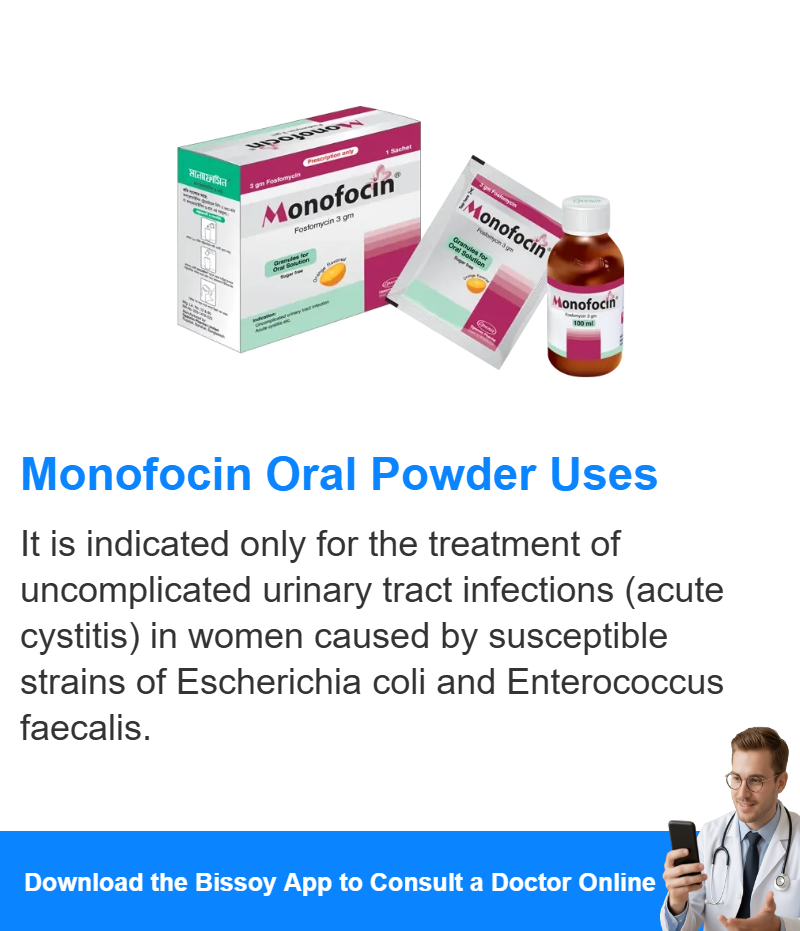
Fosfomycin is indicated for the treatment of uncomplicated cases of cystitis caused by susceptible strains of Escherichia coli and Enterococcus faecalis. Fosfomycin is not officially indicated for the treatment of pyelonephritis or perinephric abscess, although there have been reported cases of off-label usage in these situations.
Associated Conditions
Pharmacodynamics
Although used primarily to treat urinary tract infections, fosfomycin has been shown to act synergistically with other antibiotics against clinically relevant bacteria. There is also growing interest in the potential of fosfomycin to treat more complex infections since it has retained activity against many difficult-to-treat strains of bacteria including methicillin-resistant Staphylococcus aureus (MRSA) and multidrug-resistant enterobacteria. Further, since fosfomycin has a unique and singular mechanism of action, the risk of cross-resistance with other antibiotics is low.
Fosfomycin also demonstrates immunomodulating properties. For example, the antibiotic may influence components of the acute inflammatory cytokine response and enhances neutrophil phagocytic destruction of pathogens.
Fosfomycin penetrates biofilms effectively and is capable of not only reducing or eliminating microorganisms in biofilms but can also alter the biofilm structure.
Mechanism of Action
Fosfomycin exerts its bactericidal effects by binding covalently to a cysteine in the active site of the UDP-N-acetylglucosamine enolpyruvyl transferase (MurA) enzyme, rendering it inactive. By preventing MurA from catalyzing the condensation of phosphoenolpyruvate (PEP) with UDP-N-acetylglucosamine (UNAG), fosfomycin inhibits the production of the peptidoglycan precursor UDP N-acetylmuramic acid (UDP-MurNAc). Ultimately, the first step of bacterial cell wall synthesis is disrupted.
In Escherichia coli, fosfomycin gains entry into bacterial cells via two mechanisms: the L-alpha-glycerophosphate system and the hexose-6-phosphate transporter system.
Fosfomycin also has important effects on cell adhesion. For example, the adhesion of bacterial cells to urinary epithelial cells is reduced in the presence of fosfomycin. The adhesion of Streptococcus pneumoniae and Haemophilus influenzae to respiratory epithelial cells is also reduced
Absorption
Fosfomycin is a low molecular weight and hydrophilic drug. When administered orally, fosfomycin is rapidly absorbed in the small intestine and distributed widely to the tissues. The oral bioavailability ranges from 34-58%. Co-administration of fosfomycin with food decreases gastrointestinal absorption to approximately 30%. The reported AUC = 145-228 mg x h/L, while the reported Cmax = 26.1 (∓9.1) mcg/mL.
Volume of Distribution
In healthy subjects, the volume of distribution (Vd) of fosfomycin is approximately 0.3 L/Kg. Due to changes in the vascular endothelium, the Vd can be up to 50% higher in critically ill patients.
Protein Binding
Fosfomycin does not bind to plasma proteins to any significant extent.
Route of Elimination
Fosfomycin is excreted almost entirely by the kidneys. Factors including administration with food, impaired renal function, and older age may reduce the rate of fosfomycin elimination.
Half Life
The mean elimination half-life of fosfomycin is 5.7 (∓2.8) hours.
Clearance
In one study, the reported CL/F of fosfomycin in healthy volunteers was 17 ∓ 4.7 L/hour.
Toxicity
Acute toxicology studies have found that oral fosfomycin doses 50-125 times the human therapeutic dose were well-tolerated in rats and mice, resulted in minor and transient watery stools in rabbits, and caused diarrhea with anorexia in dogs 2-3 days after single-dose administration.
In humans, symptoms of overdose have included impaired hearing, vestibular loss, general decline in taste perception, and metallic taste. In the event of overdose, the patient should be managed with symptomatic and supportive measures.
Food Interactions
- Take with or without food. The absorption is unaffected by food.
Dosage
Preparation: At first pour the 100 ml purified water in a glass. Then add full contents of one Fosfomycin sachet into purified water and stir to dissolve completely. Drink full mixture immediately after preparation.