Introduction
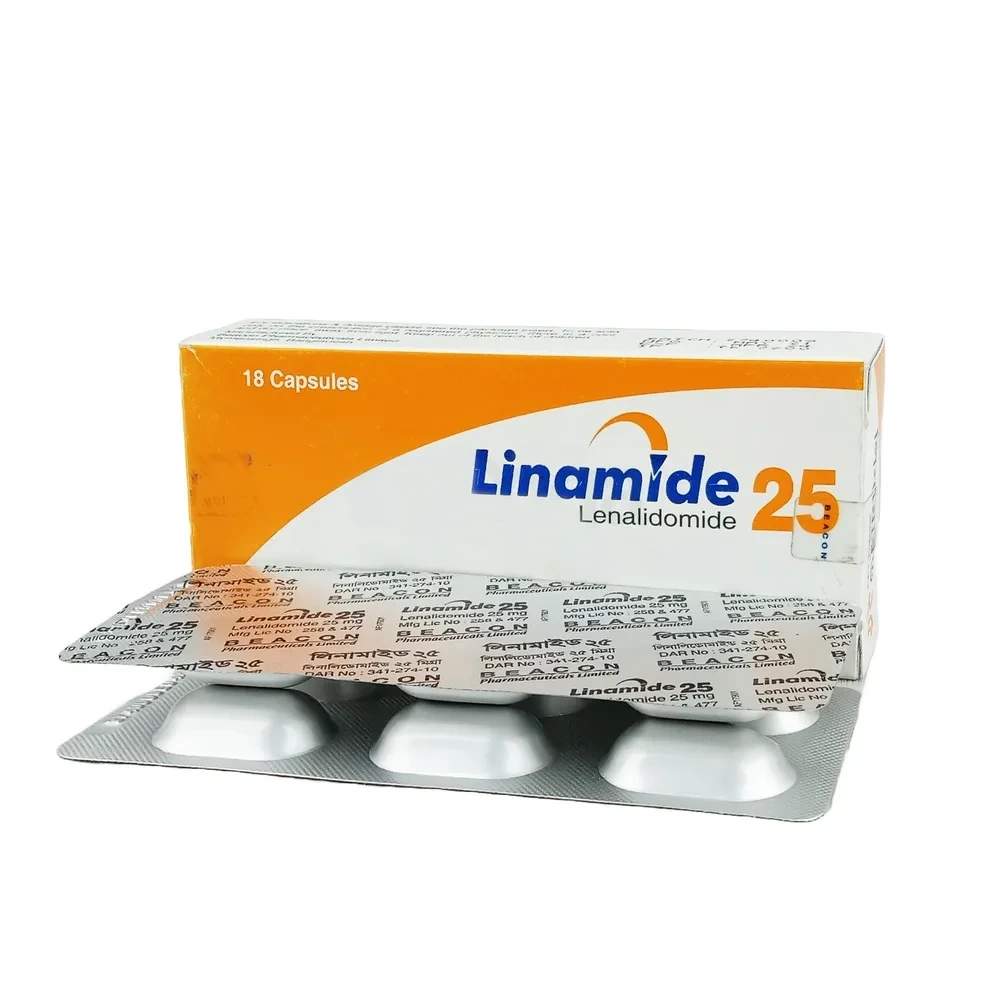
Linamide Capsule 25 mg (previously referred to as CC-5013) is an immunomodulatory drug with potent antineoplastic, anti-angiogenic, and anti-inflammatory properties. It is a 4-amino-glutamyl analogue of thalidomide and like thalidomide, lenalidomide exists as a racemic mixture of the active S(-) and R(+) forms. However, lenalidomide is much safer and potent than thalidomide, with fewer adverse effects and toxicities. Thalidomide and its analogues, including lenalidomide, are referred to as immunomodulatory imide drugs (also known as cereblon modulators), which are a class of immunomodulatory drugs that contain an imide group. Linamide Capsule 25 mg works through various mechanisms of actions that promote malignant cell death and enhance host immunity. Available as oral capsules, lenalidomide is approved by the FDA and EU for the treatment of multiple myeloma, myelodysplastic syndromes, mantle cell lymphoma, follicular lymphoma, and marginal zone lymphoma in selected patients. Linamide Capsule 25 mg is available only under a special restricted distribution program.
Uses
Linamide Capsule 25 mg is a thalidomide derivative used to treat multiple myeloma and anemia in low to intermediate risk myelodysplastic syndrome.
Linamide Capsule 25 mg is indicated for the treatment of adult patients with multiple myeloma (MM) in combination with dexamethasone. It is also indicated as maintenance therapy in multiple myeloma following autologous hematopoietic stem cell transplantation (auto-HSCT).
It is indicated for the treatment of adult patients with transfusion-dependent anemia due to low- or intermediate-1-risk myelodysplastic syndromes (MDS) associated with a deletion 5q cytogenetic abnormality with or without additional cytogenetic abnormalities.
Linamide Capsule 25 mg is indicated for the treatment of adult patients with mantle cell lymphoma (MCL) whose disease has relapsed or progressed after two prior therapies, one of which included bortezomib.
In combination with a rituximab product, lenalidomide is indicated for the treatment of adult patients with previously treated follicular lymphoma (FL) or previously treated marginal zone lymphoma (MZL).
Associated Conditions
Pharmacodynamics
In hematological malignancies, the immune system is deregulated in the form of altered cytokine networks in the tumour microenvironment, defective T cell regulation of host-tumour immune interactions, and diminished NK cell activity. Linamide Capsule 25 mg is an immunomodulatory agent with antineoplastic, antiangiogenic, and anti-inflammatory properties. Linamide Capsule 25 mg exerts direct cytotoxicity by increasing apoptosis and inhibiting the proliferation of hematopoietic malignant cells. It delays tumour growth in nonclinical hematopoietic tumour models in vivo, including multiple myeloma. Linamide Capsule 25 mg also works to limit the invasion or metastasis of tumour cells and inhibits angiogenesis.
Linamide Capsule 25 mg also mediates indirect antitumour effects via its immunomodulatory actions: it inhibits the production of pro-inflammatory cytokines, which are implicated in various hematologic malignancies. Linamide Capsule 25 mg enhances the host immunity by stimulating T cell proliferation and enhancing the activity of natural killer (NK) cells. Linamide Capsule 25 mg is about 100–1000 times more potent in stimulating T cell proliferation than thalidomide. In vitro, it enhances antibody-dependent cell-mediated cytotoxicity (ADCC), which is even more pronounced when used in combination with rituximab. Due to its anti-inflammatory properties, lenalidomide has been investigated in the context of inflammatory and autoimmune diseases, such as amyotrophic lateral sclerosis.
Mechanism of Action
Linamide Capsule 25 mg is a drug with multiple mechanisms of action. Linamide Capsule 25 mg exerts immunomodulating effects by altering cytokine production, regulating T cell co-stimulation, and enhancing the NK cell-mediated cytotoxicity. Linamide Capsule 25 mg directly inhibits the cullin ring E3 ubiquitin ligase complex: upon binding to cereblon, a substrate adaptor of the complex, lenalidomide modulates substrate specificity of the complex to recruit substrate proteins of the ligase, including Ikaros (IKZF1), Aiolos (IKZF3), and CK1α. These substrates are then tagged for ubiquitination and subsequent proteasomal degradation. IKZF1 and IKZF3 are B-cell transcription factors that are essential for B-cell differentiation and survival of malignant cells. IKZF3 also regulates the expression of interferon regulatory factor 4 (IRF4), which is a transcription factor that regulates the aberrant myeloma-specific gene. The immunomodulatory actions of lenalidomide can be partly explained by the degradation of IKZF3, since it is a repressor of the interleukin 2 gene (IL2): as lenalidomide decreases the level of IKZF3, the production of IL-2 increases, thereby increasing the proliferation of natural killer (NK), NKT cells, and CD4+ T cells. Linamide Capsule 25 mg inhibits the production of pro-inflammatory cytokines TNF-α, IL-1, IL-6, and IL-12, while elevating the production of anti-inflammatory cytokine IL-10. Linamide Capsule 25 mg acts as a T-cell co-stimulatory molecule that promotes CD3 T-cell proliferation and increases the production of IL-2 and IFN-γ in T lymphocytes, which enhances NK cell cytotoxicity and ADCC. It inhibits the expression and function of T-regulatory cells, which are often overabundant in some hematological malignancies.
Linamide Capsule 25 mg directly exerts antitumour effects by inhibiting the proliferation and inducing apoptosis of tumour cells. Linamide Capsule 25 mg triggers the activation of pro-apoptotic caspase-8, enhances tumour cell sensitivity to FAS-induced apoptosis, and downregulates NF-κB, an anti-apoptotic protein. Independent of its immunomodulatory effects, lenalidomide mediates anti-angiogenic effects by inhibiting angiogenic growth factors released by tumour cells, such as vascular endothelial growth factor (VEGF), basic fibroblastic-growth factor (BFGF), and hepatocyte-growth factor. In vitro, lenalidomide inhibits cell adhesion molecules such as ICAM-1, LFA-1, β2 and β3 integrins, as well as gap-junction function, thereby preventing metastasis of malignant cells.
Absorption
Following oral administration, lenalidomide is rapidly absorbed with high bioavailability. It has a Tmax ranging from 0.5 to six hours. Linamide Capsule 25 mg exhibits a linear pharmacokinetic profile, with its AUC and Cmax increasing proportionally with dose. Multiple dosing does not result in drug accumulation. In healthy male subjects, the Cmax was 413 ± 77 ng/ml and the AUCinfinity was 1319 ± 162 h x ng/ml.
Volume of Distribution
In healthy male subjects, the apparent volume of distribution was 75.8 ± 7.3 L.
Protein Binding
In vitro, about 30% of lenalidomide was bound to plasma proteins.
Route of Elimination
Linamide Capsule 25 mg is eliminated predominantly via urinary excretion in the unchanged form. Following oral administration of 25 mg of radiolabeled lenalidomide in healthy subjects, about 90% of the dose (4.59% as metabolites) was eliminated in urine and 4% of the dose (1.83% as metabolites) was eliminated in feces within ten days post-dose. Approximately 85% of the dose was excreted as lenalidomide in the urine within 24 hours.
Half Life
In healthy subjects, the mean half-life of lenalidomide is three hours in the clinically relevant dose range (5–50 mg). Half-life can range from three to five hours in patients with multiple myeloma, myelodysplastic syndromes, or mantle cell lymphoma.
Clearance
The renal clearance of lenalidomide exceeds the glomerular filtration rate. In healthy male subjects, the oral clearance was 318 ± 41 mL/min.
Toxicity
The lowest lethal dose (LDLo) in rats is >2000 mg/kg following oral administration and >40 mg/kg following intravenous administration. The oral Lowest published toxic dose (TDLo) in humans is 9 mg/kg/4W (intermittent).
There is limited clinical experience in managing lenalidomide overdose. In single-dose studies, healthy subjects have been exposed to doses up to 400 mg. In clinical trials, the dose-limiting toxicity was neutropenia and thrombocytopenia. Toxicities associated with lenalidomide, some leading to fatality, include embryo-fetal toxicity, neutropenia, thrombocytopenia, venous (deep vein thrombosis and pulmonary embolism) and arterial thromboembolic events (myocardial infarction and stroke), serious adverse cardiovascular reactions, second primary malignancies, hepatotoxicity, severe cutaneous reactions, tumour lysis syndrome, tumour flare reaction, hypothyroidism, and hyperthyroidism.
Food Interactions
- Take at the same time every day. Skip the missed dose if it has been more than 12 hours since your regular time.
- Take with or without food. High-fat meals decrease absorption, but not to a clinically significant extent.
Dosage
Linamide Capsule 25 mg Maintenance Therapy Following Auto-HSCT: Following auto-HSCT, initiate Linamide Capsule 25 mg maintenance therapy after adequate hematologic recovery (ANC at least 1000/mcL and/or platelet counts at least 75,000/mcL). The recommended starting dose of Linamide Capsule 25 mg is 10 mg once daily continuously (Days 1-28 of repeated 28-day cycles) until disease progression or unacceptable toxicity. After 3 cycles of maintenance therapy, the dose can be increased to 15 mg once daily if tolerated.
Recommended Dosage for Myelodysplastic Syndromes: The recommended starting dose of Linamide Capsule 25 mg is 10 mg daily. Treatment is continued or modified based upon clinical and laboratory findings. Continue treatment until disease progression or unacceptable toxicity.
Recommended Dosage for Mantle Cell Lymphoma: The recommended starting dose of Linamide Capsule 25 mg is 25 mg/day orally on Days 1-21 of repeated 28-day cycles for relapsed or refractory mantle cell lymphoma. Treatment should be continued until disease progression or unacceptable toxicity. Treatment is continued, modified or discontinued based upon clinical and laboratory findings.
Recommended Dosage for Follicular Lymphoma or Marginal Zone Lymphoma: The recommended starting dose of Linamide Capsule 25 mg is 20 mg orally once daily on Days 1-21 of repeated 28-day cycles for up to 12 cycles of treatment in combination with a Rituximab-product.