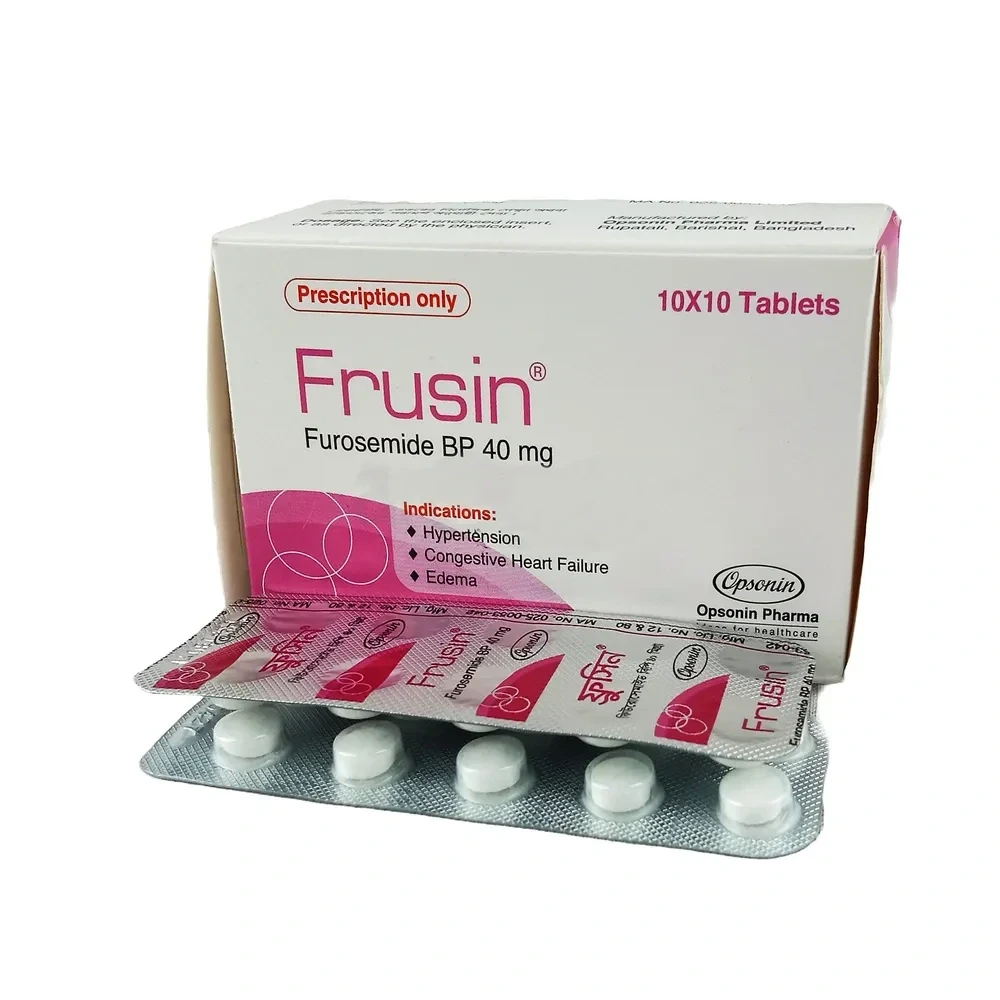
Introduction
Lasix Tablet 40 mg is a loop diuretic (water pill) that prevents the body from absorbing too much salt. It is used to treat high blood pressure, edema, congestive heart failure, and other conditions in which fluid retention may occur.
Uses For
Lasix Tablet 40 mg is primarily used to treat hypertension (high blood pressure) and edema caused by various medical conditions, including heart failure, liver disease, and kidney disease. It is sometimes used to treat lower urinary tract symptoms associated with benign prostatic hyperplasia (BPH). It may also be used to prevent calcium deposits in the kidney.
| Brand Name | Lasix |
|---|---|
| Type | Tablet |
| Weight | 40 mg |
| Generic | Furosemide |
| Manufacturer | Sanofi Bangladesh Ltd. |
| Available in | English বাংলা |
Mechanism of Action
Lasix Tablet 40 mg works by preventing the kidneys from reabsorbing salt and water from the urine, which allows the body to eliminate excess fluid and salt. It also increases renal blood flow, which helps improve kidney function.
How Long Does It Take to Work
Lasix Tablet 40 mg typically starts to work within an hour and its effects can last up to 8 hours.
Absorption
Lasix Tablet 40 mg is absorbed quickly from the gastrointestinal tract, with peak concentrations achieved within one hour of oral administration.
Route of Elimination
Lasix Tablet 40 mg is eliminated primarily through the kidneys, with a small amount being eliminated through the liver.
Dosage
Furosemide 40 mg Tablet-Edema:
- Adults: The initial adult dose is 40 mg daily, reduced to 20 mg daily or 40mg on alternate days. In some patients daily doses of 80mg or higher (given in divided doses) may be required. The individually determined single dose should then be given once or twice daily (eg, at 8 am and 2 pm). For resistant edema, 80-120 mg daily. In patients with clinically severe edematous states the dose of furosemide may be carefully titrated up to 600 mg/day. When doses exceeding 80 mg/day are given for prolonged periods, careful clinical observation and laboratory monitoring are particularly advisable.
- Children: Neonate: 0.5-2 mg/kg every 12-24 hours (every 24 hours if postmenstrual age under 31 weeks).
- Child 1 month-12 years: 0.5-2 mg/kg 2-3 times daily (every 24 hours if postmenstrual age less than 31 weeks); higher doses may be required in resistant edema; max. 12 mg/kg daily, not to exceed 80 mg daily.
- Child 12-18 years:20-40 mg daily, increased in resistant edema to 80-120 mg daily.
- Elderly: In the elderly furosemide is generally eliminated more slowly. Dosage should be titrated until the required response is achieved.
- Adults: The usual initial dose of furosemide for hypertension is 80 mg, usually divided into 40 mg twice a day. Dosage should then be adjusted according to response. If response is not satisfactory, add other antihypertensive agents.
- Children: The usual dose is 1 - 3 mg/kg body weight daily up to a maximum dose of 40mg/day.
- Elderly: In the elderly furosemide is generally eliminated more slowly. Dosage should be titrated until the required response is achieved.
Furosemide Syrup: Furosemide Liquid has an exceptionally wide therapeutic range, the effect being proportional to the dosage. Furosemide Liquid is best given as a single dose either daily or on alternate days. The usual initial daily dose is 40 mg. This may require adjustment until the effective dose is achieved as a maintenance dose. In mild cases, 20 mg daily or 40 mg on alternate days may be sufficient, whereas in cases of resistant edema, daily doses of 80 mg and above may be used as one or two daily, or intermittently. Severe cases may require gradual titration of the furosemide dosage up to 600 mg daily. The recommended maximum daily dose of furosemide administration is 1,500 mg.
Furosemide Injection-
Edema:
Adults: Doses of 20-50 mg intramuscularly or intravenously may be given initially. If larger doses are required, they should be given increasing by 20 mg increments and not given more often than every two hours. If doses greater than 50 mg are required it is recommended that they should be given by slow intravenous infusion. The recommended maximum daily dose of furosemide administration is 1,500 mg.
By slow intravenous injection:
- Neonate: 0.5-1 mg/kg every 12-24 hours (every 24 hours if postmenstrual age under 31 weeks).
- Child 1 month-12 years: 0.5-1 mg/kg repeated every 8 hours as necessary;maximum 2 mg/kg (max. 40 mg) every 8 hours.
- Child 12-18 years: 20-40 mg repeated every 8 hours as necessary; higher doses may be required in resistant cases.
- Child 1 month-18 years: 0.1-2 mg/kg/hour (following cardiac surgery, initially 100 micrograms/kg/hour, doubled every 2 hours until urine output exceeds 1 mL/kg/hour).
- Elderly: In the elderly furosemide is generally eliminated more slowly. Dosage should be titrated until the required response is achieved.
- Adults: Doses of 20 to 50 mg intramuscularly or intravenously may be given initially. If larger doses are required, they should be given increasing by 20 mg increments and not given more often than every two hours. If doses greater than 50 mg are required it is recommended that they should be given by slow intravenous infusion. The recommended maximum daily dose of furosemide administration is 1,500 mg. Children: Parenteral doses for children range from 0.5-1.5 mg/kg body weight daily up to a maximum total daily dose of 20 mg.
- Elderly: In the elderly furosemide is generally eliminated more slowly. Dosage should be titrated until the required response is achieved.
The dosage of furosemide varies depending on the individual and the condition being treated. The usual starting dose for adults is 20-40 mg once daily. Dosage can be increased up to 600 mg/day if needed. The dosage should be adjusted gradually based on blood pressure response. For pediatric patients, the dosage should be adjusted according to age, weight, and renal function.
Administration
Lasix Tablet 40 mg is typically taken orally, usually once or twice daily. It may also be given by intravenous injection or infusion.
Side Effects
Common side effects of furosemide include dizziness, drowsiness, thirst, diarrhea, constipation, nausea and vomiting, and headache. Rarely, it may cause hypotension (low blood pressure), dehydration, electrolyte imbalances, or an allergic reaction.
Toxicity
Lasix Tablet 40 mg is generally well tolerated, but large doses may cause toxicity, including dehydration, electrolyte imbalances, kidney damage, low blood pressure, and allergic reactions.
Precautions
Patients taking furosemide should be monitored for signs of dehydration, electrolyte imbalances, and low blood pressure. Patients with kidney or liver disease should take lower doses of furosemide and should be monitored for side effects.
Interaction
Lasix Tablet 40 mg may interact with other medications. It may increase potassium levels and decrease the effectiveness of other diuretics. It may also increase the effects of other medications, including anticoagulants, antihypertensives, and medications for diabetes.
Disease Interaction
Lasix Tablet 40 mg may interact with certain diseases or medical conditions, such as diabetes, gout, kidney disease, and lupus. It is important to discuss any pre-existing health conditions with a doctor before taking furosemide.
Drug Interaction
Lasix Tablet 40 mg may interact with other medications, such as anticoagulants, antihypertensives, and medications for diabetes. It is important to talk to a doctor about any medications being taken or any other existing medical conditions before taking furosemide.
Food Interactions
Lasix Tablet 40 mg may interact with certain foods, such as high-potassium foods like bananas, oranges, and spinach. It is important to discuss any dietary restrictions with a doctor before taking furosemide.
Pregnancy Use
Lasix Tablet 40 mg is not recommended for use in pregnant women due to the risk of fetal harm. If a woman becomes pregnant while taking furosemide, she should contact her doctor immediately.
Lactation Use
Lasix Tablet 40 mg is not recommended for use in breastfeeding women due to the risk of adverse effects on the newborn. If a woman is breastfeeding while taking furosemide, she should discuss potential risks with her doctor.
Acute Overdose
An overdose of furosemide can be dangerous and may require immediate medical attention. Signs of an overdose include confusion, drowsiness, nausea and vomiting, and rapid heart rate.
Contraindication
Lasix Tablet 40 mg should not be used in people with an allergy to sulfa drugs, as well as in people with severe kidney or liver impairment, or in pregnant or breastfeeding women.
Use Direction
Lasix Tablet 40 mg should be taken exactly as prescribed by a doctor. For best results, it should be taken as directed, with or without food, ideally at the same time each day.
Storage Condition
Lasix Tablet 40 mg should be stored at room temperature, away from light and moisture.
Volume of Distribution
The volume of distribution of furosemide is 25-35 L/kg.
Half Life
The half-life of furosemide varies according to the patient and the condition being treated. Generally, it has a half-life of approximately two hours.
Clearance
Lasix Tablet 40 mg has an elimination clearance of approximately 12-16 mL/min/kg.
See in details version Lasix Tablet 40 mg also Lasix Tablet 40 mg in bangla
Social card