Introduction
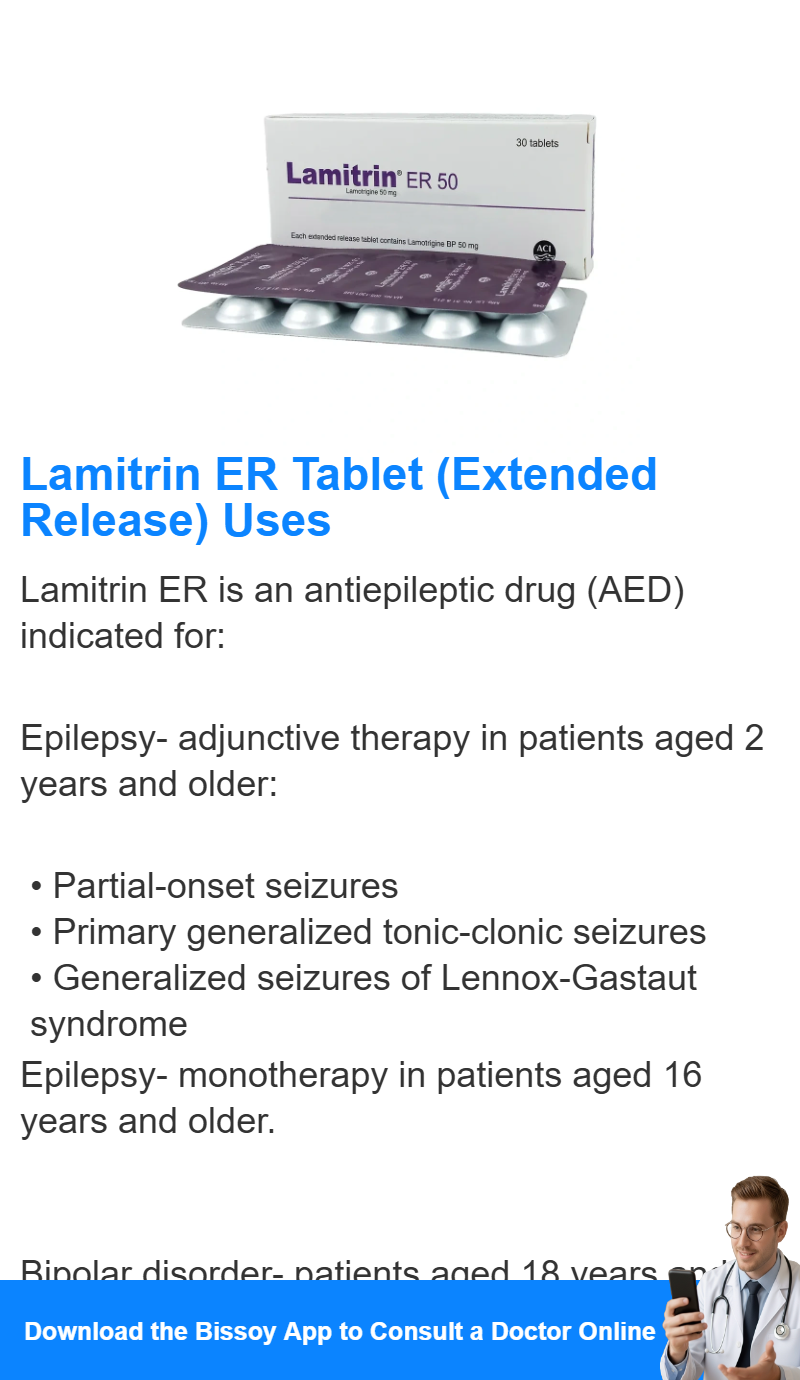
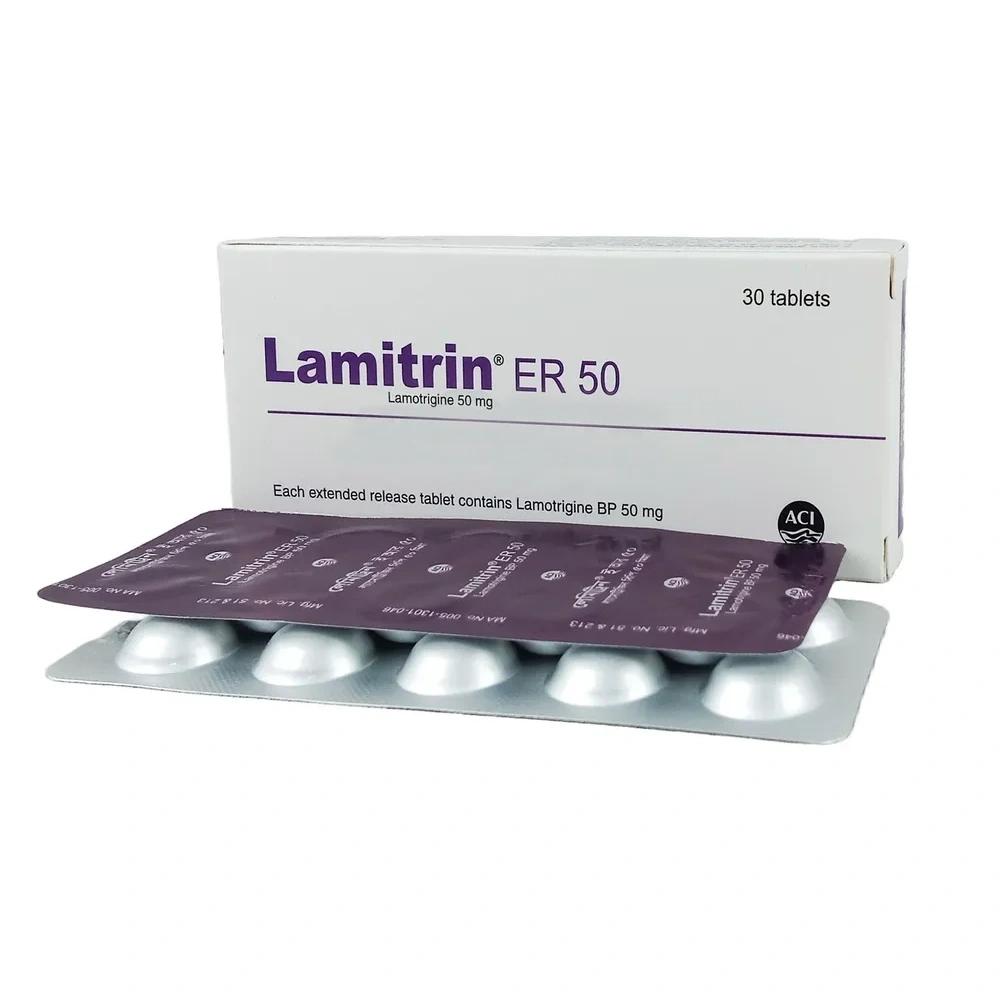
Lamitrin ER Tablet (Extended Release) 50 mg is an antiepileptic drug belonging in the phenyltriazine class. It is used in the treatment of both epilepsy and as a mood stabilizer in bipolar disorder.
Lamitrin ER Tablet (Extended Release) 50 mg has relatively few side-effects and does not require laboratory monitoring. While it is indicated for epilepsy and bipolar disorders, there is evidence that lamotrigine could have some clinical efficacy in certain neuropathic pain states.
Uses
Lamitrin ER Tablet (Extended Release) 50 mg is a phenyltriazine antiepileptic used to treat some types of epilepsy and bipolar I disorder.
Lamitrin ER Tablet (Extended Release) 50 mg is indicated as adjunctive therapy for the following seizure types in patients ≥2 years of age: partial seizures, primary generalized tonic-clonic seizures, and generalized seizures due to Lennox-Gastaut syndrome.
It is also indicated for the process of conversion to drug monotherapy for those at least 16 years of age or older with partial seizures and currently are receiving treatment with carbamazepine, phenytoin, phenobarbital, primidone, or valproate as the single antiepileptic drug (AED).
In addition to the above, lamotrigine is also indicated for the maintenance treatment of bipolar I disorder, delaying the time to mood episodes (which may include mania, hypomania, depression, mixed episodes) in adults at least 18 years or older, who have been treated for acute mood symptoms with standard therapy.
Limitations of use
It is important to note that lamotirigine should not be used in the treatment of acute mood episodes, as efficacy has not been established in this context.
Associated Conditions
Pharmacodynamics
Lamitrin ER Tablet (Extended Release) 50 mg likely prevents seizures and prevents mood symptoms via stabilizing presynaptic neuronal membranes and preventing the release of excitatory neurotransmitters such as glutamate, which contribute to seizure activity.
A note on cardiovascular effects
The metabolite of lamotrigine, 2-N-methyl metabolite (formed by glucuronidation), is reported to cause dose-dependent prolongations of the PR interval, widening of the QRS complex, and at higher doses, complete AV block. Although this harmful metabolite is only found in trace amounts in humans, plasma concentrations may increase in conditions that cause decreased drug glucuronidation, such as liver disease.
Mechanism of Action
The exact mechanism of action of lamotrigine is not fully elucidated, as it may exert cellular activities that contribute to its efficacy in a range of conditions. Although chemically unrelated, lamotrigine actions resemble those of phenytoin and carbamazepine, inhibiting voltage-sensitive sodium channels, stabilizing neuronal membranes, thereby modulating the release of presynaptic excitatory neurotransmitters.
Lamitrin ER Tablet (Extended Release) 50 mg likely acts by inhibiting sodium currents by selective binding to the inactive sodium channel, suppressing the release of the excitatory amino acid, glutamate. The mechanism of action of lamotrigine in reducing anticonvulsant activity is likely the same in managing bipolar disorder. Studies on lamotrigine have identified its binding to sodium channels in a fashion similar to local anesthetics, which could explain the demonstrated clinical benefit of lamotrigine in some neuropathic pain states.
Lamitrin ER Tablet (Extended Release) 50 mg displays binding properties to several different receptors. In laboratory binding assays, it demonstrates weak inhibitory effect on the serotonin 5-HT3 receptor. Lamitrin ER Tablet (Extended Release) 50 mg also weakly binds to Adenosine A1/A2 receptors, α1/α2/β adrenergic receptors, dopamine D1/D2 receptors, GABA A/B receptors, histamine H1 receptors, κ-opioid receptor (KOR), mACh receptors and serotonin 5-HT2 receptors with an IC50>100 µM. Weak inhibitory effects were observed at sigma opioid receptors. An in vivo study revealed evidence that lamotrigine inhibits Cav2.3 (R-type) calcium currents, which may also contribute to its anticonvulsant effects.
Absorption
Lamitrin ER Tablet (Extended Release) 50 mg is rapidly and entirely absorbed with minimal first-pass metabolism effects, with a bioavailability estimated at 98%. Cmax is reached in the range of 1.4 to 4.8 hours post-dose, but this depends on the dose administered, concomitant medications, and epileptic status. The rate and extent of lamictal absorption is considered equivalent between the compressed tablet form taken with water to that of the chewable dispersible tablets, taken with or without water.
Volume of Distribution
The mean apparent volume of distribution (Vd/F) of lamotrigine following oral administration ranges from 0.9 to 1.3 L/kg and is independent of dose administered. Lamitrin ER Tablet (Extended Release) 50 mg accumulated in the kidney of the male rat, and likely behaves in a similar fashion in humans. Lamitrin ER Tablet (Extended Release) 50 mg also binds to tissues containing melanin, such as the eyes and pigmented skin.
Protein Binding
The plasma protein binding of lamotrigine is estimated at 55%. This drug is not expected to undergo clinically significant interactions with other drugs via competition for protein binding sites due its lower protein binding.
Route of Elimination
Lamitrin ER Tablet (Extended Release) 50 mg is excreted in both the urine and feces. Following oral administration of 240 mg radiolabelled lamotrigine, about 94% of total drug and its metabolites administered is recovered in the urine and 2% is recovered in the feces. One pharmacokinetic study recovered 43 to 87% of a lamotrigine dose in the urine mainly as glucuronidated metabolites. 2-N-glucuronide is mainly excreted in the urine.
Half Life
The average elimination half-life of lamotrigine ranges from approximately 14-59 hours. The value is dependent on the dose administered, concomitant drug therapy, as well as disease status. One pharmacokinetic study revealed a half-life of 22.8 to 37.4 hours in healthy volunteers. It also reported that enzyme-inducing antiepileptic drugs such as pheobarbital, phenytoin, or carbamazepine decrease the half-life of lamotrigine. On the other hand, valproic acid increases the half-life of lamotrigine (in the range of 48-59 hours).
Clearance
The mean apparent plasma clearance (Cl/F) ranges from 0.18 to 1.21 mL/min/kg. The values vary depending on dosing regimen, concomitant antiepileptic medications, and disease state of the individual. In one study, healthy volunteers on lamictal monotherapy showed a clearance of about 0.44 mL/min/kg after a single dose.
Toxicity
The oral LD50 in mouse and rat is 205 mg/kg and 245 mg/kg, respectively.
Fatal cases of overdose of up to 15g of lamotrigine have been reported. Overdose with lamotrigine has been manifested by ataxia, nystagmus, increased seizures, decreased level of consciousness, coma, and intraventricular conduction delay. Though no known antidote exists for lamotrigine, hospitalization and general supportive measures should be employed in the case of a suspected lamotrigine overdose. Gastric lavage and emesis may be warranted with simultaneous protection of the airway. It is uncertain at this time whether hemodialysis is an effective means of removing lamotrigine from the sytemic circulation.
Food Interactions
- Take with or without food. The absorption is unaffected by food.
Dosage
Epilepsy-
Table-1: Escalation Regimen for Lamitrin ER Tablet (Extended Release) 50 mg in Patients Older than 12 Years with Epilepsy
- In patients not taking Carbamazepine, Phenytoin, Phenobarbital, Primidone or Valproate: 25 mg every day
- In patients taking Valproate: 25 mg every other day
- In patients taking Carbamazepine, Phenytoin, Phenobarbital or Primidone and not taking Valproate: 50 mg/day
- In patients not taking Carbamazepine, Phenytoin, Phenobarbital, Primidone or Valproate: 50 mg/day
- In patients taking Valproate: 25 mg every day
- In patients taking Carbamazepine, Phenytoin, Phenobarbital or Primidone and not taking Valproate: 100 mg/day (in 2 divided doses)
- In patients not taking Carbamazepine, Phenytoin, Phenobarbital, Primidone or Valproate: Increase by 50 mg/day every 1 to 2 weeks
- In patients taking Valproate: Increase by 25 to 50 mg/day every 1 to 2 weeks
- In patients taking Carbamazepine, Phenytoin, Phenobarbital or Primidone and not taking Valproate: Increase by 100 mg/day every 1 to 2 weeks
- In patients not taking Carbamazepine, Phenytoin, Phenobarbital, Primidone or Valproate: 225 to 375 mg/day (in 2 divided doses)
- In patients taking Valproate: 100 to 200 mg/day with Valproate alone 100 to 400 mg/day with Valproate and other drugs that induce glucuronidation (in 1 or 2 divided doses)
- In patients taking Carbamazepine, Phenytoin, Phenobarbital or Primidone and not taking Valproate: 300 to 500 mg/day (in 2 divided doses)
Weeks 1 & 2:
- In patients not taking Carbamazepine, Phenytoin, Phenobarbital, Primidone or Valproate: 0.3 mg/kg/day in 1 or 2 divided doses
- In patients taking Valproate: 0.15 mg/kg/day in 1 or 2 divided doses
- In patients taking Carbamazepine, Phenytoin, Phenobarbital or Primidone and not taking Valproate: 0.6 mg/kg/day (in 2 divided doses)
In patients not taking Carbamazepine, Phenytoin, Phenobarbital, Primidone or Valproate: 0.6 mg/kg/day (in 2 divided doses)
- In patients taking Valproate: 0.3 mg/kg/day in 1 or 2 divided doses
- In patients taking Carbamazepine, Phenytoin, Phenobarbital or Primidone and not taking Valproate: 1.2 mg/kg/day (in 2 divided doses)
- In patients not taking Carbamazepine, Phenytoin, Phenobarbital, Primidone or Valproate: The dose should be increased every 1 to 2 weeks as follows-calculate 0.6 mg/kg/day
- In patients taking Valproate: The dose should be increased every 1 to 2 weeks as follows-calculate 0.3 mg/kg/day
- In patients taking Carbamazepine, Phenytoin, Phenobarbital or Primidone and not taking Valproate: The dose should be increased every 1 to 2 weeks as follows-calculate 1.2 mg/kg/day
- In patients not taking Carbamazepine, Phenytoin, Phenobarbital, Primidone or Valproate: 4.5 to 7.5 mg/kg/day (maximum 300 mg/day in 2 divided doses)
- In patients taking Valproate: 1 to 3 mg/kg/day with Valproate alone 1 to 5 mg/kg/day (maximum 200 mg/day in 1 or 2 divided doses)
- In patients taking Carbamazepine, Phenytoin, Phenobarbital or Primidone and not taking Valproate: 5 to 15 mg/kg/day (maximum 400 mg/day in 2 divided doses)
Weeks 1 & 2:
- If the patients weight is 6.7 kg to 14 kg: 2 mg every other day
- If the patients weight is 14.1 kg to 27 kg: 2 mg every day
- If the patients weight is 27.1 kg to 34 kg: 4 mg every day
- If the patients weight is 34.1 kg to 40 kg: 5 mg every day
- If the patients weight is 6.7 kg to 14 kg: 2 mg every day
- If the patients weight is 14.1 kg to 27 kg: 4 mg every day
- If the patients weight is 27.1 kg to 34 kg: 8 mg every day
- If the patients weight is 34.1 kg to 40 kg: 10 mg every day
Table-4: Escalation Regimen for Lamitrin ER Tablet (Extended Release) 50 mg in Adults with Bipolar Disorder
Weeks 1 & 2:
- In patients not taking Carbamazepine, Phenytoin, Phenobarbital, Primidone or Valproate: 25 mg daily
- In patients taking Valproate: 25 mg every other day
- In patients taking Carbamazepine, Phenytoin, Phenobarbital or Primidone and not taking Valproate: 50 mg daily
- In patients not taking Carbamazepine, Phenytoin, Phenobarbital, Primidone or Valproate: 50 mg daily
- In patients taking Valproate: 25 mg daily
- In patients taking Carbamazepine, Phenytoin, Phenobarbital or Primidone and not taking Valproate: 100 mg daily (in divided doses)
- In patients not taking Carbamazepine, Phenytoin, Phenobarbital, Primidone or Valproate: 100 mg daily
- In patients taking Valproate: 50 mg daily
- In patients taking Carbamazepine, Phenytoin, Phenobarbital or Primidone and not taking Valproate: 200 mg daily (in divided doses)
- In patients not taking Carbamazepine, Phenytoin, Phenobarbital, Primidone or Valproate: 200 mg daily
- In patients taking Valproate: 100 mg daily
- In patients taking Carbamazepine, Phenytoin, Phenobarbital or Primidone and not taking Valproate: 300 mg daily (in divided doses)
- In patients not taking Carbamazepine, Phenytoin, Phenobarbital, Primidone or Valproate: 200 mg daily
- In patients taking Valproate: 100 mg daily
- In patients taking Carbamazepine, Phenytoin, Phenobarbital or Primidone and not taking Valproate: up to 400 mg daily (in divided doses)