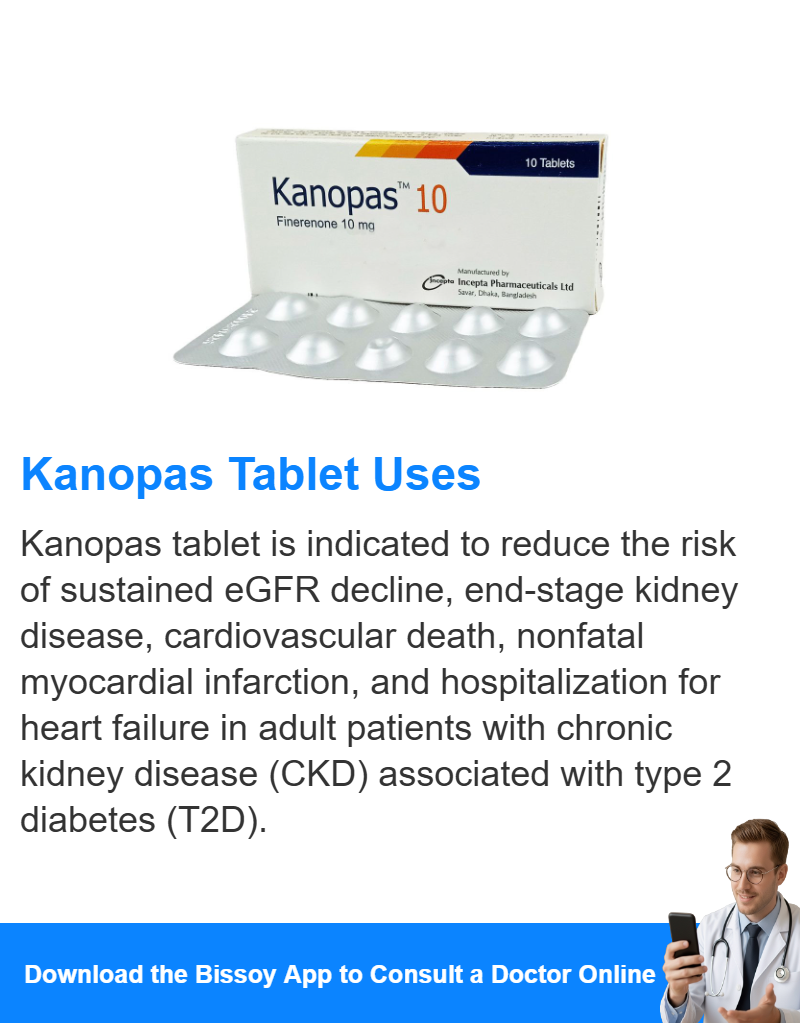
Introduction
Kanopas Tablet 10 mg is a novel non-steroidal mineralocorticoid receptor antagonist (MRA) used in the treatment of chronic kidney disease (CKD) and diabetic nephropathy. It is designed to selectively target and block the mineralocorticoid receptor to reduce inflammation and fibrosis associated with kidney damage, thereby slowing disease progression.
Uses
Kanopas Tablet 10 mg is primarily used for:
- Chronic kidney disease (CKD) in patients with type 2 diabetes (T2D)
- Diabetic nephropathy to reduce the risk of kidney function decline and cardiovascular events
Mechanism of Action
Kanopas Tablet 10 mg works by selectively blocking mineralocorticoid receptors in the kidneys, heart, and blood vessels. This action reduces the effects of aldosterone, a hormone that contributes to inflammation, fibrosis, and fluid retention. By inhibiting these effects, Kanopas Tablet 10 mg helps to reduce kidney damage and improve renal and cardiovascular outcomes.
How Long Does It Take to Work?
Kanopas Tablet 10 mg typically begins to show clinical effects within a few weeks of starting treatment. However, significant improvements in kidney function and reduction in proteinuria may take several months to become fully apparent. Regular monitoring is necessary to assess the drug's effectiveness and adjust treatment as needed.
Absorption
Kanopas Tablet 10 mg is well-absorbed after oral administration. Peak plasma concentrations are usually reached within 1 to 2 hours. The drug is absorbed effectively and reaches therapeutic levels necessary for its intended effects on kidney and cardiovascular health.
Route of Elimination
Kanopas Tablet 10 mg is metabolized primarily in the liver. It is then excreted through the feces and urine, with the majority of the drug being eliminated in the feces. The drug undergoes extensive hepatic metabolism and is not significantly excreted unchanged in the urine.
Dosage
The recommended starting dosage: 10 mg or 20 mg orally once daily based on estimated glomerular filtration rate (eGFR) and serum potassium thresholds. Increase dosage after 4 weeks to the target dose of 20 mg once daily, based on eGFR and serum potassium thresholds. Tablets may be taken with or without food.Recommended Dosage-
- eGFR ≥60 mL/min/1.73 m2: starting dose 20 mg once daily
- eGFR ≥25 to <60 mL/min/1.73 m2: starting dose 10 mg once daily
- eGFR <25 mL/min/1.73 m2: not recommended
Monitoring and Dose Adjustment: The target daily dose of Kanopas Tablet 10 mg is 20 mg. Measure serum potassium 4 weeks after initiating treatment and adjust dose (see Table 2); if serum potassium levels are > 4.8 to 5.0 mEq/L, initiation of Kanopas Tablet 10 mg treatment may be considered with additional serum potassium monitoring within the first 4 weeks based on clinical judgment and serum potassium levels. Monitor serum potassium 4 weeks after a dose adjustment and throughout treatment and adjust the dose as needed.
Missed doses: Direct a patient to take a missed dose as soon as possible after it is noticed, but only on the same day. If this is not possible, the patient should skip the dose and continue with the next dose as prescribed.
The typical dosage of Kanopas Tablet 10 mg is:
- Initial Dose: 10 mg once daily.
- Maintenance Dose: The dose can be adjusted based on individual response and tolerability, with a usual range of 10 mg to 20 mg once daily.
Dosage adjustments may be necessary for patients with renal impairment or those taking other medications that interact with Kanopas Tablet 10 mg.
Administration
Kanopas Tablet 10 mg should be taken orally with or without food. It is usually administered once daily. The tablets should be swallowed whole, without crushing or chewing. Adherence to the prescribed dosing schedule is crucial for achieving optimal therapeutic outcomes.
Side Effects
Common side effects of Kanopas Tablet 10 mg include:
- Hyperkalemia (elevated potassium levels)
- Hypotension (low blood pressure)
- Renal impairment
- Headache
Serious side effects may include:
- Severe hyperkalemia
- Severe renal function deterioration
- Allergic reactions (e.g., rash, itching)
Monitoring for side effects is important, and any severe or persistent symptoms should be reported to a healthcare provider immediately.
Toxicity
Overdose of Kanopas Tablet 10 mg may lead to severe hyperkalemia and hypotension. Symptoms of toxicity may include severe weakness, irregular heartbeat, or fainting. Treatment involves discontinuation of the drug, supportive care, and management of electrolyte imbalances. Emergency medical attention may be required in severe cases.
Precautions
Precautions should be taken in patients with:
- Pre-existing renal impairment
- Severe hyperkalemia or risk factors for high potassium levels
- Concurrent use of other medications that affect potassium levels or renal function
Regular monitoring of renal function and potassium levels is essential during treatment.
Interaction
Drug Interactions
Kanopas Tablet 10 mg may interact with other medications, including:
- Potassium-sparing diuretics (e.g., spironolactone) which can increase the risk of hyperkalemia
- Other antihypertensives which may enhance the hypotensive effects
- Strong CYP3A4 inhibitors (e.g., ketoconazole) which may increase Kanopas Tablet 10 mg levels
- Strong CYP3A4 inducers (e.g., rifampin) which may decrease Kanopas Tablet 10 mg levels
Always inform healthcare providers of all medications being taken to avoid potential interactions.
Food Interactions
Food does not significantly affect the absorption of Kanopas Tablet 10 mg. However, maintaining a balanced diet is important to manage potential side effects such as hyperkalemia.
Disease Interaction
Patients with significant renal impairment or those with conditions that predispose them to hyperkalemia should use Kanopas Tablet 10 mg with caution. Regular monitoring and potential dose adjustments are necessary.
Pregnancy Use
Kanopas Tablet 10 mg is categorized as a Category C drug during pregnancy. The safety of Kanopas Tablet 10 mg in pregnant women has not been established. It should only be used during pregnancy if the potential benefits outweigh the risks, and under the guidance of a healthcare provider.
Lactation Use
The excretion of Kanopas Tablet 10 mg in breast milk is unknown. Caution should be exercised when administering this drug to nursing mothers. Consideration should be given to alternative treatments or discontinuation of breastfeeding if Kanopas Tablet 10 mg use is deemed necessary.
Acute Overdose
In the case of acute overdose, symptoms may include severe hyperkalemia and hypotension. Immediate medical intervention is required to manage symptoms and address electrolyte imbalances. Treatment may include discontinuation of the drug and supportive measures.
Contraindication
Kanopas Tablet 10 mg is contraindicated in individuals with:
- Severe hyperkalemia
- Severe renal impairment
- Hypersensitivity to Kanopas Tablet 10 mg or any of its components
Use Direction
Kanopas Tablet 10 mg should be used as directed by a healthcare provider. Follow the prescribed dosage and frequency. Regular monitoring of kidney function and potassium levels is essential during treatment. Do not discontinue the medication or adjust the dose without consulting a healthcare provider.
Storage Conditions
Store Kanopas Tablet 10 mg at room temperature (15°C to 30°C), away from light and moisture. Keep the medication in its original container and out of reach of children.
Volume of Distribution
The volume of distribution of Kanopas Tablet 10 mg is approximately 50 liters, indicating moderate distribution into body tissues.
Half-Life
The plasma half-life of Kanopas Tablet 10 mg is approximately 2 to 3 hours, which supports its once-daily dosing regimen.
Clearance
Kanopas Tablet 10 mg is primarily cleared through hepatic metabolism, with the majority of the drug excreted in the feces. Renal clearance is minimal, but careful monitoring is required in patients with renal impairment.