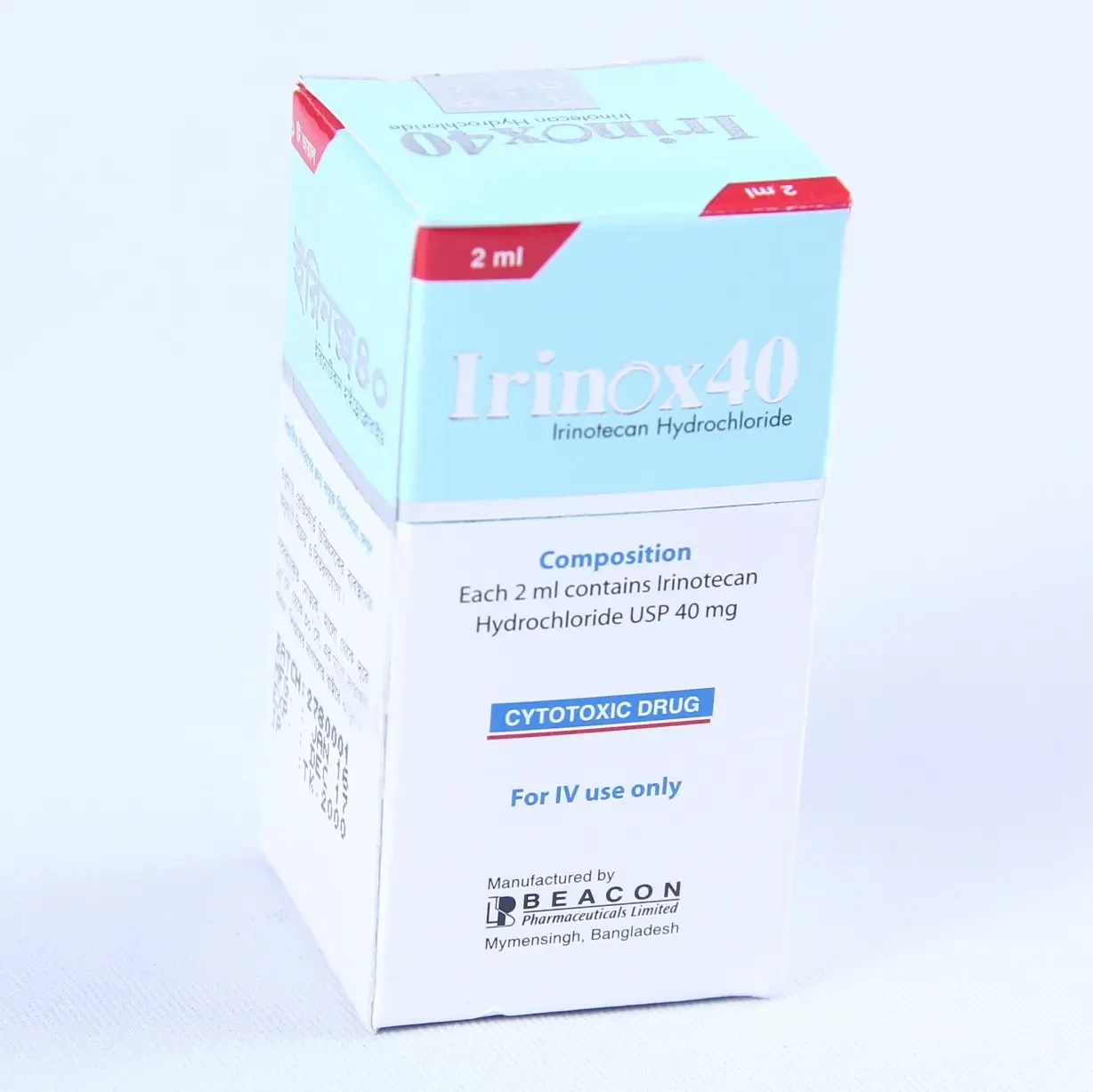
Introduction
Irinotecan is an antineoplastic enzyme inhibitor primarily used in the treatment of colorectal cancer. It is a derivative of camptothecin that inhibits the action of topoisomerase I. Irinotecan prevents religation of the DNA strand by binding to topoisomerase I-DNA complex, and causes double-strand DNA breakage and cell death. It is a derivative of camptothecin. Irinotecan was approved for the treatment of advanced pancreatic cancer in October, 2015 (irinotecan liposome injection, trade name Onivyde).
Uses
Irinotecan is an antineoplastic enzyme inhibitor used to treat metastatic carcinoma of the colon or rectum.
For the treatment of metastatic colorectal cancer (first-line therapy when administered with 5-fluorouracil and leucovorin). Also used in combination with cisplatin for the treatment of extensive small cell lung cancer. Irinotecan is currently under investigation for the treatment of metastatic or recurrent cervical cancer. Also used in combination with fluorouracil and leucovorin for the treatment of patients with metastatic adenocarcinoma of the pancreas after disease progression following gemcitabine-based therapy.
Associated Conditions
Pharmacodynamics
Irinotecan is an antineoplastic enzyme inhibitor primarily used in the treatment of colorectal cancer. Irinotecan is a semisynthetic derivative of camptothecin. Camptothecins interact specifically with topoisomerase I, an enzyme in the cell nucleus that regulates DNA topology and facilitates nuclear processes such as DNA replication, recombination, and repair. During these processes, topoisomerase I relieves torsional strain in DNA by inducing reversible single-strand breaks, allowing single DNA strands to pass through the break. The 3'-DNA terminus of the broken DNA strands bind covalently with the topoisomerase enzyme to form a catalytic intermediate called a cleavable complex. After the DNA is sufficiently relaxed and the strand passage reaction is complete, DNA topoisomerase reattaches the broken DNA strands to form the chemically unaltered topoisomers that allow transcription to proceed. Irinotecan and its active metabolite SN-38 bind to the topoisomerase I-DNA complex and prevent religation of these single-strand breaks. Current research suggests that the cytotoxicity of irinotecan is due to double-strand DNA damage produced during DNA synthesis when replication enzymes interact with the ternary complex formed by topoisomerase I, DNA, and either Irinotecan or SN-38. Mammalian cells cannot efficiently repair these double-strand breaks. The precise contribution of SN-38 to the activity of irinotecan in humans is not known. Irinotecan is cell cycle phase-specific (S-phase).
Mechanism of Action
Irinotecan inhibits the action of topoisomerase I. Irinotecan prevents religation of the DNA strand by binding to topoisomerase I-DNA complex. The formation of this ternary complex interferes with the moving replication fork, which induces replication arrest and lethal double-stranded breaks in DNA. As a result, DNA damage is not efficiently repaired and apoptosis (programmed cell death) occurs.
Absorption
The maximum plasma concentration (Cmax) when a dose of 125 mg/m^2 is given to patients with solid tumours is 1660 ng/mL. The AUC (0-24) is 10,200 ng·h/mL. The Cmax when a dose of 340 mg/m^2 is given to patients with solid tumours is 3392 ng/mL. The AUC (0-24) is 20,604 ng·h/mL.
Volume of Distribution
The volume of distribution of terminal elimination phase is 110 L/m^2 when a dose of 125 mg/m^2 is given to patients with solid tumours. The volume of distribution of terminal elimination phase is 234 L/m^2 when a dose of 340 mg/m^2 is given to patients with solid tumours.
Protein Binding
30%-68% protein bound, mainly to albumin.
Route of Elimination
The cumulative biliary and urinary excretion of irinotecan and its metabolites (SN-38 and SN-38 glucuronide) over a period of 48 hours following administration of irinotecan in two patients ranged from approximately 25% (100 mg/m2) to 50% (300 mg/m2).
Half Life
The half life of irinotecan is about 6 - 12 hours. The terminal elimination half-life of the active metabolite, SN-38 is 10 - 20 hours.
Clearance
- 13.3 L/h/m^2 [Dose of 125 mg/m^2, patients with solid tumours]
- 13.9 L/h/m^2 [Dose of 340 mg/m^2, patients with solid tumours]
Toxicity
Gastrointestinal complications, such as nausea, vomiting, abdominal cramping, diarrhea, and infection.
Food Interactions
No interactions found.
Dosage
Colorectal cancer combination regimen 2: Irinotecan 180 mg/m2 intravenous infusion over 90 minutes on days 1, 15, 29 with LV 200 mg/m2 intravenous infusion over 2 hours on days 1, 2, 15, 16, 29, 30 followed by 5-FU 400 mg/m 2 intravenous bolus infusion on days 1, 2, 15, 16, 29, 30 and 5-FU 600 mg/m 2 intravenous infusion over 22 hours on days 1, 2, 15, 16, 29, 30.
Colorectal cancer single agent regimen 1: Irinotecan 125 mg/m2 intravenous infusion over 90 minutes on days 1, 8, 15, 22 then 2-week rest.
Colorectal cancer single agent regimen 2: Irinotecan 350 mg/m2 intravenous infusion over 90 minutes on day 1 every 3 weeks.