Introduction
Sir Henry H. Dale first identified oxytocin and its uterine contractile properties in 1906. Like all other neurohypophysial hormones, oxytocin is composed of nine amino acids with a disulfide bridge between the Cys 1 and 6 residues. In the mid-1950s, synthetic oxytocin was successfully synthesized by a biochemist named Vincent du Vigneaud; he was later recognized with a Nobel prize for his work. Inducin IM/IV Injection 10 IU/ml continues to be an important tool in modern obstetrics to induce labor when indicated and to manage postpartum hemorrhage. It is estimated that labor induction with oxytocin is used in almost 10% of deliveries globally.
It should be noted that there are risks associated with oxytocin intervention during childbirth. Inducin IM/IV Injection 10 IU/ml should be used judiciously only when necessary and by experienced healthcare practitioners.
Although most commonly linked to labor and delivery, oxytocin actually has broad peripheral and central effects. It plays an important role in pair bonding, social cognition and functioning, and even fear conditioning. Inducin IM/IV Injection 10 IU/ml also serves a role in metabolic homeostasis and cardiovascular regulation.
Uses
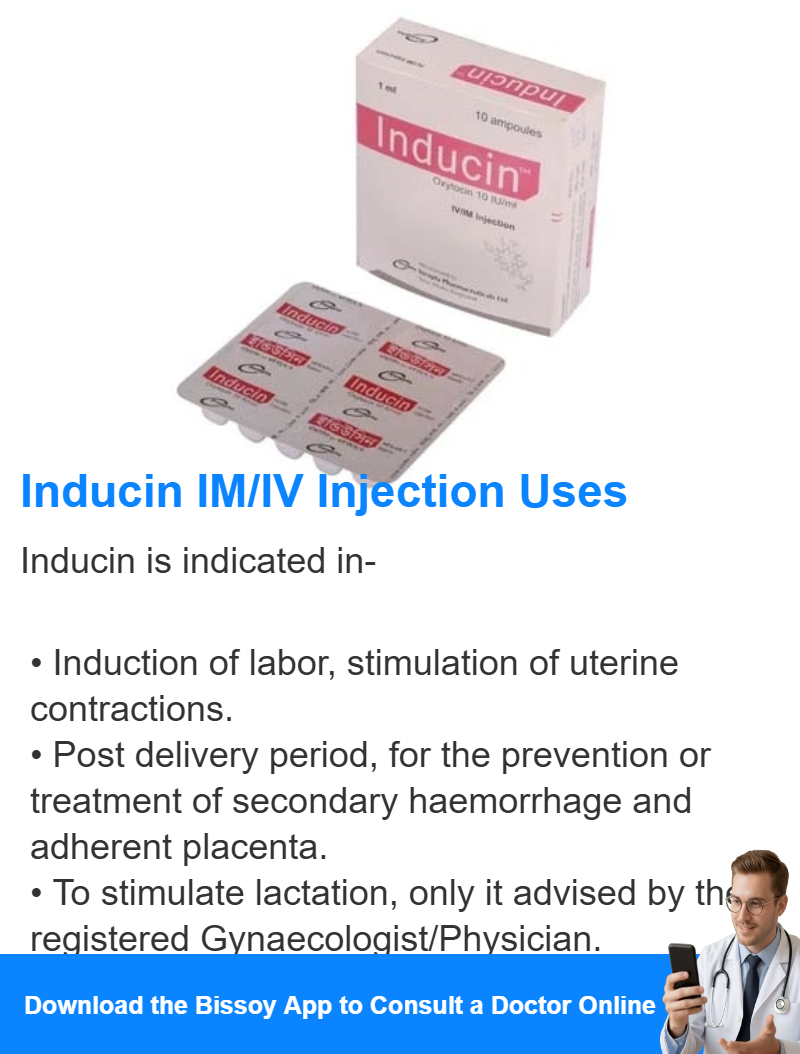
Inducin IM/IV Injection 10 IU/ml is a recombinant hormone used to induce or strengthen uterine contractions in pregnant women to aid in labor and delivery or to control postpartum bleeding.
Administration of exogenous oxytocin is indicated in the antepartum period to initiate or improve uterine contractions for vaginal delivery in situations where there is fetal or maternal concern. For example, It may be used to induce labor in cases of Rh sensitization, maternal diabetes, preeclampsia at or near term, and when delivery is indicated due to prematurely ruptured membranes. Importantly, oxytocin is not approved or indicated for elective induction of labor. Inducin IM/IV Injection 10 IU/ml may be used to reinforce labor in select cases of uterine inertia and as adjunctive therapy in the management of incomplete or inevitable abortion. In the postpartum period, oxytocin may be used to induced contractions in the 3rd stage of labor and to control postpartum bleeding or hemorrhage.
Associated Conditions
Pharmacodynamics
Inducin IM/IV Injection 10 IU/ml is a nonapeptide, pleiotropic hormone that exerts important physiological effects. It is most well known to stimulate parturition and lactation, but also has important physiological influences on metabolic and cardiovascular functions, sexual and maternal behaviour, pair bonding, social cognition, and fear conditioning.
It is worth noting that oxytocin receptors are not limited to the reproductive system but can be found in many peripheral tissues and in central nervous system structures including the brain stem and amygdala.
Mechanism of Action
Inducin IM/IV Injection 10 IU/ml plays a vital role in labour and delivery. The hormone is produced in the hypothalamus and is secreted from the paraventricular nucleus to the posterior pituitary where it is stored. It is then released in pulses during childbirth to induce uterine contractions.
The concentration of oxytocin receptors on the myometrium increases significantly during pregnancy and reaches a peak in early labor. Activation of oxytocin receptors on the myometrium triggers a downstream cascade that leads to increased intracellular calcium in uterine myofibrils which strengthens and increases the frequency of uterine contractions.
In humans, most hormones are regulated by negative feedback; however, oxytocin is one of the few that is regulated by positive feedback. The head of the fetus pushing on the cervix signals the release of oxytocin from the posterior pituitary of the mother. Inducin IM/IV Injection 10 IU/ml then travels to the uterus where it stimulates uterine contractions. The elicited uterine contractions will then stimulate the release of increasing amounts of oxytocin. This positive feedback loop will continue until parturition.
Since exogenously administered and endogenously secreted oxytocin result in the same effects on the female reproductive system, synthetic oxytocin may be used in specific instances during the antepartum and postpartum period to induce or improve uterine contractions.
Absorption
Inducin IM/IV Injection 10 IU/ml is administered parenterally and is fully bioavailable. It takes approximately 40 minutes for oxytocin to reach steady-state concentrations in the plasma after parenteral administration.
Route of Elimination
The enzyme oxytocinase is largely responsible for the metabolism and regulation of oxytocin levels in pregnancy; only a small percentage of the neurohormone is excreted in the urine unchanged.
Half Life
The plasma half-life of oxytocin ranges from 1-6 minutes. The half-life is decreased in late pregnancy and during lactation.
Clearance
In a study that observed 10 women who were given oxytocin to induce labor, the mean metabolic clearance rate was 7.87 mL/min.
Toxicity
Administration of supratherapeutic doses of exogenous oxytocin can lead to myocardial ischemia, tachycardia, and arrhythmias. High doses can also lead to uterine spasms, hypertonicity, or rupture. Inducin IM/IV Injection 10 IU/ml has antidiuretic properties, thus, high daily doses (as a single dose or administered slowly over 24 hours) may lead to extreme water intoxication resulting in maternal seizures, coma, and even death. The risk of antidiuresis and water intoxication in the mother appears to be greater when fluids are given orally.
Food Interactions
No interactions found.
Dosage
N.B.: Intramuscular administration of Inducin IM/IV Injection 10 IU/ml may lead to an irregular response and symptoms of overdosage. It intramuscular administration is nevertheless unavoidable, dosage should not exceed 0.5-1 IU per injection.
Post delivery period, for the prevention or treatment of secondary haemorrhage and adherent placenta: Intramuscular injection of 2-5 IU, or as intravenous infusion in an adequate dosage
To stimulate lactation, only it advised by the registered Gynaecologist/Physician: Intramuscular injection of 2 IU
Treatment of incomplete abortion to obtain more rapid expulsion in order to prevent secondary hemorrhage: Intramuscular injection of 2-5 IU every 30-60 minutes or as intravenous infusion in an adequate dosage