Introduction
The most significant modifiable risk factor for cardiovascular disease and the most prominent contributor to all-cause mortality is hypertension. Characterized by an office blood pressure of ≥140/90, hypertension is pervasive and impacts an estimated 25% of adults globally. Treatment for hypertension should include a number of lifestyle changes (ie. reduced sodium intake) along with pharmacotherapy - it should be noted that treatment with several antihypertensive agents may be required in order to achieve blood pressure targets.
Thiazide-like diuretics such as indapamide are a valuable tool for the treatment of hypertension and continue to grow in popularity, falling behind only ACE inhibitors in terms of prescription frequency. When compared to hydrochlorothiazide (another commonly prescribed diuretic), indapamide has been shown to be superior at lowering systolic blood pressure, reducing left ventricular mass index, lowering oxidative stress, inhibiting platelet aggregation, and reducing microalbuminuria associated with diabetes. Interestingly, unlike thiazide diuretics, several sources suggest that indapamide is not associated with glucose or lipid disturbances.
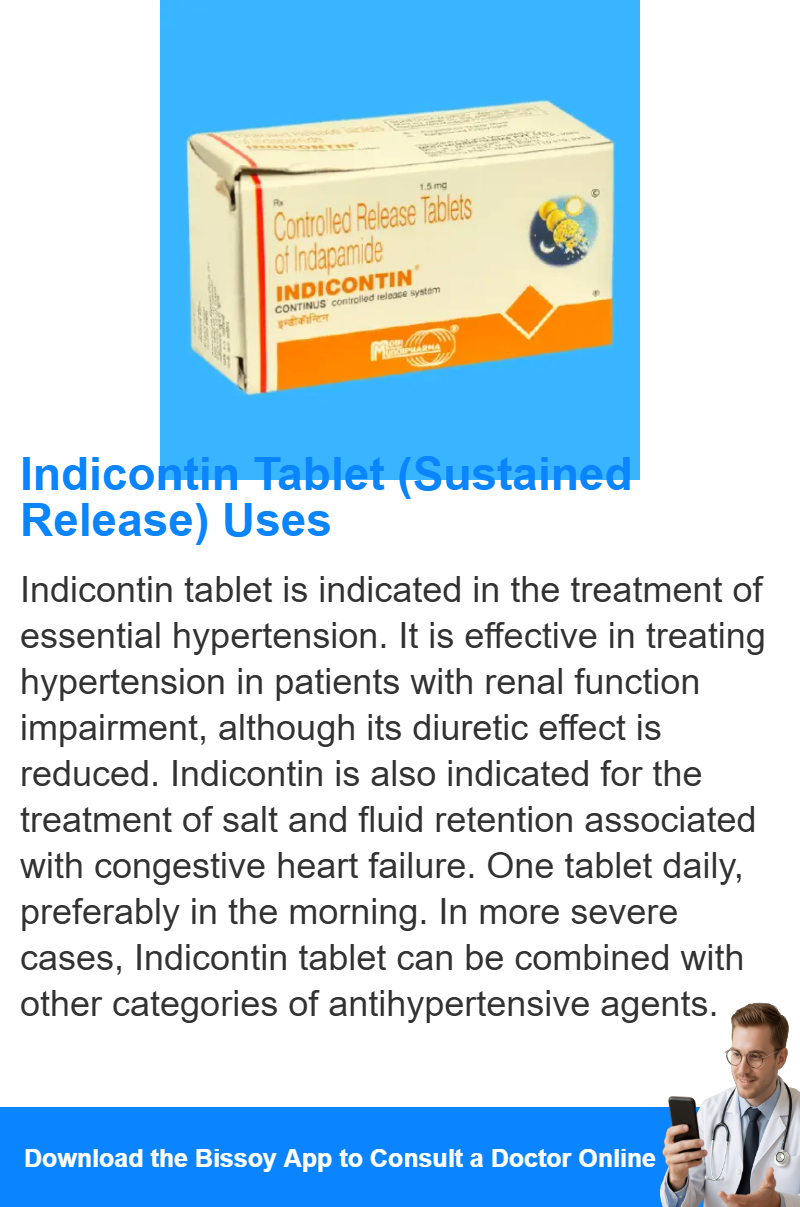
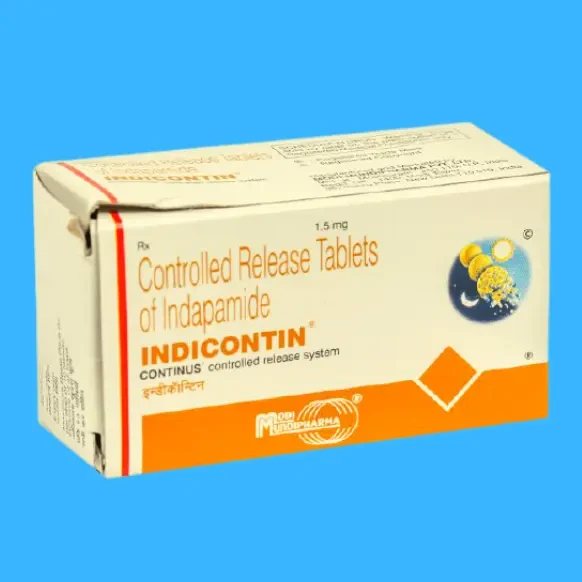
Indicontin Tablet (Sustained Release) 1.5 mg is characterized by both a methylindoline and a sulfamoyl chlorobenzamide functional group, with the former being largely responsible for the molecule’s lipid solubility.
Uses
Indicontin Tablet (Sustained Release) 1.5 mg is a thiazide diuretic used to treat hypertension as well as edema due to congestive heart failure.
Indicontin Tablet (Sustained Release) 1.5 mg is a diuretic indicated for use as monotherapy or in combination with other blood pressure-lowering agents to treat hypertension. It may also be used to treat fluid and salt retention associated with congestive heart failure.
Associated Conditions
Pharmacodynamics
Classified as a sulfonamide diuretic, indapamide is an effective antihypertensive agent and by extension, has shown efficacy in the prevention of target organ damage. Administration of indapamide produces water and electrolyte loss, with higher doses associated with increased diuresis. Severe and clinically significant electrolyte disturbances may occur with indapamide use - for example, hypokalemia resulting from renal potassium loss may lead to QTc prolongation. Further electrolyte imbalances may occur due to renal excretion of sodium, chloride, and magnesium.
Other indapamide induced changes include increases in plasma renin and aldosterone, and reduced calcium excretion in the urine. In many studies investigating the effects of indapamide in both non-diabetic and diabetic hypertensive patients, glucose tolerance was not significantly altered. However, additional studies are necessary to assess the long term metabolic impacts of indapamide, since thiazide related impaired glucose tolerance can take several years to develop in non-diabetic patients.
Mechanism of Action
Indicontin Tablet (Sustained Release) 1.5 mg acts on the nephron, specifically at the proximal segment of the distal convoluted tubule where it inhibits the Na+/Cl- cotransporter, leading to reduced sodium reabsorption. As a result, sodium and water are retained in the lumen of the nephron for urinary excretion. The effects that follow include reduced plasma volume, reduced venous return, lower cardiac output, and ultimately decreased blood pressure.
Interestingly, it is likely that thiazide-like diuretics such as indapamide have additional blood pressure lowering mechanisms that are unrelated to diuresis. This is exemplified by the observation that the antihypertensive effects of thiazides are sustained 4-6 weeks after initiation of therapy, despite recovering plasma and extracellular fluid volumes.
Some studies have suggested that indapamide may decrease responsiveness to pressor agents while others have suggested it can decrease peripheral resistance. Although it is clear that diuresis contributes to the antihypertensive effects of indapamide, further studies are needed to investigate the medication’s ability to decrease peripheral vascular resistance and relax vascular smooth muscle.
Absorption
The bioavailability of indapamide is virtually complete after an oral dose and is unaffected by food or antacids. Indicontin Tablet (Sustained Release) 1.5 mg is highly lipid-soluble due to its indoline moiety - a characteristic that likely explains why indapamide’s renal clearance makes up less than 10% of its total systemic clearance. The Tmax occurs approximately 2.3 hours after oral administration. The Cmax and AUC0-24 values are 263 ng/mL and 2.95 ug/hr/mL, respectively.
Volume of Distribution
Some sources report an apparent volume of distribution of 25 L for indapamide, while others report a value of approximately 60 L.
Protein Binding
Approximately 76-79% of indapamide is protein bound. Indicontin Tablet (Sustained Release) 1.5 mg binds primarily to alpha 1-acid glycoprotein and less significantly to serum albumin and lipoproteins. In the blood, indapamide is extensively and preferentially bound to erythrocytes.
Route of Elimination
An estimated 60-70% of indapamide is eliminated in the urine, while 16-23% is eliminated in the feces.
Half Life
Indicontin Tablet (Sustained Release) 1.5 mg is characterized by biphasic elimination. In healthy subjects, indapamide's elimination half-life can range from 13.9 to 18 hours. The long half-life is conducive to once-daily dosing.
Clearance
Indicontin Tablet (Sustained Release) 1.5 mg's renal and hepatic clearance values are reported to be 1.71 mL/min and 20-23.4 mL/min, respectively.
Toxicity
Indicontin Tablet (Sustained Release) 1.5 mg overdose symptoms may include but are not limited to nausea, vomiting, gastrointestinal disorders, electrolyte disturbances and weakness. Other signs of overdose include respiratory depression and severe hypotension. In cases of overdose, supportive care interventions may be necessary to manage symptoms. Emesis and gastric lavage may be recommended to empty the stomach; however, patients should be monitored closely for any electrolyte or fluid imbalances.
Food Interactions
- Avoid alcohol. Alcohol may potentiate orthostatic hypotension.
- Increase consumption of potassium-rich foods. Indicontin Tablet (Sustained Release) 1.5 mg my cause potassium depletion leading to hypokalemia.
- Take with or without food.