Introduction
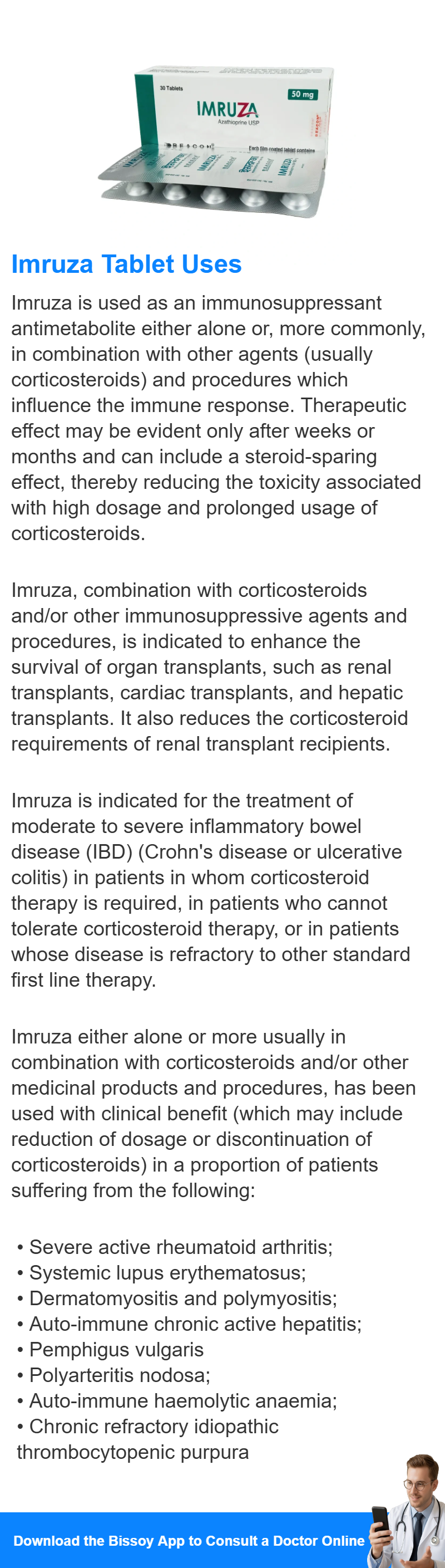
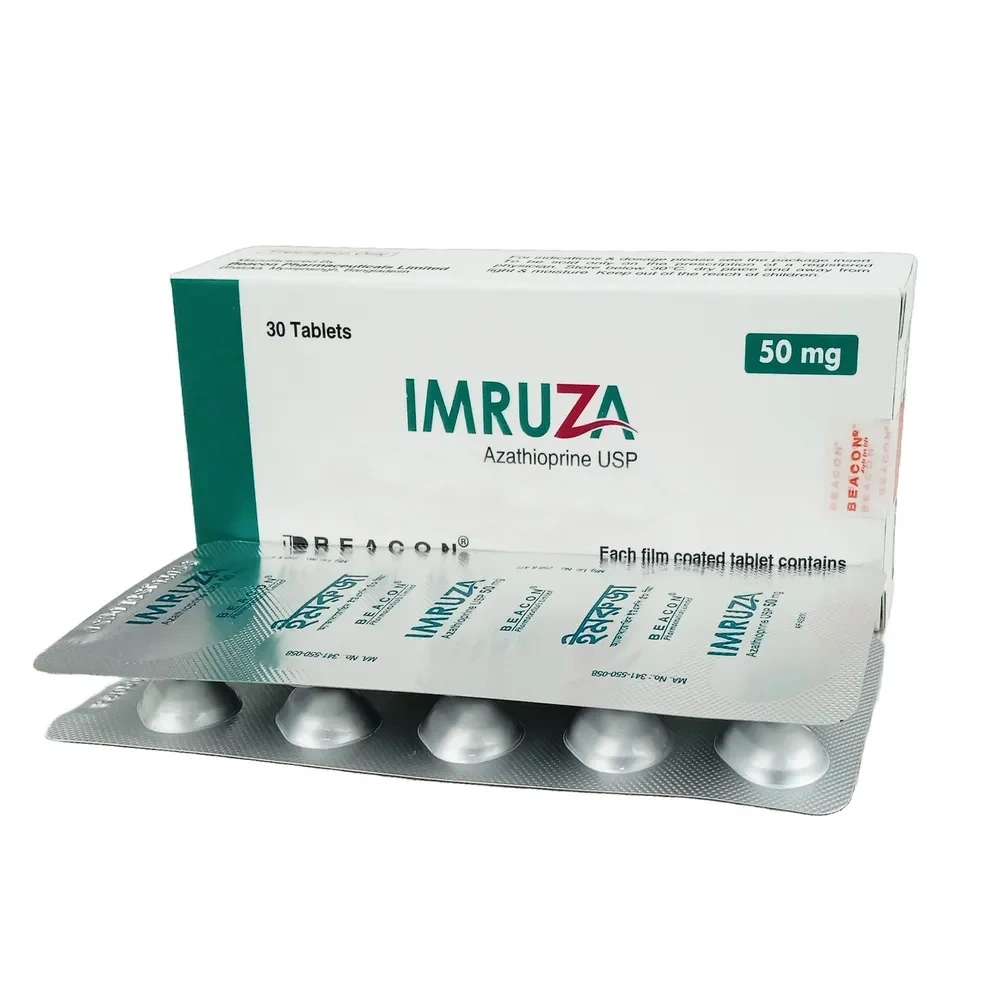
Imruza Tablet 50 mg is a prodrug of 6-mercaptopurine, first synthesized in 1956 by Gertrude Elion, William Lange, and George Hitchings in an attempt to produce a derivative of 6-mercaptopurine with a better therapeutic index. Imruza Tablet 50 mg is used to treat inflammatory conditions like rheumatoid arthritis and as an immunosuppressant in the prevention of renal transplant rejection.
Uses
Imruza Tablet 50 mg is an immunosuppressant used to prevent renal transplant rejection, treat rheumatoid arthritis, Crohn's disease, and ulcerative colitis.
Imruza Tablet 50 mg is indicated to treat rheumatoid arthritis and prevent renal transplant rejection.
Associated Conditions
Pharmacodynamics
Imruza Tablet 50 mg is an immunosuppressive agent which functions through modulation of rac1 to induce T cell apoptosis, as well as other unknown immunosuppressive functions. It has a long duration of action as it is given daily, and has a narrow therapeutic index. Patients should be counselled regarding the risk of malignancies of the skin and lymphomas.
Mechanism of Action
Imruza Tablet 50 mg's mechanism of action is not entirely understood but it may be related to inhibition of purine synthesis, along with inhibition of B and T cells.
6-thioguanine triphosphate, a metabolite of azathioprine, modulates activation of rac1 when costimulated with CD28, inducing T cell apoptosis. This may be mediated through rac1's action on mitogen-activated protein kinase, NF-kappaB.
Absorption
Oral azathioprine is well absorbed, with a Tmax of 1-2h. Further data regarding the absorption of azathioprine is not readily available.
Volume of Distribution
Data regarding the volume of distribution of azathioprine is not readily available.
Protein Binding
Imruza Tablet 50 mg is 30% bound to proteins such as human serum albumin in circulation.
Route of Elimination
Imruza Tablet 50 mg and mercaptopurine are not detectable in urine after 8 hours. Further data regarding the route of elimination of azathioprine are not available.
Half Life
The half life of azathioprine is approximately 5 hours.
Clearance
Data regarding the clearance of azathioprine is not readily available.
Toxicity
The oral LD50 in mice is 2500mg/kg and in rats is 400mg/kg.
Patients experiencing an overdose may present with bone marrow hypoplasia, bleeding, and infection, which may progress to death. Patients should be treated with supportive and symptomatic treatments. 8 hour hemodialysis may remove 45% of a dose from serum.
Food Interactions
- Take with food. Food reduces irritation.
Dosage
- Depending on the immunosuppressive regimen employed, a dosage of up to 5mg/kg body weight/day may be given orally or intravenously on the first day of therapy.
- Maintenance dosage should range from 1 to 4mg/kg body weight/day and must be adjusted according to clinical requirements and haematological tolerance.
- Evidence indicates that azathioprine therapy should be maintained indefinitely, even if only low doses are necessary, because of the risk of graft rejection.
- In general, the starting dosage is 1 to 3mg/kg body weight/day, and should be adjusted, within these limits, depending on the clinical response (which may not be evident for weeks or months) and haematological tolerance.
- When the therapeutic response is evident, consideration should be given to reducing the maintenance dosage to the lowest level compatible with the maintenance of that response. If no improvement occurs in the patient's condition within three months, consideration should be given to withdrawing azathioprine. However, for patients with IBD, a treatment duration of at least twelve months should be considered and a response to treatment may not be clinically apparent until after three to four months of treatment.
- The maintenance dosage required may range from less than 1mg/kg body weight/day to 3mg/kg body weight/day, depending on the clinical condition being treated and the individual patient response, including haematological tolerance.
Elderly: There is limited experience of the administration of azathioprine to elderly patients. Although the available data do not provide evidence that the incidence of side effects among elderly patients is higher than that among other patients treated with azathioprine, it is recommended that the dosages used should be at the lower end of the range.
Renal impairment: In patients with renal insufficiency, consideration should be given to reducing the dosage.
Hepatic impairment: In patients with hepatic insufficiency, consideration should be given to reducing the dosage.