Introduction
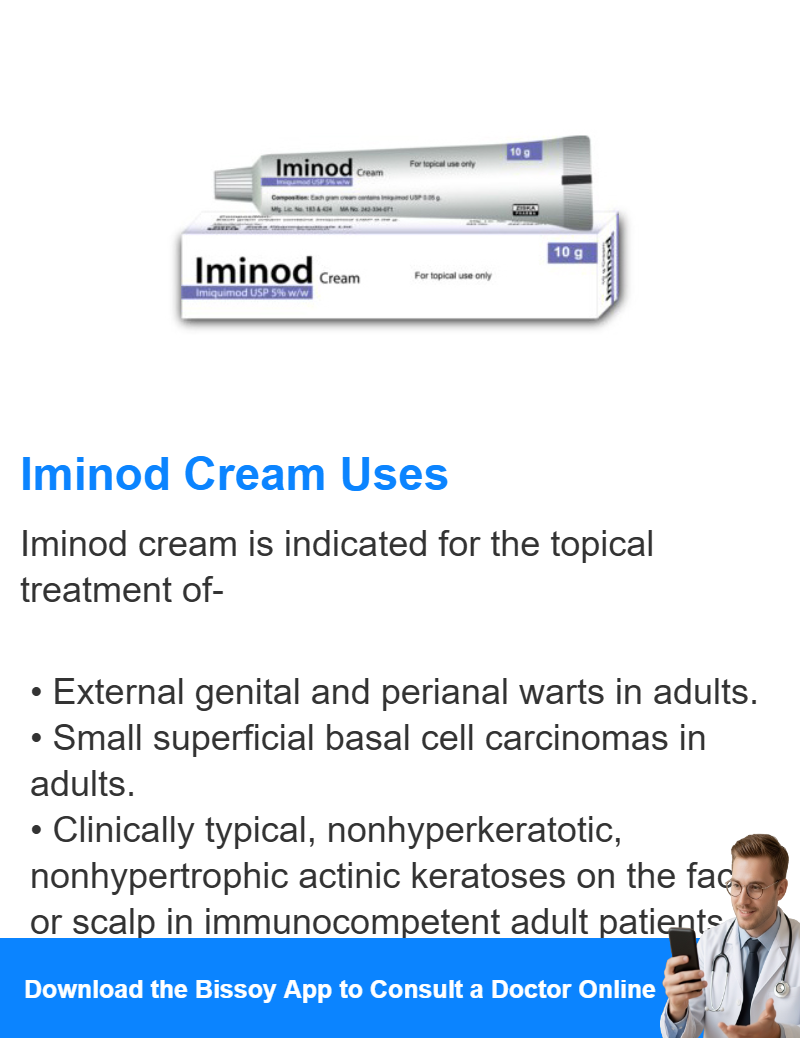
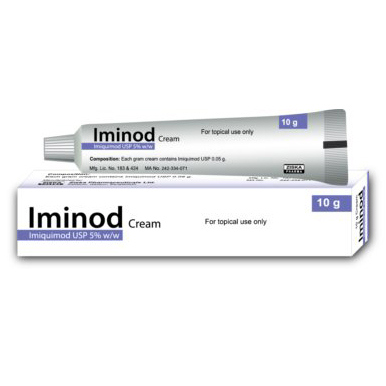
Iminod Cream 5% is an immune response modifier that acts as a toll-like receptor 7 agonist. Iminod Cream 5% is commonly used topically to treat warts on the skin of the genital and anal areas. Iminod Cream 5% does not cure warts, and new warts may appear during treatment. Iminod Cream 5% does not fight the viruses that cause warts directly, however, it does help to relieve and control wart production. Miquimod is also used to treat a skin condition of the face and scalp called actinic keratoses and certain types of skin cancer called superficial basal cell carcinoma.
Uses
Iminod Cream 5% is a toll-like receptor 7 agonist used to treat non hyperkeratotic, non hypertrophic actinic keratosis, basal cell carcinoma, genital or perianal warts, and condyloma acuminata.
For the topical treatment of clinically typical, nonhyperkeratotic, nonhypertrophic actinic keratoses on the face or scalp in immunocompetent adults. Also indicated for the treatment of external genital and perianal warts/condyloma acuminata in individuals 12 years old and above.
Associated Conditions
Pharmacodynamics
Iminod Cream 5% is an immune response modifier that acts as a toll-like receptor 7 agonist. Iminod Cream 5% is commonly used topically to treat warts on the skin of the genital and anal areas. Iminod Cream 5% does not cure warts, and new warts may appear during treatment. Iminod Cream 5% does not fight the viruses that cause warts directly, however, it does help to relieve and control wart production. It is not used on warts inside the vagina, penis, or rectum. Iminod Cream 5% is also used to treat a skin condition of the face and scalp called actinic keratoses. Iminod Cream 5% can also be used to treat certain types of skin cancer called superficial basal cell carcinoma. Iminod Cream 5% is particularly useful on areas where surgery or other treatments may be difficult, complicated or otherwise undesirable, especially the face and lower legs.
Mechanism of Action
Iminod Cream 5%'s mechanism of action is via stimulation of innate and acquired immune responses, which ultimately leads to inflammatory cell infiltration within the field of drug application followed by apoptosis of diseased tissue. Iminod Cream 5% does not have direct antiviral activity. Studies of mice show that imiquimod may induce cytokines, including interferon-alpha (IFNA) as well as several IFNA genes (IFNA1, IFNA2, IFNA5, IFNA6, and IFNA8) as well as the IFNB gene. Iminod Cream 5% also induced the expression of interleukin (IL)-6, IL-8, and tumor necrosis factor alpha genes. In the treatment of basal cell carcinoma, Iminod Cream 5% appears to act as a toll-like receptor-7 agonist, and is thought to exert its anti-tumor effect via modification of the immune response and stimulation of apoptosis in BCC cells. In treating basal cell carcinoma it may increase the infiltration of lymphocytes, dendritic cells, and macrophages into the tumor lesion.
Absorption
Well absorbed through skin (as a cream)
Half Life
20 hours (topical dose), 2 hours (subcutaneous dose)
Toxicity
Symptoms of overdose include flu-like symptoms, such as fever, fatigue, headache, nausea, diarrhoea and muscle pain.
Food Interactions
- Take with or without food.
Dosage
Iminod Cream 5% cream should be applied in a thin layer and rubbed on the clean wart area until the cream vanishes. Only apply to affected areas and avoid any application on internal surfaces. Iminod Cream 5% cream should be applied prior to normal sleeping hours. During the 6 to 10 hour treatment period, showering or bathing should be avoided. After this period it is essential that Iminod Cream 5% cream is removed with mild soap and water. Application of an excess of cream or prolonged contact with the skin may result in a severe application site reaction. A single use sachet is sufficient to cover a wart area of 20 cm2 (approx. 3 inches2). Sachets should not be re-used once opened. Hands should be washed carefully before and after application of cream. Uncircumcised males treating warts under the foreskin should retract the foreskin and wash the area daily.
Superficial basal cell carcinoma in adults: Apply Iminod Cream 5% cream for 6 weeks, 5 times per week (example: Monday to Friday) prior to normal sleeping hours, and leave on the skin for approximately 8 hours. Before applying Iminod Cream 5% cream, patients should wash the treatment area with mild soap and water and dry thoroughly. Sufficient cream should be applied to cover the treatment area, including one centimetre of skin surrounding the tumour. The cream should be rubbed into the treatment area until the cream vanishes. The cream should be applied prior to normal sleeping hours and remain on the skin for approximately 8 hours. During this period, showering and bathing should be avoided. After this period it is essential that Iminod Cream 5% cream is removed with mild soap and water. Sachets should not be re-used once opened. Hands should be washed carefully before and after application of cream. Response of the treated tumour to Iminod Cream 5% cream should be assessed 12 weeks after the end of treatment. If the treated tumour shows an incomplete response, a different therapy should be used. A rest period of several days may be taken if the local skin reaction to Iminod Cream 5% cream causes excessive discomfort to the patient, or if infection is observed at the treatment site. In this latter case, appropriate other measures should be taken.
Actinic keratosis in adults: Treatment should be initiated and monitored by a physician. Iminod Cream 5% cream should be applied 3 times per week (example: Monday, Wednesday and Friday) for four weeks prior to normal sleeping hours, and left on the skin for approximately 8 hours. Sufficient cream should be applied to cover the treatment area. After a 4-week treatment-free period, clearance of Actinic Keratosis should be assessed. If any lesions persist, treatment should be repeated for another four weeks. An interruption of dosing should be considered if intense local inflammatory reactions occur or if infection is observed at the treatment site. In this latter case, appropriate other measures should be taken. Each treatment period should not be extended beyond 4 weeks due to missed doses or rest periods. If the treated area does not show complete clearance at a follow-up examination about 8 weeks after the last 4-weeks course of treatment, an additional 4-weeks course of Iminod Cream 5% treatment may be considered. A different therapy is recommended if the treated lesion(s) shows insufficient response to Iminod Cream 5%. Actinic keratosis lesions that have cleared after one or two courses of treatment and subsequently recur can be re-treated with one or two further courses of Iminod Cream 5% cream following an at least 12 weeks treatment pause. Before applying Iminod Cream 5% cream, patients should wash the treatment area with mild soap and water and dry thoroughly. Sufficient cream should be applied to cover the treatment area, including one centimetre of skin surrounding the tumour. The cream should be rubbed into the treatment area until the cream vanishes. The cream should be applied prior to normal sleeping hours and remain on the skin for approximately 8 hours. During this period, showering and bathing should be avoided. After this period it is essential that Iminod Cream 5% cream is removed with mild soap and water. Sachets should not be re-used once opened. Hands should be washed carefully before and after application of cream.
Information applicable to all indications: If a dose is missed, the patient should apply the cream as soon as he/she remember and then he/she should continue with the regular schedule. However the cream should not be applied more than once a day.