Introduction
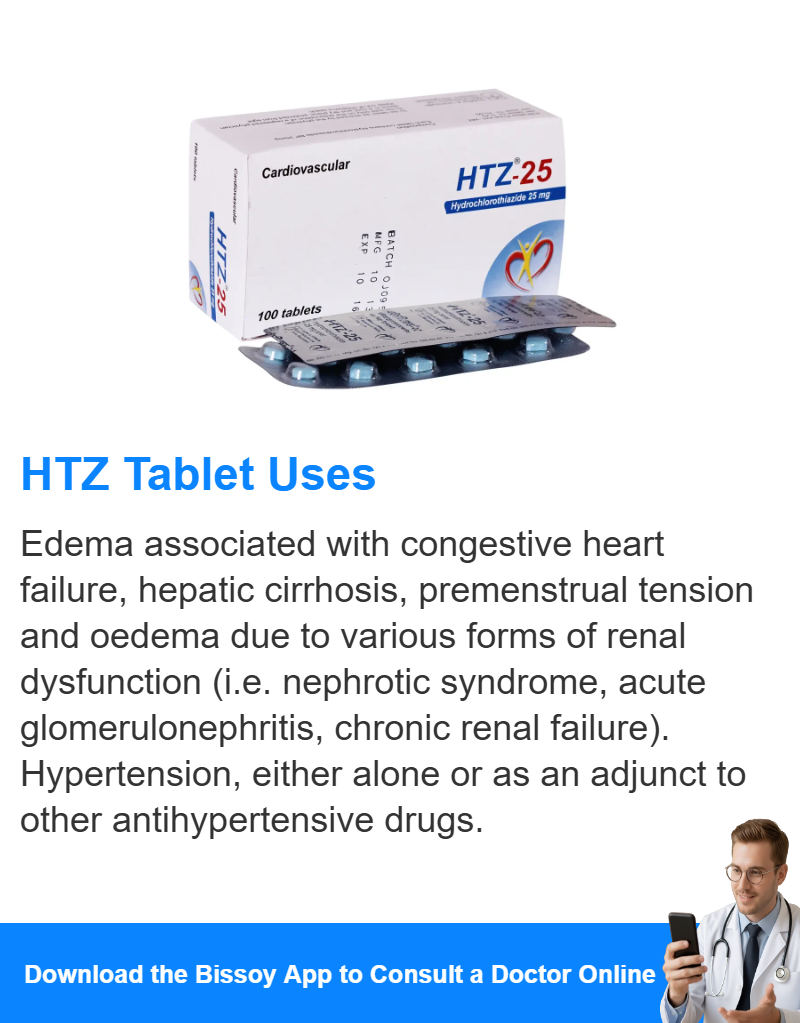
HTZ Tablet 25 mg is the most commonly prescribed thiazide diuretic. It is indicated to treat edema and hypertension. HTZ Tablet 25 mg use is common but declining in favour of angiotensin converting enzyme inhibitors. Many combination products are available containing hydrochlorothiazide and angiotensin converting enzyme inhibitors or angiotensin II receptor blockers.
Uses
HTZ Tablet 25 mg is a thiazide diuretic used to treat edema associated with a number of conditions, and hypertension.
HTZ Tablet 25 mg is indicated alone or in combination for the management of edema associated with congestive heart failure, hepatic cirrhosis, nephrotic syndrome, acute glomerulonephritis, chronic renal failure, and corticosteroid and estrogen therapy. HTZ Tablet 25 mg is also indicated alone or in combination for the management of hypertension.
Associated Conditions
Pharmacodynamics
HTZ Tablet 25 mg prevents the reabsorption of sodium and water from the distal convoluted tubule, allowing for the increased elimination of water in the urine. HTZ Tablet 25 mg has a wide therapeutic window as dosing is individualized and can range from 25-100mg. HTZ Tablet 25 mg should be used with caution in patients with reduced kidney or liver function.
Mechanism of Action
HTZ Tablet 25 mg is transported from the circulation into epithelial cells of the distal convoluted tubule by the organic anion transporters OAT1, OAT3, and OAT4. From these cells, hydrochlorothiazide is transported to the lumen of the tubule by multidrug resistance associated protein 4 (MRP4).
Normally, sodium is reabsorbed into epithelial cells of the distal convoluted tubule and pumped into the basolateral interstitium by a sodium-potassium ATPase, creating a concentration gradient between the epithelial cell and the distal convoluted tubule that promotes the reabsorption of water.
HTZ Tablet 25 mg acts on the proximal region of the distal convoluted tubule, inhibiting reabsorption by the sodium-chloride symporter, also known as Solute Carrier Family 12 Member 3 (SLC12A3). Inhibition of SLC12A3 reduces the magnitude of the concentration gradient between the epithelial cell and distal convoluted tubule, reducing the reabsorption of water.
Absorption
An oral dose of hydrochlorothiazide is 65-75% bioavailable, with a Tmax of 1-5 hours, and a Cmax of 70-490ng/mL following doses of 12.5-100mg. When taken with a meal, bioavailability is 10% lower, Cmax is 20% lower, and Tmax increases from 1.6 to 2.9 hours.
Volume of Distribution
The volume of distribution varies widely from one study to another with values of 0.83-4.19L/kg.
Protein Binding
HTZ Tablet 25 mg is 40-68% protein bound in plasma. HTZ Tablet 25 mg has been shown to bind to human serum albumin.
Route of Elimination
HTZ Tablet 25 mg is eliminated in the urine as unchanged hydrochlorothiazide.
Half Life
The plasma half life of hydrochlorothiazide is 5.6-14.8h.
Clearance
The renal clearance of hydrochlorothiazide in patients with normal renal function is 285mL/min. Patients with a creatinine clearance of 31-80mL/min have an average hydroxychlorothiazide renal clearance of 75mL/min, and patients with a creatinine clearance of ≤30mL/min have an average hydroxychlorothiazide renal clearance of 17mL/min.
Toxicity
The oral LD50 of hydrochlorothiazide is >10g/kg in mice and rats.
Patients experiencing an overdose may present with hypokalemia, hypochloremia, and hyponatremia. Treat patients with symptomatic and supportive treatment including fluids and electrolytes. Vasopressors may be administered to treat hypotension and oxygen may be given for respiratory impairment.
Food Interactions
- Avoid alcohol. Alcohol may potentiate orthostatic hypotension.
- Avoid multivalent ions. Take this medication 2 hours before or after the administration of antacids, calcium supplements, or iron supplements to avoid decreased absorption of hydrochlorothiazide.
- Avoid natural licorice. Licorice potentiates the hypokalemic effect of hydrochlorothiazide.
- Increase consumption of potassium-rich foods. This medication may cause potassium depletion. Foods containing potassium include bananas and orange juice.
- Limit salt intake. Avoid excessive salt, unless recommended by a physician.
- Take with or without food.
Dosage
Hypertension: 25 mg daily, increased to 50 mg daily if necessary.
Elderly: in some patients, especially the elderly an initial dose of 12.5 mg daily may be sufficient.
Children: An initial dose for children has been 1 to 2 mg per kg body-weight in 2 divided doses. Infants under 6 months may need doses up to 3 mg per kg daily.