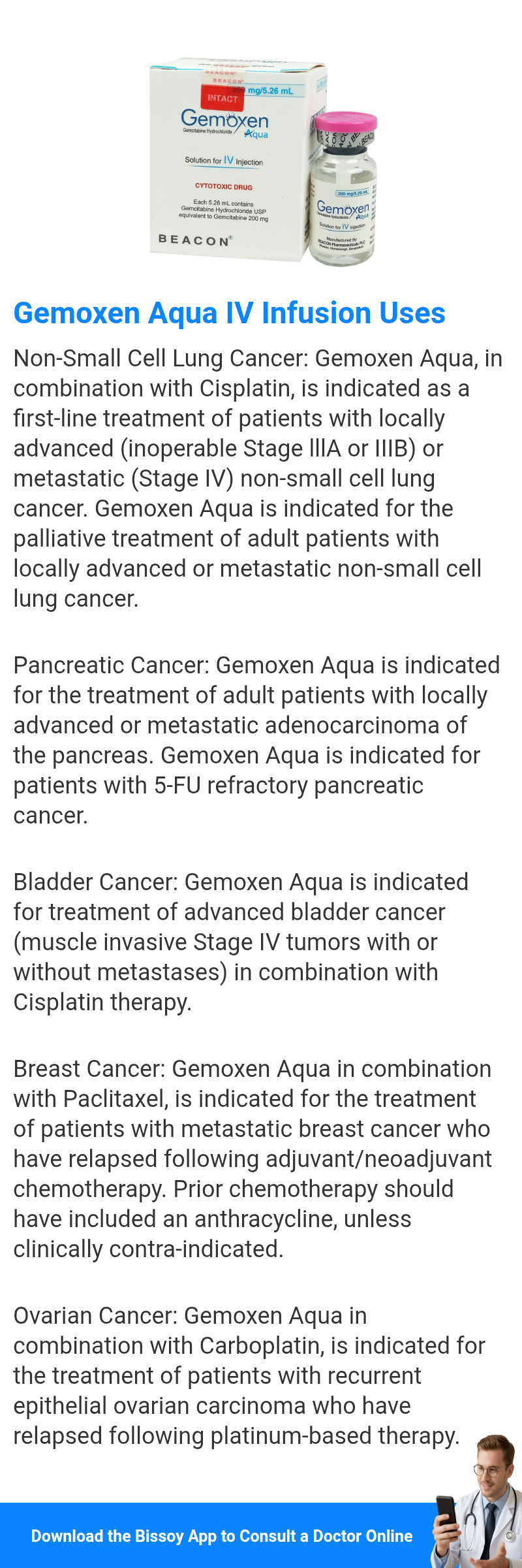
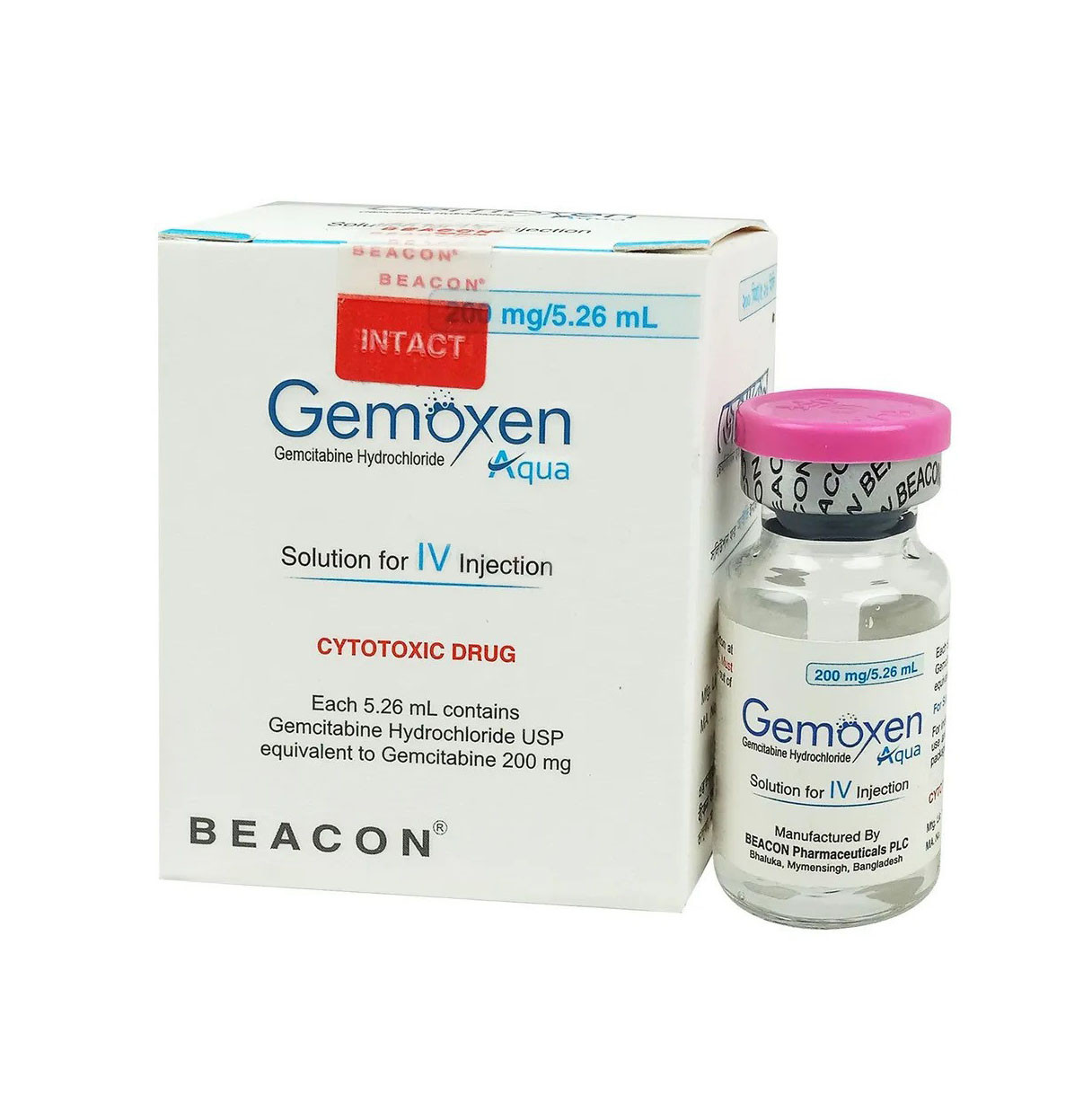
Introduction
Gemoxen Aqua IV Infusion 200 mg/5.26 ml is a nucleoside analog and a chemotherapeutic agent. It was originally investigated for its antiviral effects, but it is now used as an anticancer therapy for various cancers. Gemoxen Aqua IV Infusion 200 mg/5.26 ml is a cytidine analog with two fluorine atoms replacing the hydroxyl on the ribose. As a prodrug, gemcitabine is transformed into its active metabolites that work by replacing the building blocks of nucleic acids during DNA elongation, arresting tumour growth and promoting apoptosis of malignant cells. The structure, metabolism, and mechanism of action of gemcitabine are similar to cytarabine, but gemcitabine has a wider spectrum of antitumour activity.
. It used to treat advanced ovarian cancer in combination with carboplatin, metastatic breast cancer in combination with paclitaxel, non-small cell lung cancer in combination with cisplatin, and pancreatic cancer as monotherapy. It is also being investigated in other cancer and tumour types.
Uses
Gemoxen Aqua IV Infusion 200 mg/5.26 ml is a nucleoside metabolic inhibitor used as adjunct therapy in the treatment of certain types of ovarian cancer, non-small cell lung carcinoma, metastatic breast cancer, and as a single agent for pancreatic cancer.
Gemoxen Aqua IV Infusion 200 mg/5.26 ml is a chemotherapeutic agent used as monotherapy or in combination with other anticancer agents.
In combination with carboplatin, it is indicated for the treatment of advanced ovarian cancer that has relapsed at least 6 months after completion of platinum-based therapy.
Gemoxen Aqua IV Infusion 200 mg/5.26 ml in combination with paclitaxel is indicated for the first-line treatment of patients with metastatic breast cancer after failure of prior anthracycline-containing adjuvant chemotherapy, unless anthracyclines were clinically contraindicated.
In combination with cisplatin, gemcitabine is indicated for the first-line treatment of patients with inoperable, locally advanced (Stage IIIA or IIIB) or metastatic (Stage IV) non-small cell lung cancer (NSCLC). Dual therapy with cisplatin is also used to treat patients with Stage IV (locally advanced or metastatic) transitional cell carcinoma (TCC) of the bladder.
Gemoxen Aqua IV Infusion 200 mg/5.26 ml is indicated as first-line treatment for patients with locally advanced (nonresectable Stage II or Stage III) or metastatic (Stage IV) adenocarcinoma of the pancreas. Gemoxen Aqua IV Infusion 200 mg/5.26 ml is indicated for patients previously treated with fluorouracil.
Associated Conditions
Pharmacodynamics
Gemoxen Aqua IV Infusion 200 mg/5.26 ml is a nucleoside analog that mediates its antitumour effects by promoting apoptosis of malignant cells undergoing DNA synthesis. More specifically, it blocks the progression of cells through the G1/S-phase boundary. Gemoxen Aqua IV Infusion 200 mg/5.26 ml demonstrated cytotoxic effects against a broad range of cancer cell lines in vitro. It displayed schedule-dependent antitumour activity in various animal models and xenografts from human non-small cell lung cancer (NSCLC) and pancreatic cancer. Therefore, the antineoplastic effects of gemcitabine are enhanced through prolonged infusion time rather than higher dosage. Gemoxen Aqua IV Infusion 200 mg/5.26 ml inhibited the growth of human xenografts from carcinoma of the lung, pancreas, ovaries, head and neck, and breast. In mice, gemcitabine inhibited the growth of human tumour xenografts from the breast, colon, lung or pancreas by 69 to 99%. In clinical trials of advanced NSCLC, gemcitabine monotherapy produced objective response rates ranging from 18 to 26%, with a median duration of response ranging from 3.3 to 12.7 months. Overall median survival time was 6.2 to 12.3 months. The combined use of cisplatin and gemcitabine produced better objective response rates compared to monotherapy. In patients with advanced pancreatic cancer, objective response rates in patients ranged from 5.to 12%, with a median survival duration of 3.9 to 6.3 months. In Phase II trials involving patients with metastatic breast cancer, treatment with gemcitabine alone or with adjuvant chemotherapies resulted in response rate ranging from 13 to 42% and median survival duration ranging from 11.5 to 17.8 months. In metastatic bladder cancer, gemcitabine has a response rate 20 to 28%. In Phase II trials of advanced ovarian cancer, patients treated with gemcitabine had response rate of 57.1%, with progression free survival of 13.4 months and median survival of 24 months.
Gemoxen Aqua IV Infusion 200 mg/5.26 ml causes dose-limiting myelosuppression, such as anemia, leukopenia, neutropenia, and thrombocytopenia; however, events leading to discontinuation tend to occur less than 1% of the patients. Gemoxen Aqua IV Infusion 200 mg/5.26 ml can elevate ALT, AST and alkaline phosphatase levels.
Mechanism of Action
Gemoxen Aqua IV Infusion 200 mg/5.26 ml is a potent and specific deoxycytidine analog. After uptake into malignant cells, gemcitabine is phosphorylated by deoxycytidine kinase to form gemcitabine monophosphate, which is then converted to the active compounds, gemcitabine diphosphate (dFdCDP) and gemcitabine triphosphate (dFdCTP). These active metabolites are nucleosides that mediate antitumour effects. dFdCTP competes with deoxycytidine triphosphate (dCTP) for incorporation into DNA, thereby competitively inhibiting DNA chain elongation. The non-terminal position of dFdCTP in the DNA chain prevents detection of dFdCTP in the chain and repair by proof-reading 3′5′-exonuclease: this process is referred to as "masked DNA chain termination." Incorporation of dFdCTP into the DNA chain ultimately leads to chain termination, DNA fragmentation, and apoptotic cell death of malignant cells.
Gemoxen Aqua IV Infusion 200 mg/5.26 ml has self-potentiating pharmacological actions that can increase the probability of successful incorporation of gemcitabine triphosphate into the DNA chain: dFdCDP inhibits ribonucleotide reductase, an enzyme responsible for catalyzing the reactions that generate dCTP for DNA synthesis. Since dFdCDP reduces the levels of dCTP, there is less competition for gemcitabine triphosphate for incorporation into DNA. Gemoxen Aqua IV Infusion 200 mg/5.26 ml can also reduce metabolism and elimination of active metabolites from the target ce1l, prolonging high intracellular concentrations of the active metabolites. Such self-potentiating effects are not present with cytarabine.
Absorption
Peak plasma concentrations of gemcitabine range from 10 to 40 mg/L following a 30-minute intravenous infusion, and are reached at 15 to 30 minutes. One study showed that steady-state concentrations of gemcitabine showed a linear relationship to dose over the dose range 53 to 1000 mg/m2. Gemoxen Aqua IV Infusion 200 mg/5.26 ml triphosphate, the active metabolite of gemcitabine, can accumulate in circulating peripheral blood mononuclear cells. In one study, the Cmax of gemcitabine triphosphate in peripheral blood mononuclear cells occurred within 30 minutes of the end of the infusion period and increased increased proportionally with gemcitabine doses of up to 350 mg/m2.
Volume of Distribution
In patients with various solid tumours, the volume of distribution increased with infusion length. The volume of distribution of gemcitabine was 50 L/m2 following infusions lasting less than 70 minutes. For long infusions, the volume of distribution rose to 370 L/m2.
Gemoxen Aqua IV Infusion 200 mg/5.26 ml triphosphate, the active metabolite of gemcitabine, accumulates and retains in solid tumour cells in vitro and in vivo. It is not extensively distributed to tissues after short infusions that last less than 70 minutes. It is not known whether gemcitabine crosses the blood-brain barrier, but gemcitabine is widely distributed into tissues, including ascitic fluid. In rats, placental and lacteal transfer occurred rapidly at five to 15 minutes following drug administration.
Protein Binding
Gemoxen Aqua IV Infusion 200 mg/5.26 ml plasma protein binding is less than 10%.
Route of Elimination
Gemoxen Aqua IV Infusion 200 mg/5.26 ml mainly undergoes renal excretion. Within a week following administration of a single dose of 1000 mg/m infused over 30 minutes, about 92-98% of the dose was recovered in urine where 89% of the recovered dose was excreted as difluorodeoxyuridine (dFdU) and less than 10% as gemcitabine. Monophosphate, diphosphate, or triphosphate metabolites of gemcitabine are not detectable in urine. In a single-dose study, about 1% of the administered dose was recovered in the feces.
Half Life
Following intravenous infusions lasting less than 70 minutes, the terminal half-life ranged from 0.7 to 1.6 hours. Following infusions ranging from 70 to 285 minutes, the terminal half-life ranged from 4.1 to 10.6 hours. Females tend to have longer half-lives than male patients. Gemoxen Aqua IV Infusion 200 mg/5.26 ml triphosphate, the active metabolite of gemcitabine, can accumulate in circulating peripheral blood mononuclear cells. The terminal half-life of gemcitabine triphosphate, the active metabolite, from mononuclear cells ranges from 1.7 to 19.4 hours.
Clearance
Following intravenous infusions lasting less than 70 minutes, clearance ranged from 41 to 92 L/h/m2 in males and ranged from 31 to 69 L/h/m2 in females. Clearance decreases with age. Females have about 30% lower clearance than male patients.
Toxicity
The oral LD50 is 333 mg/kg in mice and >500 mg/kg in rats. The dermal LD50 in rabbits is >1000 mg/kg.
There is no known antidote for gemcitabine overdose. In a dose-escalation study, patients were administered a single dose of gemcitabine as high as 5700 mg/m2
Food Interactions
No interactions found.
Dosage
- Single-agent Use: The recommended dose of Gemoxen Aqua IV Infusion 200 mg/5.26 ml is 1000 mg/m2, given by 30-minute intravenous infusion. This should be repeated once weekly for three weeks, followed by a one-week rest period. This four-week cycle is then repeated. Dosage reduction with each cycle or within a cycle may be applied based upon the amount of toxicity experienced by the patient.
- Combination Use: Gemoxen Aqua IV Infusion 200 mg/5.26 ml, in combination with Cisplatin has been investigated using two dosing regimens. One regimen used a three-week schedule and the over used a four-week schedule. The three-week schedule used Gemoxen Aqua IV Infusion 200 mg/5.26 ml 1250 mg/m2, given by 30-minute intravenous infusion, on days 1 and 8 of each 21-day cycle. Dosage reduction with each cycle or within a cycle may be applied based upon the amount of toxicity experienced by the patient. The four-week schedule used Gemoxen Aqua IV Infusion 200 mg/5.26 ml 1000 mg/m2, given by 30-minute intravenous infusion, on days 1,8, and 15 of each 28-day cycle. Dosage reduction with each cycle or within a cycle may be applied based upon the amount of toxicity experienced by the patient.
Bladder Cancer:
- Single agent use: The recommended dose of Gemoxen Aqua IV Infusion 200 mg/5.26 ml is 1250 mg/m2, given by 30-minute intravenous infusion. The dose should be given on days 1,8 and 15 of each 28-day cycle. This 4-week cycle is then repeated. Dosage reduction with each cycle or within a cycle may be applied based upon the amount of toxicity experienced by the patient.
- Combination use: The recommended dose for Gemoxen Aqua IV Infusion 200 mg/5.26 ml is 1000 mg/m2, given by 30-minute infusion, The dose should be given on days 1,8 and 15 of each 28-day cycle in combination with Cisplatin. Cisplatin is given at a recommended dose of 70 mg/m2 on day 1 following Gemoxen Aqua IV Infusion 200 mg/5.26 ml or day 2 of each 28-day cycle. This 4-week cycle is then repeated. Dosage reduction with each cycle or within a cycle may be applied based upon the amount of toxicity experienced by the patient. A clinical trial showed more myelosuppression when Cisplatin was used in doses of 100 mg/m2.
Ovarian Cancer: Gemoxen Aqua IV Infusion 200 mg/5.26 ml in combination with Carboplatin is recommended using Gemoxen Aqua IV Infusion 200 mg/5.26 ml 1000 mg/m2 administered on days 1 and 8 of each 21-day cycle as a 30-minute intravenous infusion. After Gemoxen Aqua IV Infusion 200 mg/5.26 ml, Carboplatin should be given on day 1 consistent with target AUC of 4.0 mg/mL/min. Dosage reduction with each cycle or within a cycle may be applied based upon the amount of toxicity experienced by the patient.