Introduction
Chemotherapy-induced neutropenia (CIN) is a common and serious complication of myelosuppressive chemotherapy characterized by a reduced number of neutrophils, increasing the risk of severe infections, morbidity, and mortality. It may also lead to treatment delays and increased healthcare costs. Colony-stimulating factors (CSFs) are used to stimulate neutrophil production and restore immune function in affected patients.
Uses
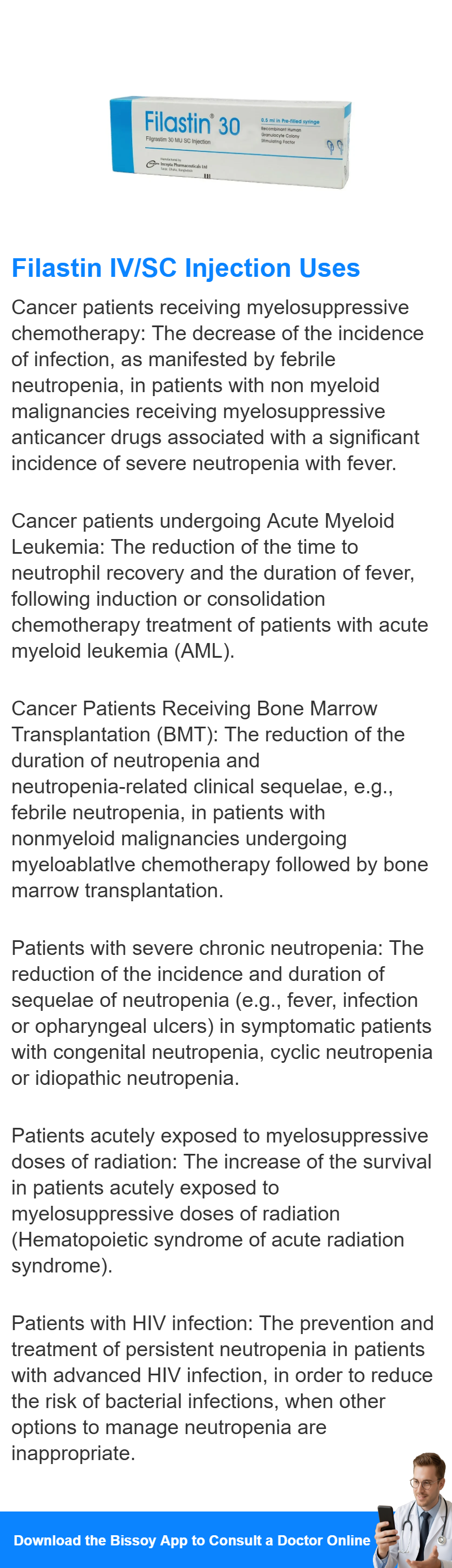
Filastin IV/SC Injection 300 mcg/0.5 ml is a recombinant human granulocyte colony-stimulating factor (G-CSF) that stimulates the production, maturation, and release of neutrophils from the bone marrow. It is used to reduce the risk and duration of neutropenia and related infections in patients receiving myelosuppressive chemotherapy or bone marrow transplantation. Filastin IV/SC Injection 300 mcg/0.5 ml also accelerates neutrophil recovery after chemotherapy, mobilizes hematopoietic stem cells into the peripheral blood for collection prior to transplantation, and is used in the management of severe chronic neutropenia, including congenital, cyclic, and idiopathic forms. Additionally, it helps treat myelosuppression resulting from radiation exposure.
Associated Conditions
Pharmacodynamics
Filastin IV/SC Injection 300 mcg/0.5 ml binds to the G-CSF receptor and stimulates the production of neutrophils in the bone marrow . Colony-stimulating factors are glycoproteins which act on hematopoietic cells by binding to specific cell surface receptors, in turn, stimulating proliferation and differentiation .
G-CSF and its receptor are necessary for basal and stress-induced granulopoiesis, which forms neutrophils. Mice deficient in G-CSF or G-CSFR have severe neutropenia and reduced levels (~50%) of late-stage neutrophil precursors in the bone marrow under normal, resting conditions .
Endogenous G-CSF is a lineage-specific colony-stimulating factor that is produced by monocytes‚ fibroblasts, and endothelial cells. G-CSF regulates the production of neutrophils within the bone marrow and enhances neutrophil progenitor proliferation‚ differentiation, and selected end-cell functions (including enhanced phagocytic ability‚ priming of the cellular metabolism associated with respiratory burst‚ antibody-dependent killing, and enhanced expression of certain cell surface antigens). G-CSF is not species-specific and has demonstrated to have negligible direct in vivo or in vitro effects on the production or action of hematopoietic cell types other than the neutrophil and its lineage.
Mechanism of Action
As a G-CSF analog, this drug controls the proliferation of committed progenitor cells and influences their maturation into mature neutrophils. Filastin IV/SC Injection 300 mcg/0.5 ml also stimulates the release of neutrophils from bone marrow storage pools and decreases their time to maturation. Filastin IV/SC Injection 300 mcg/0.5 ml acts to increase the phagocytic activity of mature neutrophils, thus allowing them to prevent infection. In patients receiving cytotoxic chemotherapy, filgrastim may accelerate neutrophil recovery, leading to a reduction in the duration of the neutropenic phase post chemotherapy .
Used in the treatment of chemotherapy-induced neutropenia by enhancing the production of neutrophils, filgrastim acts on hematopoietic cells by binding to specific cell surface receptors, thereby stimulating proliferation, differentiation, commitment, and end cell functional activation. In one efficacy study, levels of neutrophils returned to baseline by 21 days following completion of chemotherapy and the administration of tbo-filgrastim (fast-acting) .
In phase 1 studies involving 96 patients with various non-myeloid malignancies‚ filgrastim administration resulted in a dose-dependent increase in circulating neutrophil counts over the dose range of 1 to 70 mcg/kg/day.
This increase in neutrophil counts was seen whether filgrastim was administered intravenous (1 to 70 mcg/kg twice daily)‚ subcutaneous (1 to 3 mcg/kg once daily)‚ or by continuous subcutaneous (SC) infusion (3 to 11 mcg/kg/day). After the discontinuation of filgrastim therapy‚ neutrophil counts returned to baseline in most cases within only 4 days after Nevistym was used .
Absorption
Absorption and clearance of Neupogen follows first-order pharmacokinetics without concentration dependence. Subcutaneous administration of 3.45 mcg/kg and 11.5 mcg/kg of filgrastim resulted in maximum serum concentrations of 4 and 49 ng/mL‚ respectively‚ within 2-8 hours . Filastin IV/SC Injection 300 mcg/0.5 ml does not accumulate. It is estimated that when filgrastim is subcutaneously administered, the absolute bioavailability is approximately 62% and 71% for 375 mcg and 750 mcg doses respectively. When 5 mcg/kg tbo-filgrastim is subcutaneously administered, the absolute bioavailability is 33%. It takes 4-6 hours for tho-filgrastim to reach maximum concentration .
Volume of Distribution
150 mL/kg
Route of Elimination
Filastin IV/SC Injection 300 mcg/0.5 ml products demonstrate nonlinear pharmacokinetics. The clearance is dependent on filgrastim product concentration in addition to neutrophil count. G-CSF receptor-mediated clearance is saturated by a high concentration of filgrastim products and is diminished by neutropenia. In addition, filgrastim products are cleared by the kidney .
Half Life
Elimination half-life was approximately 3.5 hours in both normal subjects and cancer subjects
Clearance
0.5 - 0.7 mL/minute/kg after SC administration of 3.45 mcg/kg and 11.5 mcg/kg in both normal subjects and cancer patients
Toxicity
There are numerous adverse effects associated with Filgastrim. They are organized by organ system as follows:
Generalized effects
Serious allergic reactions, including anaphylaxis: Permanently discontinue NIVESTYM in patients with serious allergic reactions. With non-myeloid malignancies receiving myelosuppressive anti-cancer drugs (≥ 5% difference in incidence compared to placebo) are pyrexia, pain, rash, cough, and dyspnea . With AML (≥ 2% difference in incidence) are pain, epistaxis and rash . With severe chronic neutropenia (SCN) (≥ 5% difference in incidence) are pain, anemia, epistaxis, diarrhea, hypoesthesia, and alopecia .
Musculoskeletal system
Exacerbation of arthritic symptoms has been uncommonly observed .
Spleen
Fatal splenic rupture: Evaluate patients who report left upper abdominal or shoulder pain for an enlarged spleen or splenic rupture. Cases of splenomegaly and splenic rupture have been reported uncommonly following administration of filgrastim. Some cases of splenic rupture were fatal .
Respiratory system
Acute respiratory distress syndrome (ARDS): Evaluate patients who develop fever and lung infiltrates or respiratory distress for ARDS. Discontinue filgrastim in patients with ARDS . Pulmonary adverse effects, in particular interstitial lung disease, have been reported after G-CSF administration. Patients with a recent history of lung infiltrates or pneumonia may be at higher risk. The onset of pulmonary signs, such as cough, fever and dyspnea in association with radiological signs of pulmonary infiltrates and deterioration in pulmonary function may be preliminary signs of acute respiratory distress syndrome (ARDS). Filastin IV/SC Injection 300 mcg/0.5 ml should be discontinued and appropriate treatment should be given .
Hematological system
Fatal sickle cell crises have occurred.
The granulocyte-colony stimulating factor can promote the malignant growth of myeloid cells in vitro and the same effects may be seen on some non-myeloid cells in vitro. The safety and efficacy of filgrastim administration in patients with myelodysplastic syndrome, or chronic myelogenous leukemia have not been established. Filastin IV/SC Injection 300 mcg/0.5 ml is not indicated for use in these conditions. Particular care should be taken to distinguish the diagnosis of blast transformation of chronic myeloid leukemia from acute myeloid leukemia .
Capillary leak syndrome has been reported after granulocyte colony-stimulating factor administration, and is characterised by hypotension, hypoalbuminaemia, edema and hemoconcentration. Patients who show symptoms of capillary leak syndrome must be closely monitored and receive standard symptomatic treatment, which may include a need for intensive care .
Leukocytosis (white blood cell (WBC) > 50 x 109/l) was seen in 41% of donors and transient thrombocytopenia (platelets < 100 x 109/l) following filgrastim and leukapheresis was observed in 35% of donors .
Renal system
This drug increases the risk of glomerulonephritis. Evaluate and consider dose-reduction or interruption of filgrastim if causality is likely .
Food Interactions
No interactions found.
Dosage
Parenteral-
Chemotherapy-induced neutropenia: 5 mcg/kg daily as a single daily SC inj, as a continuous IV or SC infusion, or as a daily IV infusion over 15-30 minutes, starting notBone marrow transplantation: 10 mcg/kg daily by IV infusion over 30 min or 4 hr or continuous IV or SC infusion over 24 hr. Adjust according to response.
Subcutaneous-
Mobilisation of peripheral blood progenitor cells for autologous peripheral blood stem cell transplantation: 10 mcg/kg daily, as a single inj or by continuous infusion, for 4-7 days until the last leucapheresis procedure. If it is given after myelosuppressive chemotherapy: 5 mcg/kg daily by inj; given from the 1st day after chemotherapy completion until expected neutrophil nadir is passed and neutrophil count has returned to normal range, so that leucapheresis can be performed.Congenital neutropenia: 12 mcg/kg daily in single or divided doses. Adjust according to response. In patients with cyclic or idiopathic neutropenia: 5 mcg/kg daily in single or divided doses. Adjust according to response.
HIV infection and persistent neutropenia: Initially, 1 mcg/kg daily. Dose may be increased to 4 mcg/kg daily until normal neutrophil count is achieved. Maintenance: 300 mcg daily. Max: 4 mcg/kg daily.