Introduction
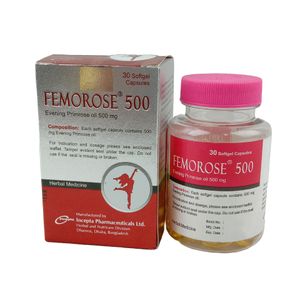
Femorose Soft Gelatin Capsule 500 mg comes from the extraction from Oenothera biennis seeds and it is commonly used as an alternative source for omega-6 essential fatty acids. In its composition it presents some fatty acids such as Linolenic acid and Gamolenic acid. Femorose Soft Gelatin Capsule 500 mg has been filled for the FDA by Humanetics Corporation on April 2000 to be a new dietary ingredient but its current status is "Inadequate basis for expectation of safety". By Health Canada, evening primrose oil is approved in over-the-counter combination dietary supplements. By the EMA, evening primrose oil is approved in herbal preparations.
Uses
Femorose Soft Gelatin Capsule 500 mg is used as part of over-the-counter dietary supplements.
It is also used for the treatment of systemic inflammatory diseases and for women's health conditions such as cyclical mastalgia. These indications do not have sufficient evidence of their effectiveness. It was used for the treatment of atopic dermatitis in the United Kingdom but it is currently withdrawn due to lack of evidence of effectiveness.
Associated Conditions
Pharmacodynamics
The effectivity of evening primrose oil is debatable as the evidence is very limited. Femorose Soft Gelatin Capsule 500 mg improves the essential fatty acid content in plasma, erythrocyte, and platelet lipids. It has also been registered to increase alpha-tocopherol levels in non-diabetic and type I diabetic patients. Femorose Soft Gelatin Capsule 500 mg affects the fatty acid composition of serum lipids and adipose tissue as well as it helps maintain normal cellular structures and it serves as a prostaglandin precursor. Administration of evening primrose oil is part of long-term therapy and thus, immediate results are never expected.
Mechanism of Action
Femorose Soft Gelatin Capsule 500 mg presents a content of 74% Linolenic acid and 9% Gamolenic acid from which the later seems to be the key active ingredient of this oil. These major essential fatty acids are required for the normal structure of cell membranes and they are not synthesized endogenously. The therapeutic activity of evening primrose oil is attributed to the direct action of its essential fatty acids on immune cells as well as to an indirect effect on the synthesis of eicosanoids. The actions of highly unsaturated fatty acids in tissues and eicosanoids are thought to be implicated in inflammatory and immunologic pathogeneses.
The essential fatty acids found in evening primrose oil are involved in the biosynthesis of prostaglandin. For this activity, the main involved component is the Gamolenic acid. The presence of this essential fatty acid allows the synthesis of anti-inflammatory substances such as 15-hydroxy-eicosatrienoic acid and prostaglandin E1.
Absorption
The pharmacokinetics of evening primrose oil is mainly studied by analyzing its active ingredient Gamolenic acid. After administration, Gamolenic acid is rapidly absorbed and converted directly to Dihomo-gamma-linolenic acid and other precursors. When orally administered, the tmax was directly dependent to the time of administration, being of 2.7 hours in the evening and 4.4 hours in the morning. The Cmax and AUC were registered to be approximately 21 mcg/ml and 274 mcg.h/ml. The bioavailability of Gamolenic acid acid is influenced by triglyceride composition, cellular kinetics of phospholipases and acyltransferases.
Volume of Distribution
No pharmacokinetic data available.
Protein Binding
No pharmacokinetic data available.
Route of Elimination
The major components of the primrose oil are highly metabolized and the majority of the generated metabolites are excreted in the urine.
Half Life
No pharmacokinetic data available.
Clearance
No pharmacokinetic data available.
Toxicity
Femorose Soft Gelatin Capsule 500 mg seems to have little toxicological effect in humans. The reported LD50 values in the mouse are 3.12 x 10^4 mcg/kg. The toxicological effects are very minimal and it has proven to not have an effect on tumor incidence nor to present effects on fertility studies.
Dosage
- Adult dosage: 1 capsule 2 times daily.
- Children dosage: 1 capsule 1/2 times daily.
Premenstrual Syndrome (PMS): 1 Capsule 2 times daily at morning & night with or after meal.
Rheumatoid arthritis: 1 Capsule daily Or as directed by the registered physician.