Introduction
Scopolamine is a tropane alkaloid isolated from members of the Solanaceae family of plants, similar to atropine and hyoscyamine, all of which structurally mimic the natural neurotransmitter acetylcholine. Scopolamine was first synthesized in 1959, but to date, synthesis remains less efficient than extracting scopolamine from plants. As an acetylcholine analogue, scopolamine can antagonize muscarinic acetylcholine receptors (mAChRs) in the central nervous system and throughout the body, inducing several therapeutic and adverse effects related to alteration of parasympathetic nervous system and cholinergic signalling. Due to its dose-dependent adverse effects, scopolamine was the first drug to be offered commercially as a transdermal delivery system, Scopoderm TTS®, in 1981. As a result of its anticholinergic effects, scopolamine is being investigated for diverse therapeutic applications; currently, it is approved for the prevention of nausea and vomiting associated with motion sickness and surgical procedures.
Scopolamine was first approved by the FDA on December 31, 1979, and is currently available as both oral tablets and a transdermal delivery system.
Uses
Scopolamine is a belladonna alkaloid with anticholinergic effects indicated for the treatment of nausea and vomiting associated with motion sickness and postoperative nausea and vomiting (PONV).
Scopolamine is indicated in adult patients for the prevention of nausea and vomiting associated with motion sickness and for the prevention of postoperative nausea and vomiting (PONV) associated with anesthesia or opiate analgesia.
Associated Conditions
Pharmacodynamics
Scopolamine is an anticholinergic belladonna alkaloid that, through competitive inhibition of muscarinic receptors, affects parasympathetic nervous system function and acts on smooth muscles that respond to acetylcholine but lack cholinergic innervation. Formulated as a patch, scopolamine is released continuously over three days and remains detectable in urine over a period of 108 hours. Scopolamine is contraindicated in angle-closure glaucoma and should be used with caution in patients with open-angle glaucoma due to scopolamine's ability to increase intraocular pressure. Also, scopolamine exhibits several neuropsychiatric effects: exacerbated psychosis, seizures, seizure-like, and other psychiatric reactions, and cognitive impairment; scopolamine may impair the ability of patients to operate machinery or motor vehicles, play underwater sports, or perform any other potentially hazardous activity. Women with severe preeclampsia should avoid scopolamine. Patients with gastrointestinal or urinary disorders should be monitored frequently for impairments, and scopolamine should be discontinued if these develop. Scopolamine can cause blurred vision if applied directly to the eye, and the transdermal patch should be removed before an MRI procedure to avoid skin burns. Due to its gastrointestinal effects, scopolamine can interfere with gastric secretion testing and should be discontinued at least 10 days before performing the test. Finally, scopolamine may induce dependence and resulting withdrawal symptoms, such as nausea, dizziness, vomiting, gastrointestinal disturbances, sweating, headaches, bradycardia, hypotension, and various neuropsychiatric manifestations following treatment discontinuation; severe symptoms may require medical attention.
Mechanism of Action
Acetylcholine (ACh) is a neurotransmitter that can signal through ligand-gated cation channels (nicotinic receptors) and G-protein-coupled muscarinic receptors (mAChRs). ACh signalling via mAChRs located in the central nervous system (CNS) and periphery can regulate smooth muscle contraction, glandular secretions, heart rate, and various neurological phenomena such as learning and memory. mAChRs can be divided into five subtypes, M1-M5, expressed at various levels throughout the brain. Also, M2 receptors are found in the heart and M3 receptors in smooth muscles, mediating effects apart from the direct modulation of the parasympathetic nervous system. While M1, M3, and M5 mAChRs primarily couple to Gq proteins to activate phospholipase C, M2 and M4 mainly couple to Gi/o proteins to inhibit adenylyl cyclase and modulate cellular ion flow. This system, in part, helps to control physiological responses such as nausea and vomiting.
Scopolamine acts as a non-selective competitive inhibitor of M1-M5 mAChRs, albeit with weaker M5 inhibition; as such, scopolamine is an anticholinergic with various dose-dependent therapeutic and adverse effects. The exact mechanism(s) of action of scopolamine remains poorly understood. Recent evidence suggests that M1 (and possibly M2) mAChR antagonism at interneurons acts through inhibition of downstream neurotransmitter release and subsequent pyramidal neuron activation to mediate neurological responses associated with stress and depression. Similar antagonism of M4 and M5 receptors is associated with potential therapeutic benefits in neurological conditions such as schizophrenia and substance abuse disorders. The significance of these observations to scopolamine's current therapeutic indications of preventing nausea and vomiting is unclear but is linked to its anticholinergic effect and ability to alter signalling through the CNS associated with vomiting.
Absorption
The pharmacokinetics of scopolamine differ substantially between different dosage routes. Oral administration of 0.5 mg scopolamine in healthy volunteers produced a Cmax of 0.54 ± 0.1 ng/mL, a tmax of 23.5 ± 8.2 min, and an AUC of 50.8 ± 1.76 ng*min/mL; the absolute bioavailability is low at 13 ± 1%, presumably because of first-pass metabolism. By comparison, IV infusion of 0.5 mg scopolamine over 15 minutes resulted in a Cmax of 5.00 ± 0.43 ng/mL, a tmax of 5.0 min, and an AUC of 369.4 ± 2.2 ng*min/mL.
Other dose forms have also been tested. Subcutaneous administration of 0.4 mg scopolamine resulted in a Cmax of 3.27 ng/mL, a tmax of 14.6 min, and an AUC of 158.2 ng*min/mL. Intramuscular administration of 0.5 scopolamine resulted in a Cmax of 0.96 ± 0.17 ng/mL, a tmax of 18.5 ± 4.7 min, and an AUC of 81.3 ± 11.2 ng*min/mL. Absorption following intranasal administration was found to be rapid, whereby 0.4 mg of scopolamine resulted in a Cmax of 1.68 ± 0.23 ng/mL, a tmax of 2.2 ± 3 min, and an AUC of 167 ± 20 ng*min/mL; intranasal scopolamine also had a higher bioavailability than that of oral scopolamine at 83 ± 10%.
Due to dose-dependent adverse effects, the transdermal patch was developed to obtain therapeutic plasma concentrations over a longer period of time. Following patch application, scopolamine becomes detectable within four hours and reaches a peak concentration (tmax) within 24 hours. The average plasma concentration is 87 pg/mL, and the total levels of free and conjugated scopolamine reach 354 pg/mL.
Volume of Distribution
The volume of distribution of scopolamine is not well characterized. IV infusion of 0.5 mg scopolamine over 15 minutes resulted in a volume of distribution of 141.3 ± 1.6 L.
Protein Binding
Scopolamine may reversibly bind plasma proteins in humans. In rats, scopolamine exhibits relatively low plasma protein binding of 30 ± 10%.
Route of Elimination
Following oral administration, approximately 2.6% of unchanged scopolamine is recovered in urine. Compared to this, using the transdermal patch system, less than 10% of the total dose, both as unchanged scopolamine and metabolites, is recovered in urine over 108 hours. Less than 5% of the total dose is recovered unchanged.
Half Life
The half-life of scopolamine differs depending on the route. Intravenous, oral, and intramuscular administration have similar half-lives of 68.7 ± 1.0, 63.7 ± 1.3, and 69.1 ±8/0 min, respectively. The half-life is greater with subcutaneous administration at 213 min. Following removal of the transdermal patch system, scopolamine plasma concentrations decrease in a log-linear fashion with a half-life of 9.5 hours.
Clearance
IV infusion of 0.5 mg scopolamine resulted in a clearance of 81.2 ± 1.55 L/h, while subcutaneous administration resulted in a lower clearance of 0.14-0.17 L/h.
Toxicity
Scopolamine overdose may manifest as lethargy, somnolence, coma, confusion, agitation, hallucinations, convulsion, visual disturbance, dry flushed skin, dry mouth, decreased bowel sounds, urinary retention, tachycardia, hypertension, and supraventricular arrhythmias. In some cases, overdose symptoms may appear similar to those associated with withdrawal following discontinuation. However, withdrawal symptoms such as bradycardia, headache, nausea, abdominal cramps, and sweating can help to distinguish between these possibilities. Overdose management primarily involves the removal of all transdermal patch systems combined with symptomatic and supportive care. Ensuring an adequate airway, supplemental oxygen, establishing intravenous access, and continuous monitoring are recommended. In cases where patients have swallowed one or more patch systems, it may be necessary to remove them or administer activated charcoal.
Animal studies revealed an oral LD50 of 1880 mg/kg in mice and 1270 mg/kg in rats, and a subcutaneous LD50 of 1650 mg/kg in mice and 296 mg/kg in rats.
Food Interactions
- Avoid grapefruit products. Coadministration of scopolamine with grapefruit juice has been shown to delay scopolamine absorption and increase its bioavailability without altering its elimination.
Dosage
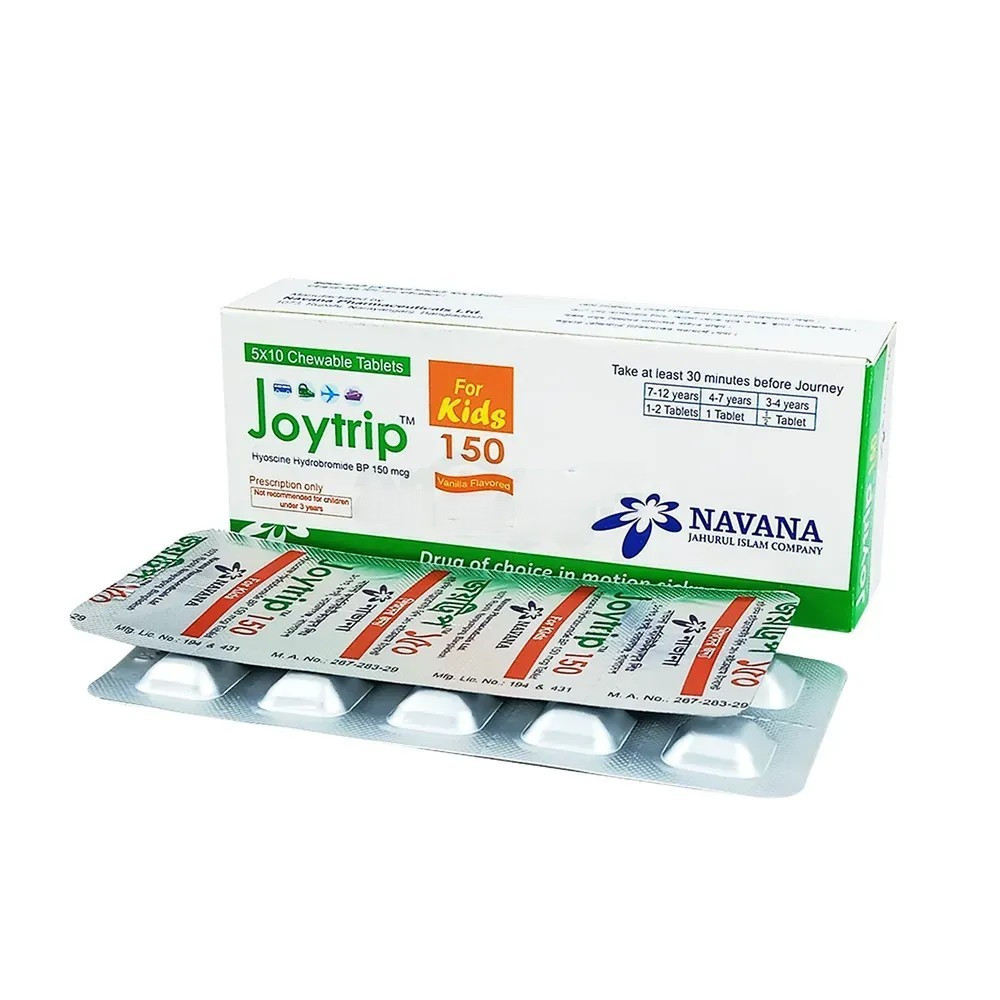
Children age 7-12 years: 1-2 tablets (Maximum 2 tablets in 24 hours).
Children age 4-7 years: 1 tablet (Maximum 2 tablets in 24 hours).
Children age 3-4 years: half a tablet (Maximum 1 tablet in 24 hours).
Children under 3 years: Not recommended under 3 years or as directed by the physician.