Introduction
Ezeta Tablet 10 mg is a lipid-lowering agent that works by inhibiting the absorption of cholesterol from the small intestine. It is commonly used to treat hypercholesterolemia and is often combined with statins to achieve optimal lipid-lowering effects. Ezeta Tablet 10 mg is marketed under the brand name Zetia and is primarily used to reduce levels of total cholesterol, low-density lipoprotein (LDL) cholesterol, and apolipoprotein B.
Uses
Ezeta Tablet 10 mg is used to lower cholesterol levels in patients with primary hyperlipidemia (high cholesterol) and homozygous familial hypercholesterolemia. It is also used to reduce cholesterol levels in patients with homozygous sitosterolemia, a condition that causes increased absorption of plant sterols. Ezeta Tablet 10 mg can be used alone or in combination with other lipid-lowering agents, such as statins.
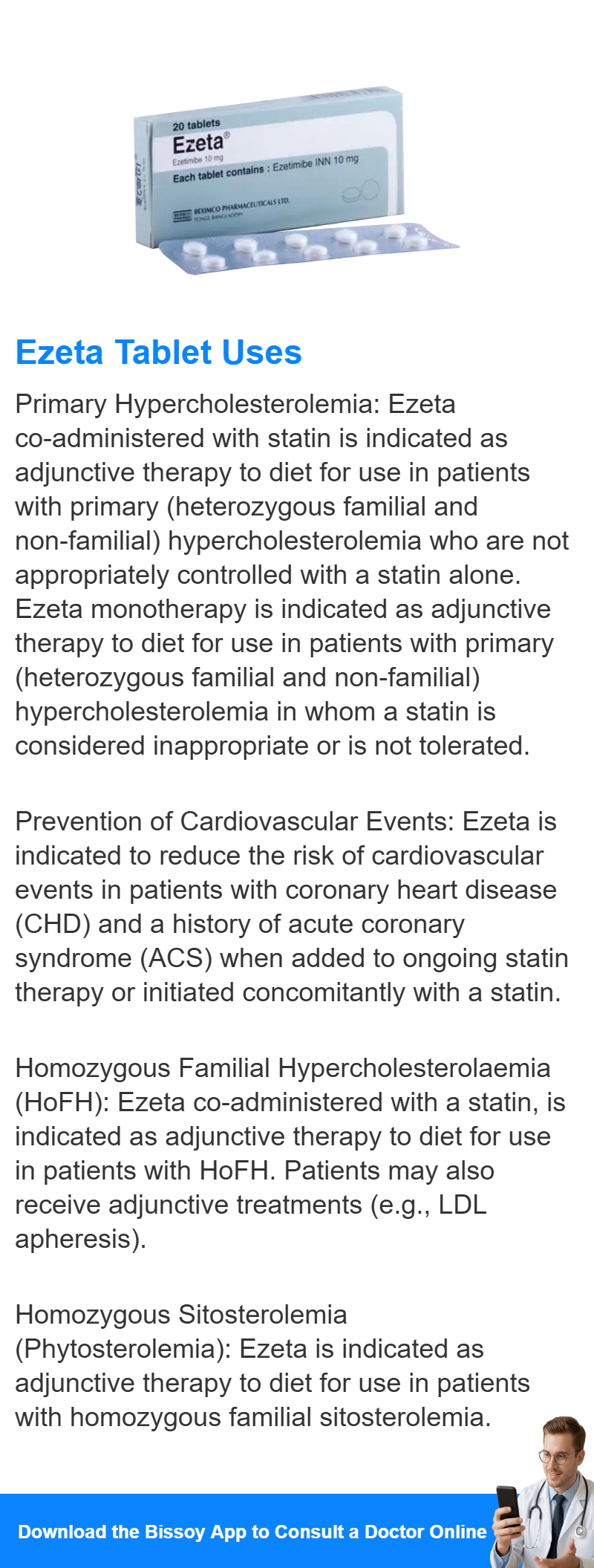
| Brand Name | Ezeta |
|---|---|
| Type | Tablet |
| Weight | 10 mg |
| Generic | Ezetimibe |
| Manufacturer | Beximco Pharmaceuticals Ltd. |
| Available in | English বাংলা |
Mechanism of Action
Ezeta Tablet 10 mg selectively inhibits the Niemann-Pick C1-like 1 (NPC1L1) protein located in the brush border of the small intestine. This protein plays a critical role in the absorption of cholesterol from dietary sources. By inhibiting NPC1L1, ezetimibe reduces the intestinal absorption of cholesterol, leading to a decrease in the amount of cholesterol delivered to the liver, which in turn lowers circulating cholesterol levels.
How Long Does It Take to Work?
Ezeta Tablet 10 mg begins to reduce cholesterol levels within 1 to 2 weeks of initiation. Maximal reduction in cholesterol levels is usually observed within 2 to 4 weeks of continuous treatment. The response to the drug varies depending on whether it is used as monotherapy or in combination with a statin.
Absorption
Ezeta Tablet 10 mg is rapidly absorbed from the gastrointestinal tract after oral administration. Peak plasma concentrations are achieved within 1 to 2 hours. The drug undergoes enterohepatic recycling, which prolongs its presence in the system and enhances its effect on cholesterol absorption.
Route of Elimination
After oral administration, ezetimibe is metabolized in the liver and small intestine to form ezetimibe-glucuronide, which is the active metabolite. Ezeta Tablet 10 mg is excreted in both the feces (approximately 78%) and urine (approximately 11%), primarily in the form of metabolites.
Dosage
The patient should be on an appropriate lipid lowering diet and should continue on this diet during treatment with Ezetimibe.Adult Dose: The recommended dose is Ezetimibe 10 mg tablet once daily. Ezetimibe can be administered at any time of the day, with or without food.
Use in the elderly: No dosage adjustment is required for elderly patients.
Pediatric Use-
- 10 to 17 years: No dosage adjustment is required. The clinical experience in pediatric and adolescent patients is however limited. When Ezetimibe is administered with statin, the dosage instructions for statin, in adolescents should be consulted.
- Children <10 years: Ezetimibe is not recommended for use in children below age 10 due to insufficient data on safety and efficacy.
Use in renal impairment: No dosage adjustment is required for renally impaired patients
Recommended Dosage for Adults:
- Primary Hyperlipidemia: The recommended dose of ezetimibe is 10 mg once daily, taken with or without food.
- Homozygous Familial Hypercholesterolemia: The recommended dose is 10 mg once daily in combination with a statin or other lipid-lowering treatments such as LDL apheresis.
- Homozygous Sitosterolemia: The recommended dose is 10 mg once daily.
- Elderly: No dosage adjustment is necessary in elderly patients.
- Renal Impairment: No dosage adjustment is required in patients with mild to moderate renal impairment. In severe renal impairment, ezetimibe should be used with caution.
- Hepatic Impairment: Ezeta Tablet 10 mg should be avoided in patients with moderate or severe hepatic impairment.
Administration
Ezeta Tablet 10 mg is taken orally, typically once daily. It can be taken with or without food. When combined with a statin, both drugs can be taken simultaneously. If the patient is also on bile acid sequestrants, ezetimibe should be administered either 2 hours before or 4 hours after the bile acid sequestrant to avoid interference with its absorption.
Side Effects
Common side effects of ezetimibe include headache, diarrhea, upper respiratory tract infection, sinusitis, and myalgia (muscle pain). Less commonly, patients may experience elevated liver enzymes or muscle pain, especially when ezetimibe is used in combination with a statin.
Toxicity
Ezeta Tablet 10 mg is generally well-tolerated, even at higher doses. However, overdose may result in more severe side effects, such as muscle pain, liver dysfunction, and gastrointestinal disturbances. In case of overdose, symptomatic treatment is recommended. Monitoring liver function and muscle symptoms may be necessary in severe cases.
Precautions
Patients with moderate to severe hepatic impairment should avoid ezetimibe. Regular monitoring of liver enzymes is recommended, especially when used in combination with statins. Caution should be exercised in patients who have had a history of muscle-related side effects with statins, as the combination with ezetimibe may increase the risk of myopathy or rhabdomyolysis.
Interaction
Ezeta Tablet 10 mg may interact with other lipid-lowering agents, particularly statins and fibrates, leading to an increased risk of myopathy. It can also interact with bile acid sequestrants, which reduce the absorption of ezetimibe if not spaced appropriately. Inhibitors or inducers of cytochrome P450 enzymes have minimal interaction with ezetimibe since it is not metabolized by these enzymes.
Disease Interaction
Ezeta Tablet 10 mg should be used with caution in patients with liver disease or elevated liver enzymes, particularly when combined with statins. Additionally, it may exacerbate the risk of myopathy in patients predisposed to muscle disorders. In patients with severe renal impairment, caution is advised, especially when used in combination with statins.
Drug Interaction
Ezeta Tablet 10 mg can interact with bile acid sequestrants, such as cholestyramine, which reduce its absorption. To avoid this interaction, ezetimibe should be taken either 2 hours before or 4 hours after the bile acid sequestrant. When combined with fibrates, there may be an increased risk of gallstones and myopathy. Interaction with cyclosporine may lead to increased levels of both drugs and should be monitored closely.
Food Interactions
There are no significant food interactions with ezetimibe. It can be taken with or without food, and its efficacy is not affected by dietary intake. However, patients are advised to follow a cholesterol-lowering diet for optimal results while on the medication.
Pregnancy Use
Ezeta Tablet 10 mg falls under Pregnancy Category C. There are no well-controlled studies in pregnant women. Ezeta Tablet 10 mg should be used during pregnancy only if the potential benefit justifies the potential risk to the fetus. When used in combination with statins, ezetimibe is contraindicated in pregnancy due to the potential teratogenic effects of statins.
Lactation Use
It is not known whether ezetimibe is excreted in human milk. Due to the potential for adverse effects in nursing infants, caution should be exercised when administering ezetimibe to breastfeeding women. The decision to discontinue breastfeeding or discontinue the drug should be made, considering the importance of the drug to the mother.
Acute Overdose
Limited data are available on ezetimibe overdose. In clinical studies, patients receiving up to 50 mg/day did not show significant adverse effects. In case of acute overdose, symptomatic and supportive care should be provided. Monitoring of liver function and muscle symptoms is recommended.
Contraindication
Ezeta Tablet 10 mg is contraindicated in patients with active liver disease or unexplained persistent elevations of serum transaminases, particularly when used in combination with statins. It is also contraindicated in patients with known hypersensitivity to ezetimibe or any of its components.
Use Direction
Ezeta Tablet 10 mg should be taken orally, usually once a day. It can be taken with or without food, and it should be taken consistently at the same time each day. If used with a bile acid sequestrant, it should be administered at least 2 hours before or 4 hours after the sequestrant. Adherence to a low-cholesterol diet is recommended during treatment.
Storage Conditions
Ezeta Tablet 10 mg should be stored at room temperature, between 20°C to 25°C (68°F to 77°F). Keep it in its original packaging, away from moisture and heat, and out of the reach of children.
Volume of Distribution
The volume of distribution of ezetimibe is approximately 107.5 liters. Ezeta Tablet 10 mg is highly protein-bound (about 90%), mainly to albumin, which influences its distribution in the body.
Half Life
The elimination half-life of ezetimibe and its active metabolite (ezetimibe-glucuronide) is approximately 22 hours. This long half-life allows for once-daily dosing.
Clearance
The clearance of ezetimibe occurs primarily through biliary excretion. Ezeta Tablet 10 mg undergoes enterohepatic recirculation, which prolongs its half-life and contributes to its sustained cholesterol-lowering effects.
See in details version Ezeta Tablet 10 mg also Ezeta Tablet 10 mg in bangla
Social card

Some Frequently Asked Questions About Ezeta Tablet 10 mg


Dr. Md. Ashrafuzzaman Khan
Neurology (Brain, Nerve, Spine, Headache, Backpain) Specialist

