Introduction
Rivastigmine is a parasympathomimetic or cholinergic agent for the treatment of mild to moderate dementia of the Alzheimer's type. Rivastigmine is a cholinesterase inhibitor that inhibits both butyrylcholinesterase and acetylcholinesterase.
Uses
Rivastigmine is a cholinesterase inhibitor used to treat mild to moderate dementia in Alzheimer's and Parkinson's.
For the treatment of mild to moderate dementia associated with Parkinson's disease or of the Alzheimer's type.
Associated Conditions
Pharmacodynamics
Rivastigmine is a parasympathomimetic and a reversible cholinesterase inhibitor. An early pathophysiological feature of Alzheimer's disease that is associated with memory loss and cognitive deficits is a deficiency of acetylcholine as a result of selective loss of cholinergic neurons in the cerebral cortex, nucleus basalis, and hippocampus. Tacrine is postulated to exert its therapeutic effect by enhancing cholinergic function. While the precise mechanism of rivastigmine's action is unknown, it is postulated to exert its therapeutic effect by enhancing cholinergic function. This is accomplished by increasing the concentration of acetylcholine through reversible inhibition of its hydrolysis by cholinesterase. If this proposed mechanism is correct, rivastigmine's effect may lessen as the disease progresses and fewer cholinergic neurons remain functionally intact.
Mechanism of Action
Rivastigmine is a carbamate derivative that is structurally related to physostigmine, but not to donepezil and tacrine. The precise mechanism of rivastigmine has not been fully determined, but it is suggested that rivastigmine binds reversibly with and inactivates chlolinesterase (eg. acetylcholinesterase, butyrylcholinesterase), preventing the hydrolysis of acetycholine, and thus leading to an increased concentration of acetylcholine at cholinergic synapses. The anticholinesterase activity of rivastigmine is relatively specific for brain acetylcholinesterase and butyrylcholinesterase compared with those in peripheral tissues.
Volume of Distribution
- 1.8 to 2.7 L/kg
Protein Binding
40%
Route of Elimination
Rivastigmine is extensively metabolized primarily via cholinesterase-mediated hydrolysis to the decarbamylated metabolite NAP226-90. Renal excretion of the metabolites is the major route of elimination. Less than 1% of the administered dose is excreted in the feces.
Half Life
1.5 hours
Clearance
- renal cl=2.1-2.8 L/hr
Food Interactions
- Take with food. Administering rivastigmine capsules with food delays absorption but increases the AUC.
Dosage
- Initial dose: Rivastigmine 1.5 mg twice a day.
- Dose titration: The starting dose is Rivastigmine 1.5 mg twice a day. If this dose is well tolerated after a minimum of two weeks of treatment, the dose may be increased to Rivastigmine 3 mg twice a day. Subsequent increases to 4.5 mg and then 6 mg twice a day should also be based on good tolerability of the current dose and may be considered after a minimum of two weeks of treatment at that dose level.
- Maintenance dose: The effective dose is 3 mg to 6 mg twice a day; to achieve maximum therapeutic benefit patients should be maintained on their highest well tolerated dose. The recommended maximum daily dose is 6 mg twice a day. Maintenance treatment can be continued for as long as a therapeutic benefit for the patient exists.
- Re-initiation of therapy: If treatment is interrupted for more than several days, it should be re-initiated at 1.5 mg twice daily. Dose titration should then be carried out as described above.
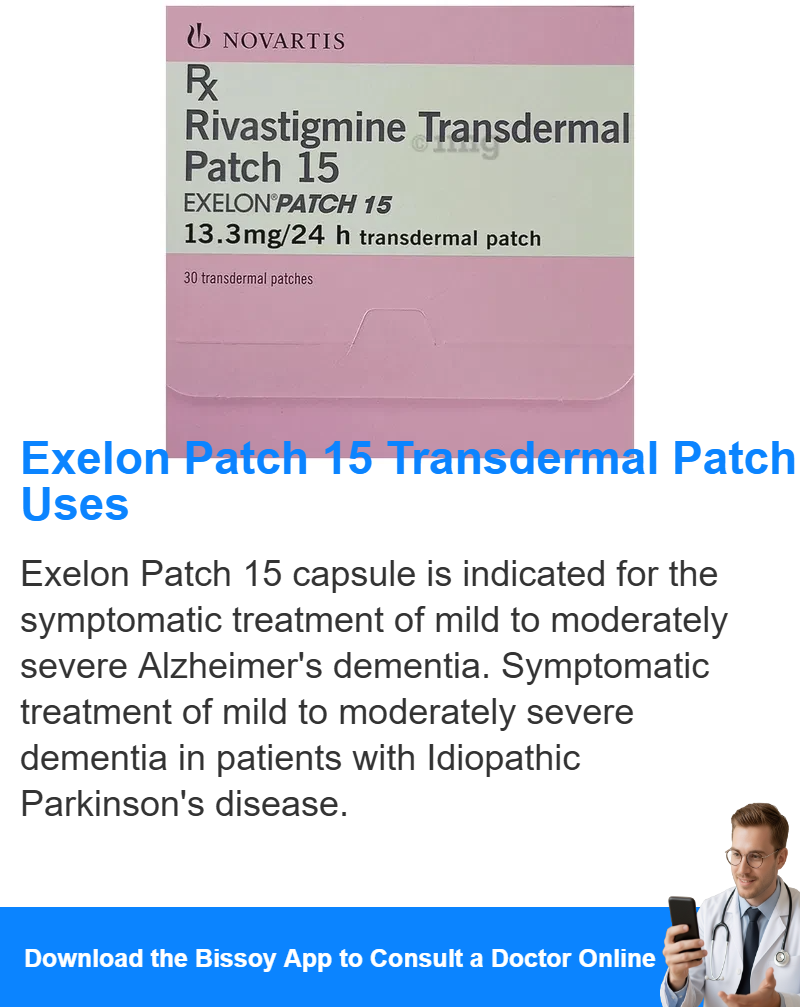
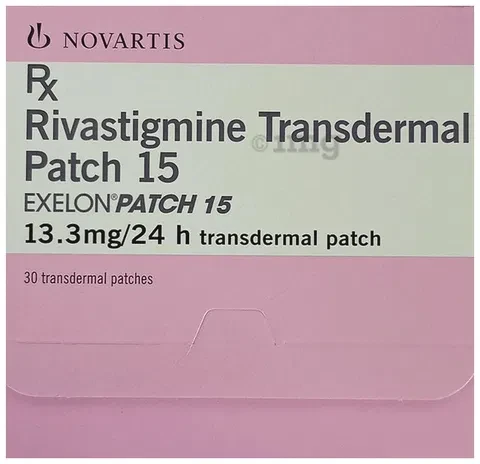
- Initial Dose: Initiate treatment with 4.6 mg/24 hours Rivastigmine transdermal patch.
- Dose Titration: After a minimum of 4 weeks, if tolerated, increase dose to 9.5 mg/24 hours, which is the minimum effective dose. Following a minimum additional 4 weeks, may increase dosage to maximum dosage of 13.3 mg/24 hours.
- Mild to Moderate Alzheimer's Disease and Parkinson’s Disease Dementia: Rivastigmine transdermal patch 9.5 mg/24 hours or 13.3 mg/24 hours once daily.
- Severe Alzheimer’s Disease: Rivastigmine transdermal patch 13.3 mg/24 hours once daily.
- For treatment interruption longer than 3 days, retitrate dosage starting at 4.6 mg per 24 hours.