Introduction

Rivastigmine tartrate is a reversible inhibitor of the enzyme acetylcholinesterase, used primarily in the treatment of dementia associated with Alzheimer's disease and Parkinson's disease. It helps improve cognitive function by increasing levels of acetylcholine in the brain.

Uses

Rivastigmine tartrate is used for:

  • Treatment of mild to moderate dementia in Alzheimer's disease.
  • Treatment of mild to moderate dementia in Parkinson's disease.
It is not a cure but helps manage symptoms and may slow the progression of cognitive decline.

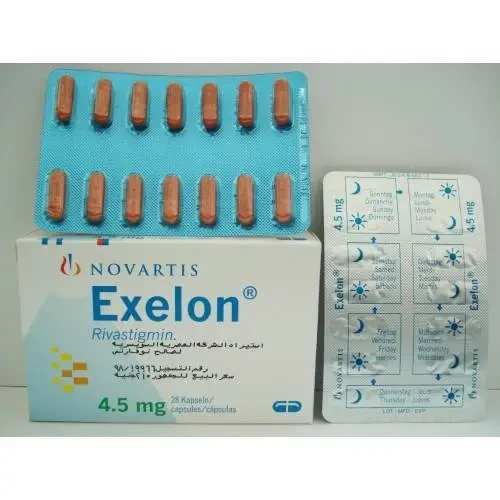
Brand Name Exelon
Type Capsule
Weight 4.5 mg
Generic Rivastigmine Tartrate
Manufacturer Novartis (Bangladesh) Ltd.
Available in English বাংলা

Mechanism of Action

Rivastigmine works by inhibiting the enzyme acetylcholinesterase, which is responsible for the breakdown of acetylcholine, a neurotransmitter involved in memory and cognitive function. By preventing the breakdown of acetylcholine, rivastigmine increases its availability in the brain, thereby improving symptoms of dementia.

How Long Does It Take to Work?

Rivastigmine may start to show effects within a few weeks of treatment, but it can take up to 3 to 6 months to notice significant improvements in cognitive function and daily living activities. Response time may vary based on individual factors and the severity of the condition.

Absorption

Rivastigmine is absorbed from the gastrointestinal tract after oral administration. Its bioavailability is approximately 36% due to first-pass metabolism in the liver. Peak plasma concentrations are usually reached within 1 to 2 hours after oral administration.

Route of Elimination

Rivastigmine is primarily eliminated through hydrolysis in the body. It undergoes metabolism primarily in the liver, and the metabolites are then excreted through the urine. Only a small fraction of the drug is excreted unchanged in the urine.

Dosage

Rivastigmine capsule-
  • Initial dose: Rivastigmine 1.5 mg twice a day.
  • Dose titration: The starting dose is Rivastigmine 1.5 mg twice a day. If this dose is well tolerated after a minimum of two weeks of treatment, the dose may be increased to Rivastigmine 3 mg twice a day. Subsequent increases to 4.5 mg and then 6 mg twice a day should also be based on good tolerability of the current dose and may be considered after a minimum of two weeks of treatment at that dose level.
  • Maintenance dose: The effective dose is 3 mg to 6 mg twice a day; to achieve maximum therapeutic benefit patients should be maintained on their highest well tolerated dose. The recommended maximum daily dose is 6 mg twice a day. Maintenance treatment can be continued for as long as a therapeutic benefit for the patient exists. 
  • Re-initiation of therapy: If treatment is interrupted for more than several days, it should be re-initiated at 1.5 mg twice daily. Dose titration should then be carried out as described above.
Rivastigmine transdermal patch: Apply patch on intact skin for a 24-hour period; replace with a new patch every 24 hours.
  • Initial Dose: Initiate treatment with 4.6 mg/24 hours Rivastigmine transdermal patch.
  • Dose Titration: After a minimum of 4 weeks, if tolerated, increase dose to 9.5 mg/24 hours, which is the minimum effective dose. Following a minimum additional 4 weeks, may increase dosage to maximum dosage of 13.3 mg/24 hours.
  • Mild to Moderate Alzheimer's Disease and Parkinson’s Disease Dementia: Rivastigmine transdermal patch 9.5 mg/24 hours or 13.3 mg/24 hours once daily.
  • Severe Alzheimer’s Disease: Rivastigmine transdermal patch 13.3 mg/24 hours once daily.
  • For treatment interruption longer than 3 days, retitrate dosage starting at 4.6 mg per 24 hours.

Dosage for rivastigmine tartrate varies based on the form of the drug and the patient's condition:

  • For oral capsules: Start with 1.5 mg twice daily, which can be gradually increased to a maximum of 6 mg twice daily, based on tolerance and therapeutic response.
  • For oral solution: Start with 1.5 mg twice daily, with a maximum of 6 mg twice daily.
  • For transdermal patches: Start with 4.6 mg/24 hours, increasing to a maximum of 9.5 mg/24 hours based on patient tolerance and response.

Administration

Rivastigmine can be administered orally or via a transdermal patch. Oral doses should be taken with food to minimize gastrointestinal side effects. Transdermal patches are applied once daily to clean, dry skin on the back, chest, or upper arm, and should be rotated to avoid skin irritation.

Side Effects

Common side effects include:

  • Nausea and vomiting.
  • Diarrhea.
  • Abdominal pain.
  • Loss of appetite.
Less common side effects may include dizziness, tremors, or bradycardia (slow heart rate). Severe allergic reactions or significant gastrointestinal bleeding may also occur.

Toxicity

Toxicity may result from overdose or severe reactions. Symptoms of overdose can include excessive salivation, muscle twitching, or severe gastrointestinal distress. Immediate medical attention is necessary in cases of suspected overdose.

Precautions

Precautions include:

  • Monitoring for gastrointestinal side effects and cardiovascular effects, especially in patients with a history of peptic ulcer disease or bradycardia.
  • Use with caution in patients with hepatic impairment.
  • Discontinuation or dose adjustment may be required if severe side effects occur.

Interaction

Rivastigmine may interact with other medications, particularly those affecting the cholinergic system or those that can exacerbate bradycardia or gastrointestinal side effects. It is important to inform healthcare providers of all concurrent medications.

Disease Interaction

Use rivastigmine with caution in patients with:

  • Peptic ulcer disease or a history of gastrointestinal bleeding.
  • Severe renal or hepatic impairment.
  • Bradycardia or other cardiac conditions.

Drug Interaction

Drug interactions may occur with medications that have anticholinergic properties or those affecting heart rate. Avoid concurrent use with other cholinesterase inhibitors or medications that may exacerbate bradycardia or gastrointestinal distress.

Food Interactions

Rivastigmine can be taken with food to reduce gastrointestinal side effects. There are no significant interactions with specific foods, but maintaining a consistent diet may help manage side effects.

Pregnancy Use

Rivastigmine should be used during pregnancy only if the potential benefit justifies the potential risk to the fetus. It is classified as a Category C drug by the FDA, indicating that risk cannot be ruled out. Consult a healthcare provider if pregnant or planning to become pregnant.

Lactation Use

Rivastigmine is excreted into breast milk in small amounts. It is generally advised to avoid breastfeeding while on this medication. Consult a healthcare provider to evaluate the risks and benefits of use during lactation.

Acute Overdose

Acute overdose of rivastigmine can lead to severe symptoms, including severe gastrointestinal symptoms, excessive salivation, and muscle twitching. Immediate medical intervention is required for suspected overdose.

Contraindication

Rivastigmine is contraindicated in patients with:

  • Known hypersensitivity to rivastigmine or other carbamate derivatives.
  • Severe hepatic impairment or active gastrointestinal bleeding.

Use Direction

Follow the healthcare provider’s instructions for dosage and administration. Do not adjust the dose without consulting a healthcare provider, and complete the prescribed course of treatment. Regular follow-ups may be necessary to monitor the response and adjust treatment as needed.

Storage Conditions

Store rivastigmine at room temperature, away from moisture and heat. Keep the medication out of reach of children. The transdermal patches should be stored in their original packaging until use.

Volume of Distribution

The volume of distribution for rivastigmine is approximately 1.2 L/kg, indicating a distribution primarily in the body tissues.

Half Life

The half-life of rivastigmine ranges from 1.5 to 2 hours after oral administration. The half-life may be longer with the transdermal patch due to sustained release.

Clearance

Rivastigmine is primarily cleared through metabolism in the liver and is excreted via the kidneys. Clearance is generally reduced in patients with hepatic impairment.

See in details version Exelon Capsule 4.5 mg also Exelon Capsule 4.5 mg in bangla

Social card

Uses

Some Frequently Asked Questions About Exelon Capsule 4.5 mg

*** Taking medicines without doctor's advice can cause long-term problems.
Dr. Somen Chowdhury

Dr. Somen Chowdhury

Brain, Stroke, Nerve & Neurology Specialist

Call Doctor
Related Medicines