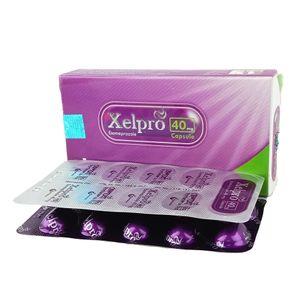
Introduction
Esoprex Capsule (Enteric Coated Pellets) 40 mg is a proton pump inhibitor (PPI) used to treat gastroesophageal reflux disease (GERD), peptic ulcers, erosive esophagitis, Zollinger-Ellison syndrome, and other conditions associated with excessive gastric acid secretion. It is also used in combination with antibiotics to eradicate Helicobacter pylori infections and to reduce the risk of NSAID-associated gastric ulcers.
Esoprex Capsule (Enteric Coated Pellets) 40 mg works by irreversibly inhibiting the gastric H+/K+-ATPase (proton pump) in parietal cells, suppressing both basal and stimulated gastric acid secretion for more than 24 hours. Although generally well tolerated, prolonged use may increase the risk of gastrointestinal infections, vitamin and mineral deficiencies, and bone fractures. Gradual dose reduction is recommended when discontinuing long-term therapy to minimize rebound acid hypersecretion.
Uses
Esoprex Capsule (Enteric Coated Pellets) 40 mg is a proton pump inhibitor used to treat GERD, reduce the risk of NSAID associated gastric ulcers, eradicate H. pylori, and to treat conditions causing gastric acid hypersecretion.
Esoprex Capsule (Enteric Coated Pellets) 40 mg is indicated for the treatment of acid-reflux disorders including healing and maintenance of erosive esophagitis, and symptomatic gastroesophageal reflux disease (GERD), peptic ulcer disease, H. pylori eradication, prevention of gastrointestinal bleeds with NSAID use, and for the long-term treatment of pathological hypersecretory conditions including Zollinger-Ellison Syndrome.
Associated Conditions
Pharmacodynamics
Esoprex Capsule (Enteric Coated Pellets) 40 mg is a compound that inhibits gastric acid secretion and is indicated in the treatment of gastroesophageal reflux disease (GERD), the healing of erosive esophagitis, and H. pylori eradication to reduce the risk of duodenal ulcer recurrence. Esoprex Capsule (Enteric Coated Pellets) 40 mg belongs to a new class of antisecretory compounds, the substituted benzimidazoles, that do not exhibit anticholinergic or H2 histamine antagonistic properties, but that suppress gastric acid secretion by specific inhibition of the H+/K+ ATPase at the secretory surface of the gastric parietal cell. By doing so, it inhibits acid secretion into the gsatric lumen. This effect is dose-related and leads to inhibition of both basal and stimulated acid secretion irrespective of the stimulus.
Esoprex Capsule (Enteric Coated Pellets) 40 mg is the s-isomer of Omeprazole, which is a racemate of the S- and R-enantiomer. Esoprex Capsule (Enteric Coated Pellets) 40 mg has been shown to inhibit acid secretion to a similar extent as Omeprazole, without any significant differences between the two compounds in vitro.
PPIs such as esomeprazole have also been shown to inhibit the activity of dimethylarginine dimethylaminohydrolase (DDAH), an enzyme necessary for cardiovascular health. DDAH inhibition causes a consequent accumulation of the nitric oxide synthase inhibitor asymmetric dimethylarginie (ADMA), which is thought to cause the association of PPIs with increased risk of cardiovascular events in patients with unstable coronary syndromes.
Due to their good safety profile and as several PPIs are available over the counter without a prescription, their current use in North America is widespread. Long term use of PPIs such as esomeprazole has been associated with possible adverse effects, however, including increased susceptibility to bacterial infections (including gastrointestinal C. difficile), reduced absorption of micronutrients including iron and B12, and an increased risk of developing hypomagnesemia and hypocalcemia which may contribute to osteoporosis and bone fractures later in life.
Mechanism of Action
Esoprex Capsule (Enteric Coated Pellets) 40 mg exerts its stomach acid-suppressing effects by preventing the final step in gastric acid production by covalently binding to sulfhydryl groups of cysteines found on the (H+, K+)-ATPase enzyme at the secretory surface of gastric parietal cells. This effect leads to inhibition of both basal and stimulated gastric acid secretion, irrespective of the stimulus. As the binding of esomeprazole to the (H+, K+)-ATPase enzyme is irreversible and new enzyme needs to be expressed in order to resume acid secretion, esomeprazole's duration of antisecretory effect that persists longer than 24 hours.
Absorption
After oral administration, peak plasma levels (Cmax) occur at approximately 1.5 hours (Tmax). The Cmax increases proportionally when the dose is increased, and there is a three-fold increase in the area under the plasma concentration-time curve (AUC) from 20 to 40 mg. At repeated once-daily dosing with 40 mg, the systemic bioavailability is approximately 90% compared to 64% after a single dose of 40 mg. The mean exposure (AUC) to esomeprazole increases from 4.32 μmolhr/L on Day 1 to 11.2 μmolhr/L on Day 5 after 40 mg once daily dosing. The AUC after administration of a single 40 mg dose of Esoprex Capsule (Enteric Coated Pellets) 40 mg is decreased by 43% to 53% after food intake compared to fasting conditions. Esoprex Capsule (Enteric Coated Pellets) 40 mg should be taken at least one hour before meals.
Combination Therapy with Antimicrobials:
Esoprex Capsule (Enteric Coated Pellets) 40 mg magnesium 40 mg once daily was given in combination with Clarithromycin 500 mg twice daily and Amoxicillin 1000 mg twice daily for 7 days to 17 healthy male and female subjects. The mean steady state AUC and Cmax of esomeprazole increased by 70% and 18%, respectively during triple combination therapy compared to treatment with esomeprazole alone. The observed increase in esomeprazole exposure during co-administration with clarithromycin and amoxicillin is not expected to produce significant safety concerns.
Volume of Distribution
The apparent volume of distribution at steady state in healthy volunteers is approximately 16 L.
Protein Binding
Esoprex Capsule (Enteric Coated Pellets) 40 mg is 97% bound to plasma proteins. Plasma protein binding is constant over the concentration range of 2 to 20 µmol/L.
Route of Elimination
The plasma elimination half-life of esomeprazole is approximately 1 to 1.5 hours. Less than 1% of parent drug is excreted in the urine. Approximately 80% of an oral dose of esomeprazole is excreted as inactive metabolites in the urine, and the remainder is found as inactive metabolites in the feces.
Half Life
1-1.5 hours
Toxicity
Blurred vision, confusion, drowsiness, dry mouth, flushing headache, nausea, rapid heartbeat, sweating
Food Interactions
- Take with or without food. Co-administration with food slightly alters pharmacokinetics, but not to a clinically significant extent.
Dosage
- Healing of Erosive Esophagitis: 20 mg or 40 mg Once Daily for 4-8 Weeks. The majority of patients are healed within 4 to 8 weeks. For patients who don't heal after 4-8 weeks, an additional 4-8 weeks of treatment may be considered. Maintenance of Healing of Erosive
- Esophagitis: 20 mg Once Daily (Clinical studies did not extend 6 months).
- Symptomatic GERD: 20 mg Once Daily for 4 Weeks. If symptoms do not resolve completely after 4 weeks, an additional 4 weeks of treatment may be considered.
- Helicobacter Pylori eradication: Triple Therapy to reduce the risk of Duodenal Ulcer recurrence-Esoprex Capsule (Enteric Coated Pellets) 40 mg 40 mg Once Daily for 10 days, Amoxicillin 1000 mg Twice Daily for 10 days, Clarithromycin 500 mg Twice Daily for 10 days.
- Zollinger-Ellison Syndrome: The dose is 20-80 mg once daily. The dosage should be adjusted individually and treatment continued as long as clinically indicated.
- Acid-related Dyspepsia: 20-40 mg once daily for 2-4 weeks according to the response.
- Duodenal ulcer: 20 mg once daily for 2-4 weeks. Gastric ulcer: 20-40 mg once daily for 4-8 weeks.
IV Injection or IV infusion:
GERD with Erosive Esophagitis-
Adult Patients (≥18 years):
- 20 mg or 40 mg once daily
- IV Injection: >3 Minutes, IV Infusion: 10-30 minutes
- Body weight <55 kg: 10 mg Once daily
- Body Weight ≥55 kg: 20 once daily
- 1 month to <1 year: 0.5 mg/kg once daily
- IV Infusion: 10-30 minutes
Adult Patients (≥18 years)
- 80 mg
- IV Infusion: 30 minutes, followed by a continuous infusion of 8 mg/h for a total treatment duration of 72 hours.