Introduction
Escitalopram is a selective serotonin re-uptake inhibitor (SSRI) and the S-enantiomer of racemic citalopram. It is used to restore serotonergic function in the treatment of depression and anxiety. Escitalopram is approximately 150 times more potent than citalopram’s R-enantiomer and is responsible for the vast majority of citalopram’s clinical activity, with some evidence suggesting that the R-enantiomer of racemic citalopram actively dampens the activity of escitalopram rather than existing simply as an inactive enantiomer. Amongst SSRIs, escitalopram exerts the highest degree of selectivity for the serotonin transporter (SERT) relative to other off-targets which may explain its lower rates of adverse effects as compared to other agents in this class. Escitalopram also differentiates itself from other SSRIs via allosteric action on its target - this may be the mechanism responsible for its observed superior efficacy and faster onset compared to other SSRIs.
Uses
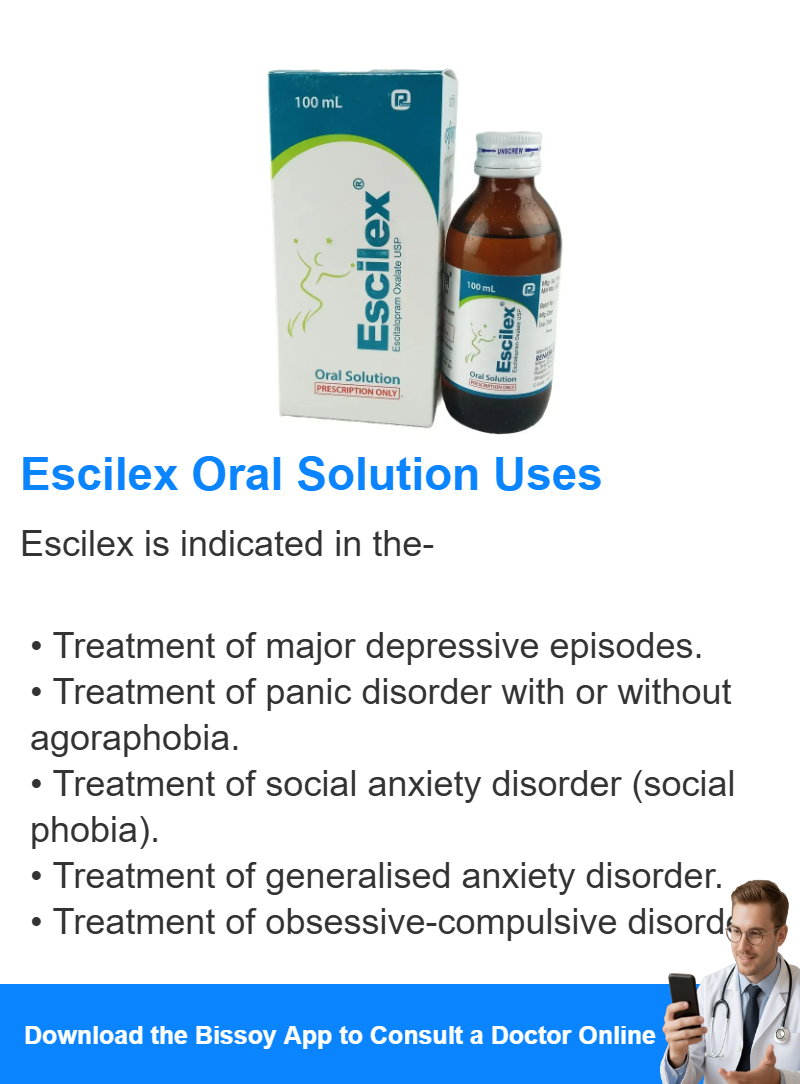
Escitalopram is a selective serotonin re-uptake inhibitor used in the treatment of major depressive disorder (MDD), generalized anxiety disorder (GAD), and other select psychiatric disorders such as obsessive-compulsive disorder (OCD).
Escitalopram is indicated for both acute and maintenance treatment of major depressive disorder (MDD) and for the acute treatment of generalized anxiety disorder (GAD). It is additionally indicated for symptomatic relief of obsessive-compulsive disorder (OCD) in Canada.
Associated Conditions
Pharmacodynamics
Escitalopram belongs to a class of medications called selective serotonin re-uptake inhibitors (SSRIs). These agents cause an increase in serotonin levels in neuronal synapses by preventing the re-uptake of serotonin (5-HT) into the presynaptic terminals of serotonergic neurons. As compared to other SSRIs, it appears to have a relatively quick onset of effect due to its potency.
SSRIs as a class have been associated with abnormal bleeding, particularly in patients receiving concomitant therapy with other medications affecting hemostasis, and with the development of serotonin syndrome. Use escitalopram with caution in patients with a higher-than-baseline risk of bleeding and in patients receiving concomitant therapy with other serotonergic drugs. Escitalopram may also cause a discontinuation syndrome with abrupt removal of the drug, and should be slowly tapered if discontinuation of therapy is warranted.
Mechanism of Action
Escitalopram, like other selective serotonin re-uptake inhibitors, enhances serotonergic activity by binding to the orthosteric (i.e. primary) binding site on the serotonin transporter (SERT), the same site to which endogenous 5-HT binds, and thus prevents the re-uptake of serotonin into the presynaptic neuron. Escitalopram, along with paroxetine, is also considered an allosteric serotonin re-uptake inhibitor - it binds to a secondary allosteric site on the SERT molecule to more strongly inhibit 5-HT re-uptake. Its combination of orthosteric and allosteric activity on SERT allows for greater extracellular 5-HT levels, a faster onset of action, and greater efficacy as compared to other SSRIs. The sustained elevation of synaptic 5-HT eventually causes desensitization of 5-HT1A auto-receptors, which normally shut down endogenous 5-HT release in the presence of excess 5-HT - this desensitization may be necessary for the full clinical effect of SSRIs and may be responsible for their typically prolonged onset of action.
Escitalopram has shown little-to-no binding affinity at a number of other receptors, such as histamine and muscarinic receptors, and minor activity at these off-targets may explain some of its adverse effects.
Absorption
Absorption of escitalopram following oral administration is expected to be almost complete, with an estimated absolute bioavailability of approximately 80%. Tmax occurs after about 4-5 hours. Cmax and AUC appear to follow dose proportionality - at steady state, patients receiving 10mg of escitalopram daily had a Cmax of 21 ng/mL and a 24h AUC of approximately 360 ng*h/mL, while patients receiving 30mg daily had a roughly 3-fold increase in both Cmax and 24h AUC, comparatively.
Volume of Distribution
Escitalopram appears to distribute extensively into tissues, with an apparent volume of distribution of approximately 12-26 L/kg.
Protein Binding
Escitalopram exhibits relatively low protein binding at approximately 55-56%.
Route of Elimination
After oral administration of escitalopram, approximately 8% of the total dose is eliminated in the urine as unchanged escitalopram and 10% is eliminated in the urine as S-desmethylcitalopram. The apparent hepatic clearance of escitalopram amounts to approximately 90% of the total dose.
Half Life
The elimination half-life of escitalopram is 27-32 hours, though this is increased by approximately 50% in the elderly and doubled in patients with reduced hepatic function. The elimination half-life of escitalopram's primary metabolite, S-desmethylcitalopram, is approximately 54 hours at steady state.
Clearance
The oral plasma clearance of escitalopram is 600 mL/min, of which approximately 7% is due to renal clearance.
Toxicity
Symptoms of overdose may include CNS effects (dizziness, convulsions, coma, somnolence), gastrointestinal distress (nausea, vomiting), and/or cardiac abnormalities (hypotension, tachycardia, ECG changes). There is no specific antidote for escitalopram overdose. Management of overdose should focus on monitoring for cardiac abnormalities and changes to vital signs as well as treatment with supportive measures as indicated. As escitalopram is highly distributed into tissue following oral administration, forced diuresis, dialysis, and other methods of extracting drug from plasma are unlikely to be beneficial.
Food Interactions
- Avoid alcohol. The combined use of alcohol with psychotropic medications should be avoided.
- Take with or without food. The absorption is unaffected by food.
Dosage
Major depressive episodes: Usual dosage is 10 mg once daily. Depending on individual patient response, the dose may be increased to a maximum of 20 mg daily. Usually, 2-4 weeks are necessary to obtain an antidepressant response. After the symptoms resolve, treatment for at least 6 months is required for consolidation of the response.
Panic disorder with or without agoraphobia: An initial dose of 5 mg is recommended for the first week before increasing the dose to 10 mg daily. The dose may be further increased, up to a maximum of 20 mg daily, dependent on individual patient response. Maximum effectiveness is reached after about 3 months. The treatment lasts several months.
Social anxiety disorder: Usual dosage is 10 mg once daily. Usually, 2-4 weeks are necessary to obtain symptom relief. The dose may subsequently, depending on individual patient response, be decreased to 5 mg or increased to a maximum of 20 mg daily. Social anxiety disorder is a disease with a chronic course, and treatment for 12 weeks is recommended to consolidate response. Long-term treatment of responders has been studied for 6 months and can be considered on an individual basis to prevent relapse; treatment benefits should be re-evaluated at regular intervals. Social anxiety disorder is a well-defined diagnostic terminology of a specific disorder, which should not be confounded with excessive shyness. Pharmacotherapy is only indicated if the disorder interferes significantly with professional and social activities. The place of this treatment compared to cognitive behavioural therapy has not been assessed. Pharmacotherapy is part of an overall therapeutic strategy.
Generalised anxiety disorder: Initial dosage is 10 mg once daily. Depending on the individual patient response, the dose may be increased to a maximum of 20 mg daily. Long term treatment of responders has been studied for at least 6 months in patients receiving 20 mg/day. Treatment benefits and dose should be re-evaluated at regular intervals.
Obsessive-Compulsive Disorder: Initial dosage is 10 mg once daily. Depending on the individual patient response, the dose may be increased to a maximum of 20 mg daily. As OCD is a chronic disease, patients should be treated for a sufficient period to ensure that they are symptom-free. Treatment benefits and dose should be re-evaluated at regular intervals.