Introduction
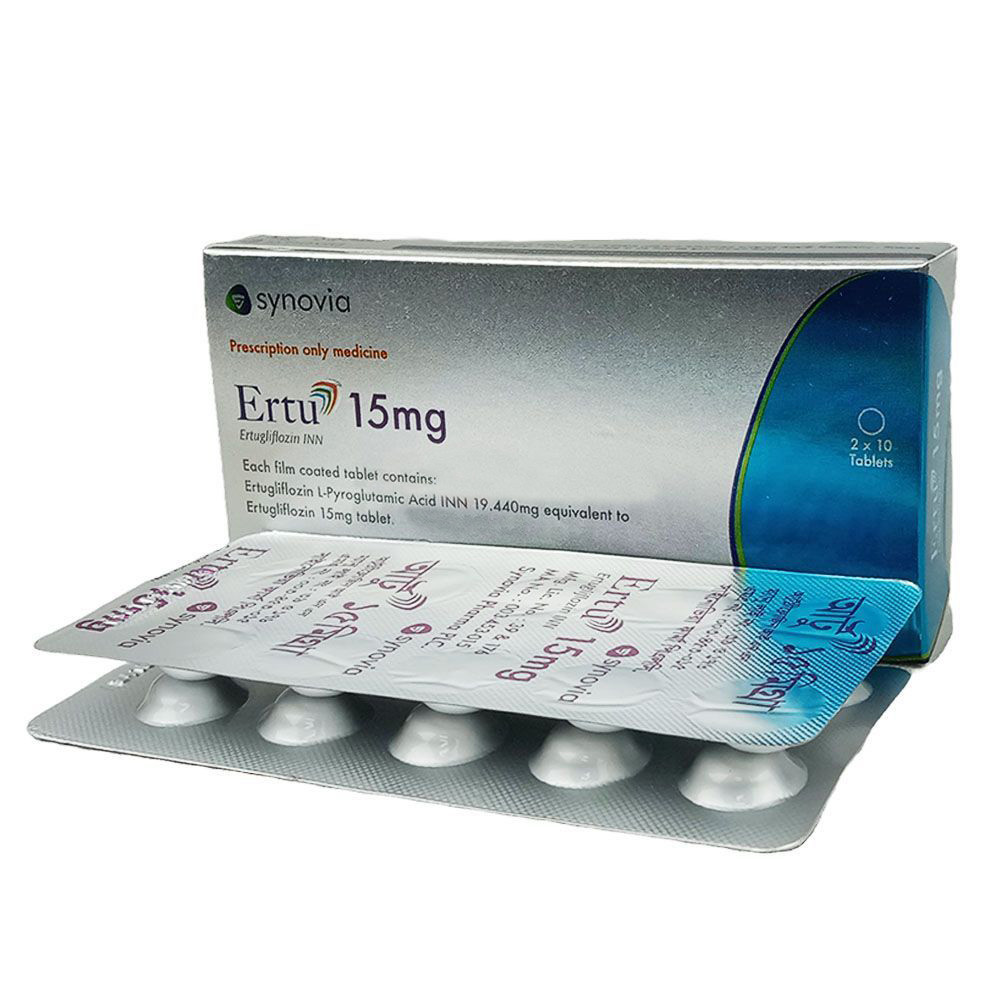
Ertu Tablet 15 mg belongs to the class of potent and selective inhibitors of the sodium-dependent glucose cotransporters (SGLT), more specifically the type 2 which is responsible for about 90% of the glucose reabsorption from glomerulus.
Uses
Ertu Tablet 15 mg is a SGLT2 inhibitor used to treat type 2 diabetes mellitus.
Ertu Tablet 15 mg as a monotherapy is indicated to improve the glycemic control in adult patients with type 2 diabetes. Ertu Tablet 15 mg, in combination with metformin hydrochloride, is indicated to improve glycemic control in patients with diabetes type 2 who are not controlled on a regimen of ertugliflozin or metformin or in patients who are already treated with both ertugliflozin and metformin. The administration of ertugliflozin in combination with sitagliptin is indicated to improve glycemic control in adult patients with type 2 diabetes when treatment with ertugliflozin and sitagliptin is appropriate. It is pointed out that the use of ertugliflozin has to be an adjunct therapy to the use of diet and exercise. The type 2 diabetes mellitus is characterized by insulin resistance in muscle and liver, which results in the elevation of glucose levels in blood, or by presence of insulin deficiency. The insulin resistance is related to genetic factors, obesity, sedentary lifestyle or/and aging. This increase in the blood glucose can cause severe damage to kidney, eyes and vascular system.
Associated Conditions
Pharmacodynamics
Administration of ertugliflozin increases urinary glucose excretion which leads to a negative balance and osmotic diuresis. Thus, this antidiabetic agent has been reported to significantly reduce the body weight and blood pressure of diabetic patients.
Mechanism of Action
As part of a normal process, the glucose from the blood is filtered for excretion and reabsorbed in the glomerulus so less than one percent of this glucose is excreted in the urine. The reabsorption is mediated by the sodium-dependent glucose cotransporter (SGLT), mainly the type 2 which is responsible for 90% of the reabsorbed glucose. Ertu Tablet 15 mg is a small inhibitor of the SGLT2 and its activity increases glucose excretion, reducing hyperglycemia without the requirement of excessive insulin secretion.
Absorption
Preclinical studies showed that ertugliflozin is well absorbed and had an oral bioavailability of 70-90%. The reported Tmax occurred at 0.5-1.5 hours after dosage. Following oral administration, the Cmax and AUC appeared to be dose proportional.Administration of 15 mg reported values of Cmax and AUC of 268 ng/ml and 1193 ng h/ml respectively.
Volume of Distribution
After oral administration of ertugliflozin, the apparent volume of distribution was reported to be 215.3 L. The steady-state volume of distribution after intravenous administration of etrugliflozin is 85.53 L.
Protein Binding
Ertu Tablet 15 mg is highly bound to plasma proteins and it binds in a range of 94-96% independently of the administered concentration.
Route of Elimination
The total recovery of ertugliflozin was 91% and this elimination route is distributed in a ratio of 50% in the urine and 41% in feces. The recovery of the administered dose was achieved approximately 168 hours after initial administration. Urine elimination occurred very rapidly and 80% of the dosage recovered in urine was obtained after 24 hours. The eliminated dose in urine was composed of seven different major metabolites and the unchanged ertugliflozin as a minor metabolite. The elimination rate in feces was depending on the bowel movements of each patient but 98.5% of the eliminated dose in feces was obtained after 168 hours of initial dosage. This eliminated dose was formed mainly by unchanged ertugliflozin and three other minor metabolites.
Half Life
The terminal elimination half-life of ertugliflozin is 11-17 hours.
Clearance
The apparent total plasma clearance rate after oral administration of ertugliflozin is 178.7 ml/min and the systemic total plasma clearance after intravenous administration is reported to be 187.2 ml/min.
Toxicity
The reports from clinical trials have portrait ertugliflozin to be well tolerated and abscent of significant side effects. Carcinogenic studies have been performed and it has been reported an increased incidence of adrenal medullary pheochromocytoma; possibly related to carbohydrate malabsorption leading to altered calcium homeostasis. There were no reported cases of mutagenesis or impairment in fertility.
Food Interactions
- Avoid excessive or chronic alcohol consumption. Alcohol abuse may increase the risk of ketoacidosis.
- Take with or without food.
Dosage
Patients with renal impairment-
- Assess renal function prior to initiation of Ertu Tablet 15 mg and periodically thereafter
- Use of Ertu Tablet 15 mg is contraindicated in patients with an eGFR less than 30 mL/minute/1.73 m2
- Initiation of Ertu Tablet 15 mg is not recommended in patients with an eGFR of 30 mL/minute/1.73 m2 to less than 60 mL/minute/1.73 m2
- Continued use of Ertu Tablet 15 mg is not recommended when eGFR is persistently between 30 and less than 60 mL/minute/1.73 m2.
- No dose adjustment of ertugliflozin is necessary in patients with mild or moderate hepatic impairment.
- Ertu Tablet 15 mg has not been studied in patients with severe hepatic impairment and is not recommended for use in these patients.