Introduction
Prasugrel is a thienopyridine antiplatelet medication used to reduce platelet activation and aggregation in patients with acute coronary syndromes undergoing percutaneous coronary intervention (PCI). It is a prodrug that is converted in the liver to its active metabolite, which irreversibly blocks P2Y12 ADP receptors on platelets. This prevents activation of the GPIIb/IIIa receptor complex, thereby inhibiting ADP-mediated platelet aggregation and reducing the risk of thrombotic cardiovascular events. Structurally and pharmacologically, prasugrel is closely related to clopidogrel and ticlopidine.
Uses
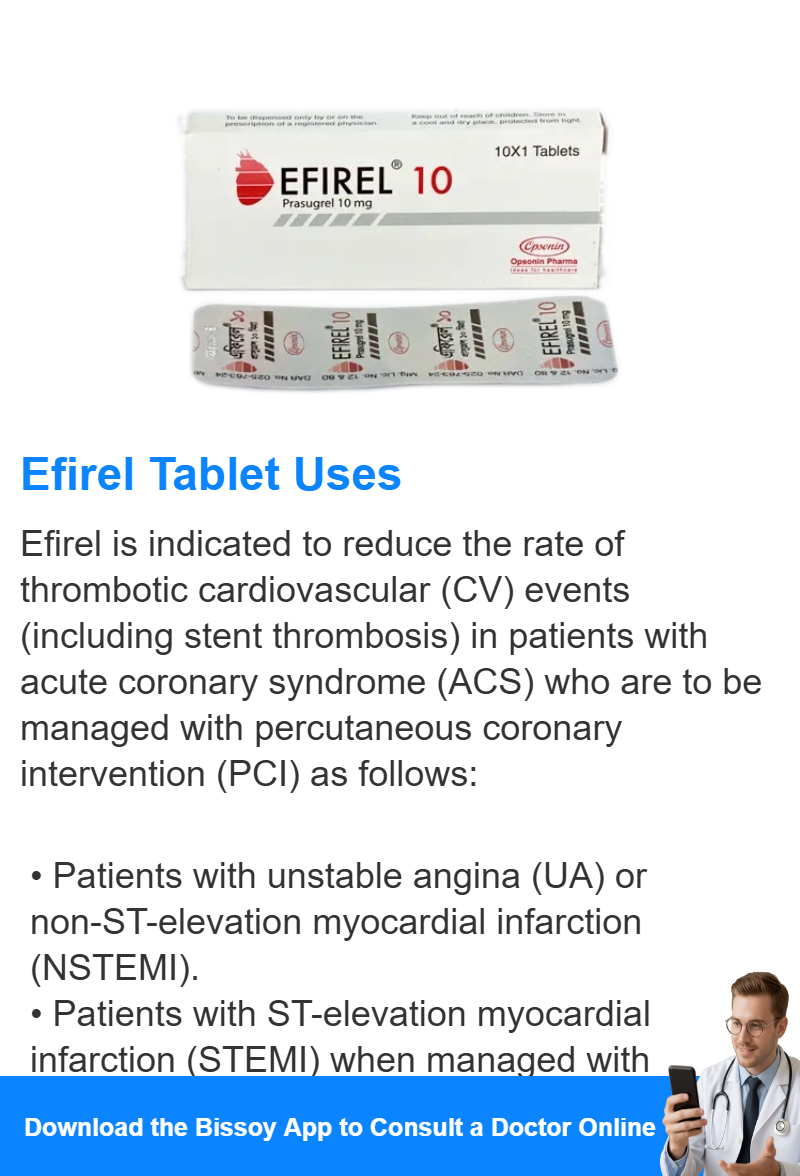
Prasugrel is a P2Y12 platelet inhibitor used to reduce risk of thrombotic cardiovascular events in unstable angina or non-ST-elevation myocardial infarction (NSTEMI), and in patients with STEMI when managed with either primary or delayed PCI.
Indicated in combination with acetylsalicylic acid (ASA) to prevent atherothrombotic events in patients with acute coronary syndrome (ACS) who are to be managed with percutaneous coronary intervention (PCI). May be used in patients with unstable angina (UA), non-ST elevation myocardial infarction (NSTEMI), ST-elevation myocardial infarction (STEMI) who are to be managed with PCI. Prasugrel is not recommended in patients 75 years of age or greater, those that weigh<60kg, and patients with a history of stroke or transient ischemic attack due to increased risk of fatal and intracranial bleeding.
Associated Conditions
Pharmacodynamics
Prasugrel is a thienopyridine ADP receptor inhibitors which inhibits platelet aggregation by irreversibly binding to P2Y12 receptors.
Mechanism of Action
Prasugrel is an thienopyridine and a prodrug which inhibits ADP receptors by irreversibly acting on the P2Y12 receptor on platelets. The active metabolite of prasugrel prevents binding of adenosine diphosphate (ADP) to its platelet receptor, impairing the ADP-mediated activation of the glycoprotein GPIIb/IIIa complex. Prasugrel is proposed to have a similar mechanism of action to clopidogrel.
Absorption
79% or greater of the dose is absorbed after oral administration. Absorption and metabolism occur rapidly and peak plasma concentrations (Cmax) are reached approximately 30 minutes following oral administration. Administration with a high fat, high calorie meal did not affect the AUC of the active metabolite in healthy individuals, but the Cmax was decreased by ~49% and the Tmax was increased to 0.5 to 1.5 hours. Prasugrel may be administered with or without food.
Volume of Distribution
44-68L
Protein Binding
Approximately 98% of the active metabolite was bound to human serum albumin in a 4% buffered solution. The major inactive metabolites are also highly bound to human plasma proteins.
Route of Elimination
Approximately 68% of the orally administered dose is excreted in urine and 27% in the feces, as inactive metabolites. The active metabolite is not expected to be removed by dialysis.
Half Life
The active metabolite has an elimination half-life of about 7.4 hours (range 2-15 hours).
Clearance
Apparent clearance = 112 - 166 L/hr
Toxicity
LD50 (rat) 1,000 - 2,000 mg/kg; LD50 (rabbit) > 1,000 mg/kg
Food Interactions
- Avoid herbs and supplements with anticoagulant/antiplatelet activity. Examples include garlic, ginger, bilberry, danshen, piracetam, and ginkgo biloba.
- Take with or without food.