Introduction
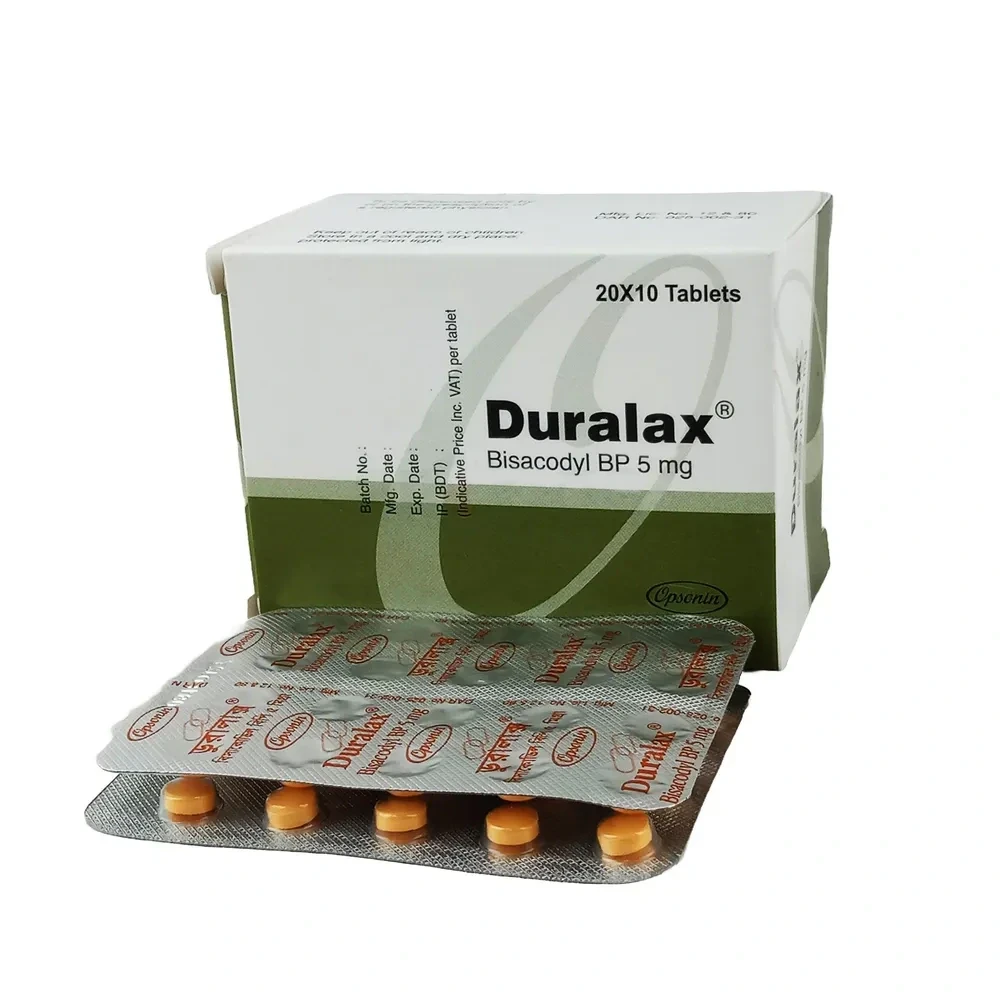
Duralax Tablet 5 mg, a diphenylmethane derivative, is a commonly used over the counter stimulant laxative for occasional constipation. Both bisacodyl and picosulfate are metabolized to the same active metabolite bis-(p-hydroxyphenyl)-pyridyl-2-methane (BHPM).
Duralax Tablet 5 mg was patented on 25 September 1956 but has been used as a laxative since 1952.
Uses
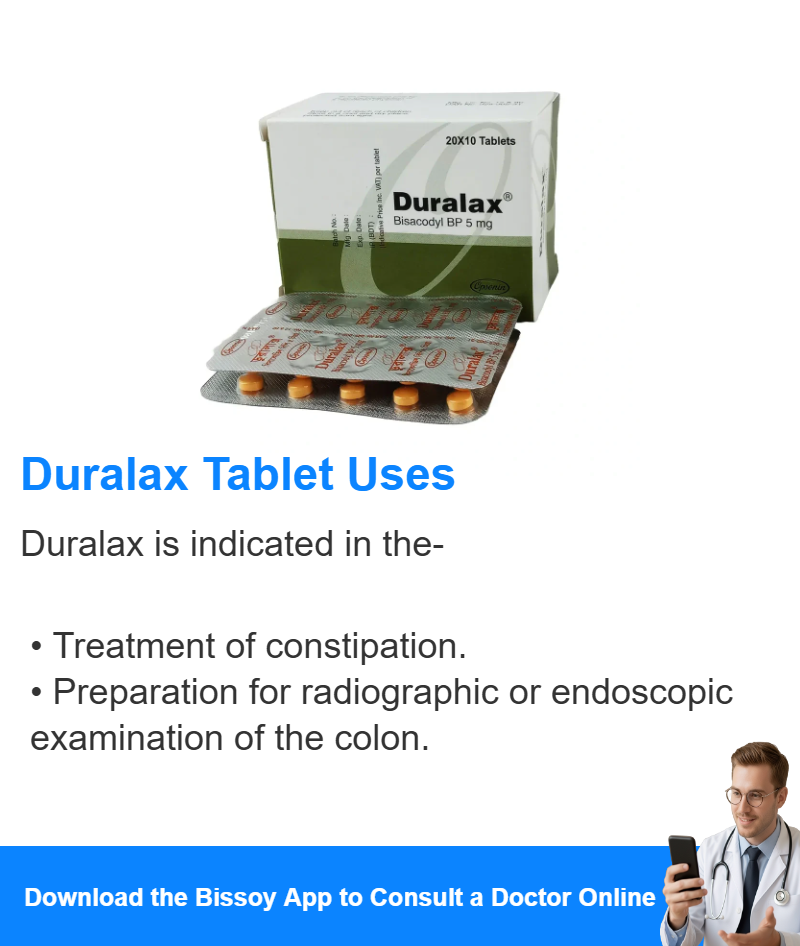
Duralax Tablet 5 mg is a stimulant laxative used for the temporary relief of occasional constipation and cleansing of the colon as a preparation for colonoscopy in adults.
Duralax Tablet 5 mg is indicated to relieve occasional constipation and irregularity.
Associated Conditions
Pharmacodynamics
Patients should be counselled regarding abdominal pain, nausea, vomiting, or a change in bowel function that lasts longer than 2 weeks. It has a wide therapeutic index, as patients can take 5-15 mg orally. Patients taking bisacodyl should be counselled before taking the medication if they are already experiencing abdominal pain, nausea, vomiting, or a change in bowel function lasting longer than 2 weeks. Patients should also be counselled to stop taking the medication if they experience rectal bleeding or no bowel movement in 12 hours.
Mechanism of Action
Duralax Tablet 5 mg is deacetylated to the active bis-(p-hydroxyphenyl)-pyridyl-2-methane (BHPM) by an intestinal deacetylase. BHPM can stimulate parasympathetic nerves in the colon directly to increase motility and secretions.
Duralax Tablet 5 mg stimulates adenylate cyclase, increasing cyclic AMP, leading to active transport of chloride and bicarbonate out of cells. Sodium ions, potassium ions, and water passively leave the cell; while sodium and chloride ions are unable to be reabsorbed.
Water is also be transported from the luminal side of cells into the vasculature by aquaporin 3. Duralax Tablet 5 mg decreases expression of aquaporin 3, preventing water from moving into the vasculature, which may contribute to increased water in the colon.
Duralax Tablet 5 mg directly stimulates parasympathetic nerves in the colon, stimulating contraction of longitudinal smooth muscle but not circular smooth muscle.
Absorption
Oral formulations of bisacodyl are only 16% bioavailable. A 10 mg enteric coated oral tablet reaches a Cmax of 26 ng/mL with a Tmax of 8 hours, while a 10 mg oral solution reaches a Cmax of 237 ng/mL with a Tmax of 1.7 hours. A 10 mg suppository reaches a Cmax of 0-64 ng/mL.
In lactating women, 10mg of oral bisacodyl reaches a Cmax of 20.5-195 ng/mL, with a Tmax of 3-4 hours, and a geometric mean AUC after a single dose of 471 h*ng/mL. After multiple doses, the geometric mean AUC decreases to 311 h*ng/mL.
Volume of Distribution
Data regarding the volume of distribution of bisacodyl is not readily available. However, the volume of distribution of the active metabolite, BHPM, in lactating women is 181 L after a single dose and 289 L at steady state.
Route of Elimination
The majority of bisacodyl is eliminated in the feces. 13.8-17.0% of a bisacodyl dose is eliminated in the urine as the active metabolite BHPM.
Half Life
Data regarding the half life of bisacodyl is not readily available. The half life of the active metabolite, BHPM, in lactating women was 7.3 h after a single 10 mg oral dose and 10.0 h after multiple doses.
Clearance
Data regarding the clearance of bisacodyl is not readily available. The apparent plasma clearance of the active metabolite, BHPM, in lactating women after a single 10 mg oral dose is 272 mL/min and after multiple doses is 412 mL/min.
Toxicity
Patients experiencing an overdose of bisacodyl may present with more severe diarrhea and electrolyte imbalance. Patients should be treated with symptomatic and supportive measures.
The oral LD50 in rats is 4320 mg/kg, and in mice is 17500 mg/kg.
Food Interactions
- Avoid milk and dairy products. Take at least 1 hour before or after antacids and milk.
- Take separate from antacids. Take at least 1 hour before or after antacids and milk.
Dosage
- Adult: 5-10 mg at night; occasionally necessary to increase to 15-20 mg;
- Child under 10 years: 5 mg.
- Adult: 10 mg orally at bed-time for 2 days before the examination.
- Child: half of the adult dose.