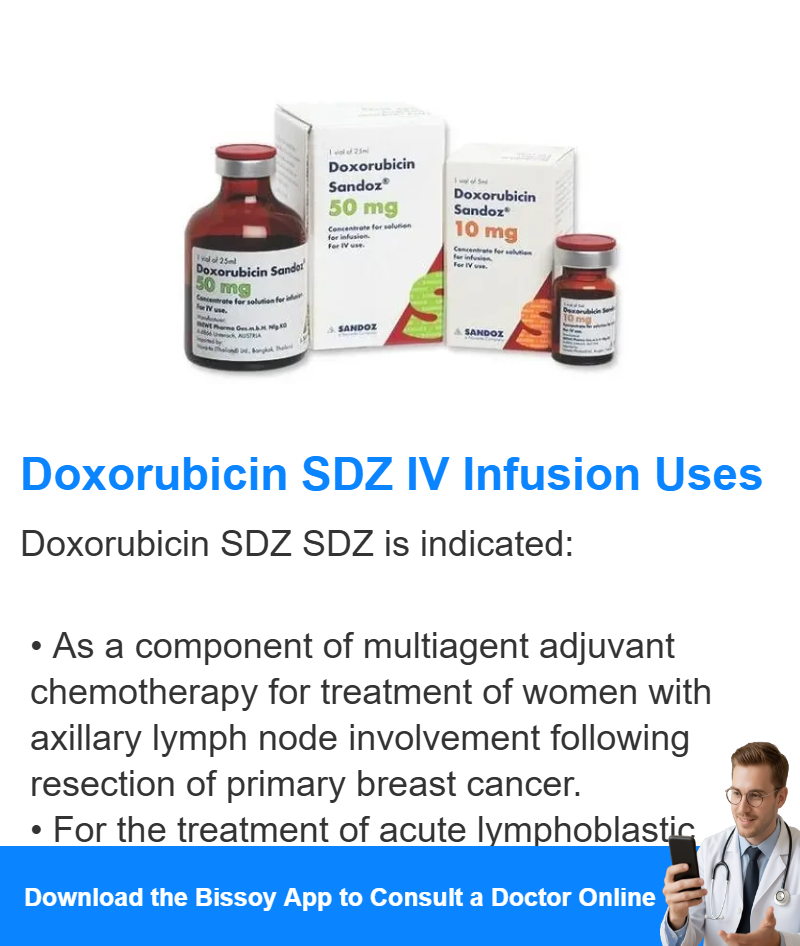
Introduction
Doxorubicin is a cytotoxic anthracycline antibiotic isolated from cultures of Streptomyces peucetius var. caesius. Doxorubicin binds to nucleic acids, presumably by specific intercalation of the planar anthracycline nucleus with the DNA double helix.
Uses
Doxorubicin is a medication used to treat various cancers and Kaposi's Sarcoma.
Doxorubicin is used to produce regression in disseminated neoplastic conditions like acute lymphoblastic leukemia, acute myeloblastic leukemia, Wilms’ tumor, neuroblastoma, soft tissue and bone sarcomas, breast carcinoma, ovarian carcinoma, transitional cell bladder carcinoma, thyroid carcinoma, gastric carcinoma, Hodgkin’s disease, malignant lymphoma and bronchogenic carcinoma in which the small cell histologic type is the most responsive compared to other cell types. Doxorubicin is also indicated for use as a component of adjuvant therapy in women with evidence of axillary lymph node involvement following resection of primary breast cancer.
Associated Conditions
Pharmacodynamics
Doxorubicin is an antineoplastic in the anthracycline class. General properties of drugs in this class include: interaction with DNA in a variety of different ways including intercalation (squeezing between the base pairs), DNA strand breakage and inhibition with the enzyme topoisomerase II. Most of these compounds have been isolated from natural sources and antibiotics. However, they lack the specificity of the antimicrobial antibiotics and thus produce significant toxicity. The anthracyclines are among the most important antitumor drugs available. Doxorubicin is widely used for the treatment of several solid tumors while daunorubicin and idarubicin are used exclusively for the treatment of leukemia. Doxorubicin may also inhibit polymerase activity, affect regulation of gene expression, and produce free radical damage to DNA. Doxorubicin possesses an antitumor effect against a wide spectrum of tumors, either grafted or spontaneous. The anthracyclines are cell cycle-nonspecific.
Mechanism of Action
Doxorubicin has antimitotic and cytotoxic activity through a number of proposed mechanisms of action: Doxorubicin forms complexes with DNA by intercalation between base pairs, and it inhibits topoisomerase II activity by stabilizing the DNA-topoisomerase II complex, preventing the religation portion of the ligation-religation reaction that topoisomerase II catalyzes.
Volume of Distribution
The distributive half-life is 5 minutes, which suggests that doxorubicin is rapidly taken up by tissue. Steady state volume of distribution = 809 to 1214 L/m2
Protein Binding
Doxorubicin and its major metabolite, doxorubicinol, is 74-76% bound to plasma protein. The extent to binding is independent of plasma concentration up to 1.1 mcg/mL. Doxorubicin does not cross the blood brain barrier.
Route of Elimination
40% of the dose appears in bile in 5 days. 5-12% of the drug and its metabolites appears in urine during the same time period. <3% of the dose recovered in urine was doxorubicinol.
Half Life
Terminal half life = 20 - 48 hours.
Clearance
- 324-809 mL/min/m2 [by metabolism and biliary excretion]
- 1088 mL/min/m2 [Men]
- 433 mL/min/m2 [Women]
- 1540 mL/min/m2 [children greater than 2 years of age receiving administration of 10 to 75 mg/m2 doses]
- 813 mL/min/m2 [infants younger than 2 years of age receiving administration of 10 to 75 mg/m2 doses]
Toxicity
LD50=21800 ug/kg (rat, subcutaneous)
Food Interactions
- Avoid St. John's Wort. This herb induces CYP3A4 metabolism, which may reduce the serum concentration of doxorubicin.
- Exercise caution with grapefruit products. Grapefruit inhibits CYP3A4 metabolism, which may increase the serum concentration of doxorubicin.
Dosage
In combination therapy: 40 to 75 mg/m2 given intravenously every 21 to 28 days. Doxorubicin HCl should be discontinued in patients who develop signs or symptoms of cardiomyopathy, and dose should be reduced in patients with hepatic impairment. As an intravenous injection, Doxorubicin HCl is administered through a central intravenous line or a secure and free-flowing peripheral venous line containing 0.9% Sodium Chloride Injection, USP, 0.45% Sodium Chloride Injection, USP, or 5% Dextrose Injection, USP over 3 to 10 minutes. The rate of Doxorubicin HCl administration should be decreased if erythematous streaking along the vein proximal to the site of infusion or facial flushing occur. As intravenous Infusion, Doxorubicin HCl is administered only through a central catheter.
Management of Suspected Extravasation: Doxorubicin HCl should be discontinued in case of burning or stinging sensation or other evidence indicating perivenous infiltration or extravasation. Confirmed or suspected extravasation are managed as follows:
- The needle should not be removed until attempts are made to aspirate extravasated fluid
- The line should not be flushed
- Pressure should not be applied to the site
- Ice should be applied to the site intermittently for 15 min 4 times a day for 3 days
- If the extravasation is in an extremity, extremity should be elevated
- In adults, administration of dexrazoxane should be considered