Introduction
Diclofenac is a phenylacetic acid derivative and non-steroidal anti-inflammatory drug (NSAID). NSAIDs inhibit cyclooxygenase (COX)-1 and-2 which are the enzyme responsible for producing prostaglandins (PGs). PGs contribute to inflammation and pain signalling. Diclofenac, like other NSAIDs, is often used as first line therapy for acute and chronic pain and inflammation from a variety of causes. Diclofenac was the product of rational drug design based on the structures of phenylbutazone, mefenamic acid, and indomethacin. The addition of two chlorine groups in the ortho position of the phenyl ring locks the ring in maximal torsion which appears to be related to increased potency. It is often used in combination with misoprostol to prevent NSAID-induced gastric ulcers.
Uses
Diclofenac is an NSAID used to treat the signs and symptoms of osteoarthritis and rheumatoid arthritis.
Diclofenac is indicated for use in the treatment of pain and inflammation from varying sources including inflammatory conditions such as osteoarthritis, rheumatoid arthritis, and akylosing spondylitis, as well as injury-related inflammation due to surgery and physical trauma. It is often used in combination with misoprostol as a gastro-protective agent in patients with high risk of developing NSAID-induced ulcers.
Associated Conditions
Pharmacodynamics
Diclofenac reduces inflammation and by extension reduces nociceptive pain and combats fever. It also increases the risk of developing a gastrointestinal ulcer by inhibiting the production of protective mucus in the stomach.
Mechanism of Action
Diclofenac inhibits cyclooxygenase-1 and -2, the enzymes responsible for production of prostaglandin (PG) G2 which is the precursor to other PGs. These molecules have broad activity in pain and inflammation and the inhibition of their production is the common mechanism linking each effect of diclofenac.
PGE2 is the primary PG involved in modulation of nociception. It mediates peripheral sensitization through a variety of effects. PGE2 activates the Gq-coupled EP1 receptor leading to increased activity of the inositol trisphosphate/phospholipase C pathway. Activation of this pathway releases intracellular stores of calcium which directly reduces action potential threshold and activates protein kinase C (PKC) which contributes to several indirect mechanisms. PGE2 also activates the EP4 receptor, coupled to Gs, which activates the adenylyl cyclase/protein kinase A (AC/PKA) signaling pathway. PKA and PKC both contribute to the potentiation of transient receptor potential cation channel subfamily V member 1 (TRPV1) potentiation, which increases sensitivity to heat stimuli. They also activate tetrodotoxin-resistant sodium channels and inhibit inward potassium currents. PKA further contributes to the activation of the P2X3 purine receptor and sensitization of T-type calcium channels. The activation and sensitization of depolarizing ion channels and inhibition of inward potassium currents serve to reduce the intensity of stimulus necessary to generate action potentials in nociceptive sensory afferents. PGE2 act via EP3 to increase sensitivity to bradykinin and via EP2 to further increase heat sensitivity. Central sensitization occurs in the dorsal horn of the spinal cord and is mediated by the EP2 receptor which couples to Gs. Pre-synaptically, this receptor increases the release of pro-nociceptive neurotransmitters glutamate, CGRP, and substance P. Post-synaptically it increases the activity of AMPA and NMDA receptors and produces inhibition of inhibitory glycinergic neurons. Together these lead to a reduced threshold of activating, allowing low intensity stimuli to generate pain signals. PGI2 is known to play a role via its Gs-coupled IP receptor although the magnitude of its contribution varies. It has been proposed to be of greater importance in painful inflammatory conditions such as arthritis. By limiting sensitization, both peripheral and central, via these pathways NSAIDs can effectively reduce inflammatory pain.
PGI2 and PGE2 contribute to acute inflammation via their IP and EP2 receptors. Similarly to β adrenergic receptors these are Gs-coupled and mediate vasodilation through the AC/PKA pathway. PGE2 also contributes by increasing leukocyte adhesion to the endothelium and attracts the cells to the site of injury. PGD2 plays a role in the activation of endothelial cell release of cytokines through its DP1 receptor. PGI2 and PGE2 modulate T-helper cell activation and differentiation through IP, EP2, and EP4 receptors which is believed to be an important activity in the pathology of arthritic conditions. By limiting the production of these PGs at the site of injury, NSAIDs can reduce inflammation.
PGE2 can cross the blood-brain barrier and act on excitatory Gq EP3 receptors on thermoregulatory neurons in the hypothalamus. This activation triggers an increase in heat-generation and a reduction in heat-loss to produce a fever. NSAIDs prevent the generation of PGE2 thereby reducing the activity of these neurons.
Absorption
Diclofenac is completely absorbed from the GI tract but likely undergoes significant first pass metabolism with only 60% of the drug reaching systemic circulation unchanged . Many topical formulations are absorbed percutaneous and produce clinically significant plasma concentrations. Absorption is dose proportional over the range of 25-150 mg. Tmax varies between formulations with the oral solution reaching peak plasma concentrations in 10-40min, the enteric coated tablet in 1.5-2h, and the sustained- and extended-release formulations prolonging Tmax even further. Administration with food has no significant effects on AUC but does delay Tmax to 2.5-12h.
Volume of Distribution
Diclofenac has a total volume of distribution of 5-10 L or 0.1-0.2 L/kg. The volume of the central compartment is 0.04 L/kg. Diclofenac distributes to the synovial fluid reaching peak concentration 2-4h after administration. There is limited crossing of the blood brain barrier and cerebrospinal fluid concentrations only reach 8.22% of plasma concentrations. Doses of 50 mg delivered via intramuscular injection produced no detectable diclofenac concentrations in breast milk, however metabolite concentrations were not investigated. Diclofenac has been shown to cross the placenta in mice and rats but human data is unavailable.
Protein Binding
Diclofenac is over 99.7% bound to serum proteins, primarily albumin. It is undergoes limited binding to lipoproteins as well with 1.1% bound to HDL, 0.3% to LDL, and 0.15% to VLDL.
Route of Elimination
Diclofenac is mainly eliminated via metabolism. Of the total dose, 60-70% is eliminated in the urine and 30% is eliminated in the feces. No significant enterohepatic recycling occurs.
Half Life
The terminal half-life of diclofenac is approximately 2 h, however the apparent half-life including all metabolites is 25.8-33 h.
Clearance
Diclofenac has a plasma clearance 16 L/h.
Toxicity
Symptoms of overdose include lethargy, drowsiness, nausea, vomiting, and epigastric pain, and gastrointestinal bleeding. Hypertension, acute renal failure, respiratory depression and coma occur rarely. In case of overdose, provide supportive care and consider inducing emesis and administering activated charcoal if overdose occurred less than 4 hours prior.
Food Interactions
- Avoid excessive or chronic alcohol consumption. Co-administration with alcohol may increase the risk of gastrointestinal side effects, such as ulceration.
- Take with food. Food reduces gastric irritation.
Dosage
Diclofenac SR Tablet:
- Adult: 1 tablet daily, taken whole with liquid, preferably at meal times. If necessary, the daily dose can be increased to 150 mg by supplementation with conventional tablets.
- Children: 1-3 mg of diclofenac/kg body wt. daily in divided doses.
- Elderly patients: In elderly or debilitated patients, the lowest effective dosage is recommended, although the pharmacokinetics of diclofenac sodium is not impaired to any clinically relevant extent in elderly patients.
- Adults: The recommended daily dosage is 2-3 tablets and the maximum daily dose is 150 mg. In milder cases, 2 tablets of Diclofenac DT per day are sufficient. Diclofenac DT should preferably be taken before meals.
- Children: Diclofenac is not recommended in children for other indications except juvenile rheumatoid arthritis where the recommended dose is 1-3 mg/kg body weight. Diclofenac DT is to be dropped into a half-glass of water and the liquid is to be stirred to aid dispersion before swallowing. There is no information on the use of Diclofenac DT for more than 03 months.
Diclofenac Suppository: For adults: 50 mg suppository 2-3 times daily. Maximum daily dose is 150 mg.
Diclofenac injection: For adults the usual dose is 1 ampoule daily. In serious cases this dose may be increased up to 2 ampoules daily.
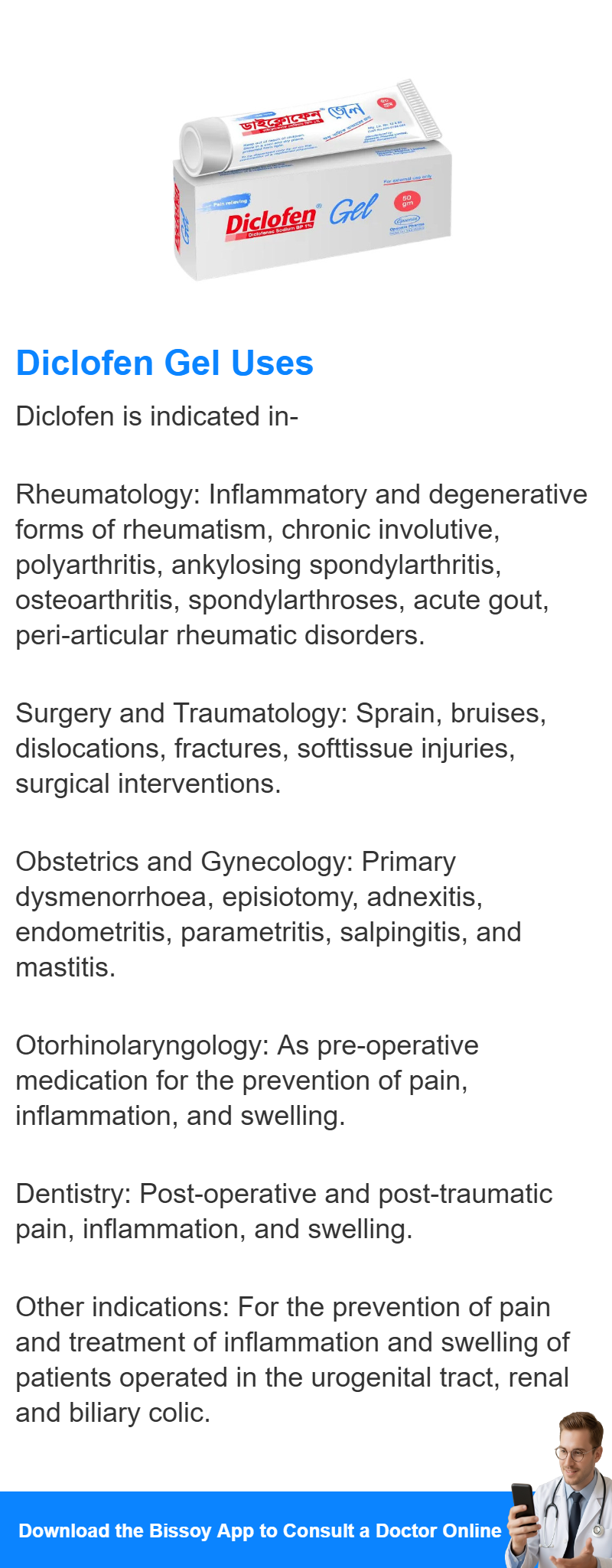
Diclofenac Gel: For external use only. Depending on the size of area to be treated, 2-4 g of Diclofenac gel should be applied to the skin 3-4 times daily. To the affected area gel should be rubbed in lightly. This gel may also be given in addition to further treatment with other dosage forms of Diclofenac.