Introduction
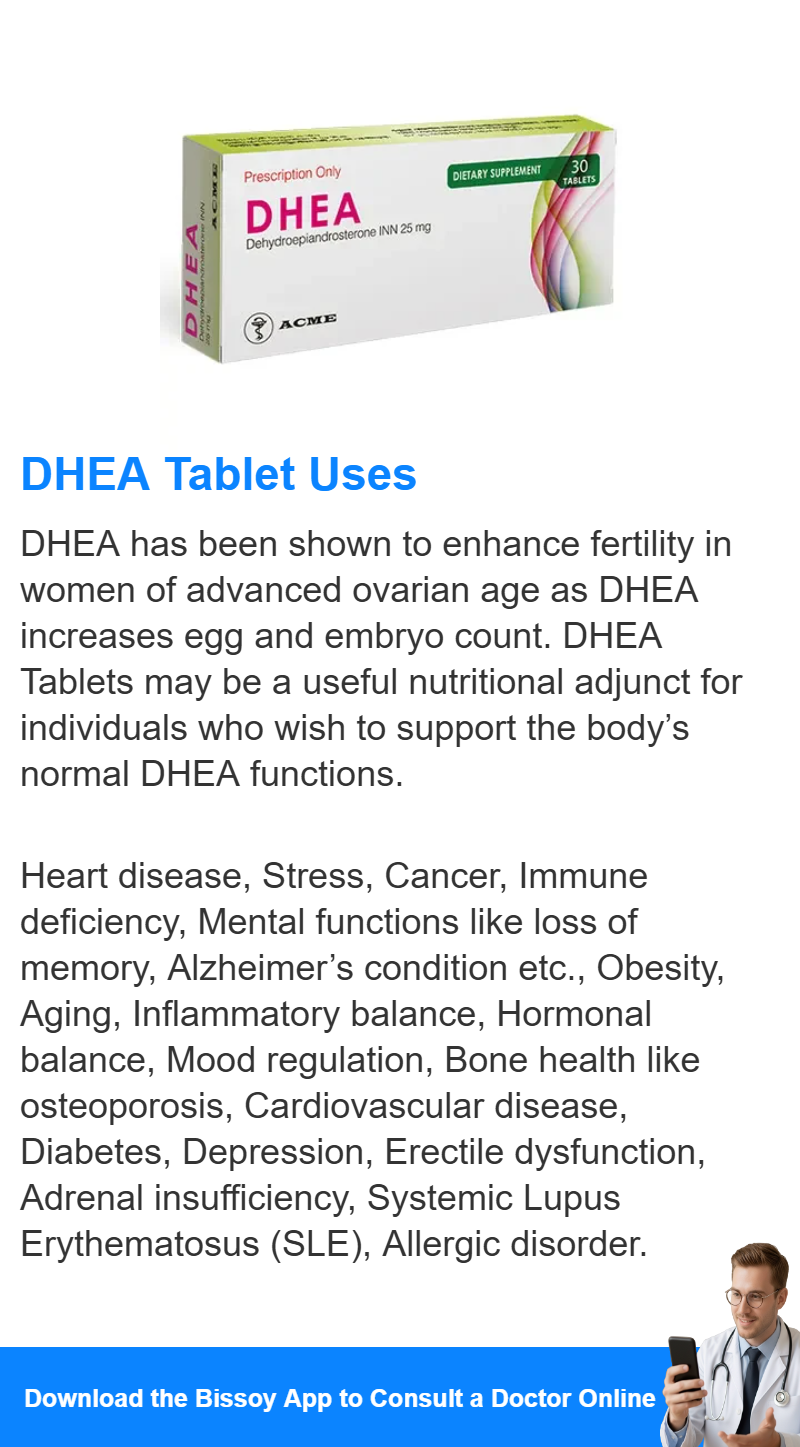
Prasterone, also known as dehydroepiandrosterone (DHEA), is a naturally occurring steroid hormone produced primarily by the adrenal cortex, with smaller amounts produced by the testes and ovaries. It serves as a precursor for the synthesis of androgens and estrogens, including testosterone, androstenedione, estradiol, and estrone. Most circulating DHEA is converted to its sulfated form (DHEA-S) before secretion. Prasterone is used to treat moderate to severe dyspareunia (pain during sexual intercourse) associated with vulvar and vaginal atrophy due to menopause.
Uses
Prasterone is a steroid formulated as a vaginal insert indicated for the treatment of moderate to severe dyspareunia associated with menopausal vulvar and vaginal atrophy.
DHEA is taken as a supplement for a variety of unsubstantiated indications. The following indications have shown promise and are backed up by some scientific evidence: schizophrenia (DHEA may be more effective in women than men); improving the appearance of older people’s skin (taking DHEA by mouth seems to increase skin thickness and moisture, and decrease facial “age spots” in elderly men and women); improving ability to achieve an erection in men with sexual dysfunction. Additionally, DHEA has shown promise in improving symptoms of lupus (SLE). Taking DHEA by mouth along with conventional treatment may help reduce the number of times symptoms flare up and may allow a reduction in the dose of prescription drugs needed. DHEA may also help SLE symptoms such as muscle ache and mouth ulcers. DHEA also seems to strengthen bones in SLE patients being treated with high-dose steroids (corticosteroids). DHEA also shows promise in the treatment of osteoporosis. Taking DHEA by mouth daily seems to improve bone mineral density (BMD) in older women and men with osteoporosis or osteopenia (pre-osteoporosis). DHEA may also increase BMD in young women with the eating disorder called anorexia nervosa. DHEA is often prescribed in India for the induction of ovulation to improve chances of pregnancy.
Associated Conditions
Pharmacodynamics
DHEA is naturally produced from cholesterol through two cytochrome P450 enzymes. Cholesterol is converted to pregnenolone by the enzyme P450 scc (side chain cleavage); then another enzyme, CYP17A1, converts pregnenolone to 17α-Hydroxypregnenolone and then to DHEA. DHEA is increased by exercise and calorie restriction. Some theorize that the increase in endogenous DHEA brought about by calorie restriction is partially responsible for the longer life expectancy known to be associated with calorie restriction.
Mechanism of Action
DHEA can be understood as a prohormone for the sex steroids. DHEAS may be viewed as buffer and reservoir. As most DHEA is produced by the zona reticularis of the adrenal cortex, it is argued that there is a role in the immune and stress response. DHEAS/DHEA are useful to detect excess adrenal activity as seen in adrenal cancer or hyperplasia, including certain forms of congenital adrenal hyperplasia as it is produced nearly entirely by the adrenal glands. Women with polycystic ovary syndrome tend to have elevated levels of DHEAS.
Absorption
Following a 50-mg DHEA PO dose in cynomolgus monkeys, systemic availability was only 3.1 +/- 0.4%. [PMID: 12970301]
Half Life
12 hours
Toxicity
Acute oral toxicity (LD50): >10000 mg/kg [Rat]. Lowest Published Toxic Dose (TDL) [Man] - Route: Oral; Dose: 10 mg/kg/2W intermittent.
Food Interactions
No interactions found.
Dosage
Anorexia nervosa: 100 mg/day for 6 months was used in a pilot study.
Diminished ovarian reserve: 50 to 75 mg/day (in divided doses) has been used in clinical studies of assisted reproduction.
Exercise training–induced muscle damage: 100 mg/day of DHEA Tablet 25 mg supplementation was administered over 5 days in a study in young men undergoing exercise training.
Major depressive disorder: Doses ranging from 30 to 450 mg/day for 6 to 8 weeks have been used in clinical studies.
Metabolic syndrome: 100 mg/day for 3 months has been used in a study evaluating effects against metabolic syndrome in pre-and postmenopausal women.
Postmenopausal women: 25 mg/day has been suggested because this dose minimizes androgenic adverse effects; however, only studies in which at least 50 mg/day was used demonstrated positive outcomes as hormonal replacement therapy.
Use in children & adolescents: Not for use by individuals under the age of 18 years.