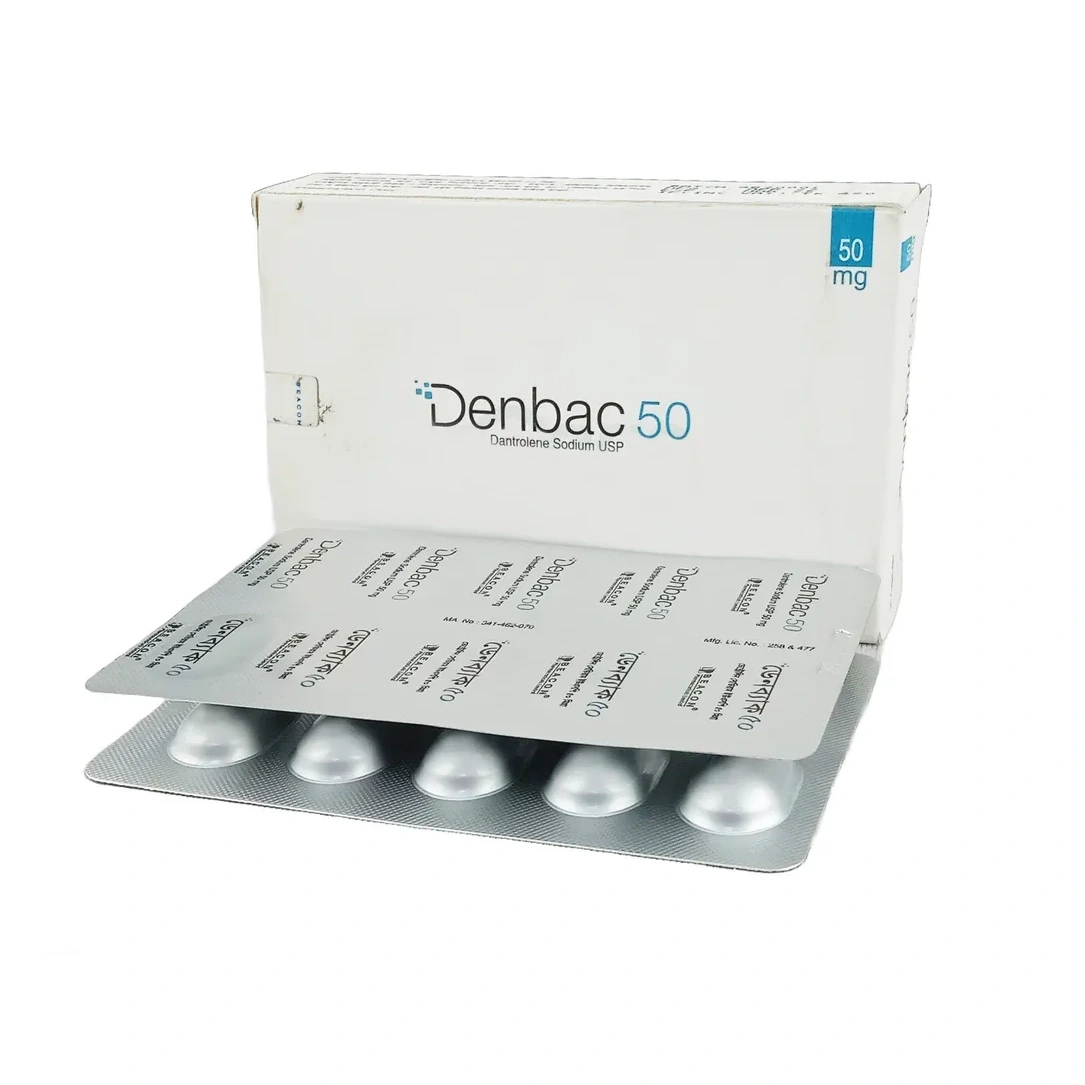
Introduction
Chemically, dantrolene is a hydantoin derivative, but does not exhibit antiepileptic activity like other hydantoin derivates such as phenytoin.
Uses
Dantrolene is a direct-acting skeletal muscle relaxant used for the treatment of management of the fulminant hypermetabolism of skeletal muscle leading to malignant hyperthermia crisis.
For use, along with appropriate supportive measures, for the management of the fulminant hypermetabolism of skeletal muscle characteristic of malignant hyperthermia crises in patients of all ages. Also used preoperatively, and sometimes postoperatively, to prevent or attenuate the development of clinical and laboratory signs of malignant hyperthermia in individuals judged to be malignant hyperthermia susceptible.
Associated Conditions
Pharmacodynamics
Dantrolene is classified as a direct-acting skeletal muscle relaxant. It is currently the only specific and effective treatment for malignant hyperthermia. In isolated nerve-muscle preparation, Dantrium has been shown to produce relaxation by affecting the contractile response of the muscle at a site beyond the myoneural junction. In skeletal muscle, Dantrium dissociates excitation-contraction coupling, probably by interfering with the release of Ca2+ from the sarcoplasmic reticulum. In the anesthetic-induced malignant hyperthermia syndrome, evidence points to an intrinsic abnormality of skeletal muscle tissue. In selected humans, it has been postulated that “triggering agents” (e.g.,general anesthetics and depolarizing neuromuscular blocking agents) produce a change within the cell which results in an elevated myoplasmic calcium. This elevated myoplasmic calcium activates acute cellular catabolic processes that cascade to the malignant hyperthermia crisis. It is hypothesized that addition of Dantrium to the “triggered” malignant hyperthermic muscle cell reestablishes a normal level of ionized calcium in the myoplasm.
Mechanism of Action
Dantrolene depresses excitation-contraction coupling in skeletal muscle by binding to the ryanodine receptor 1, and decreasing intracellular calcium concentration. Ryanodine receptors mediate the release of calcium from the sarcoplasmic reticulum, an essential step in muscle contraction.
Absorption
Bioavailability is 70%.
Protein Binding
Significant, mostly to albumin.
Half Life
The mean biologic half-life after intravenous administration is variable, between 4 to 8 hours under most experimental conditions, while oral is 8.7 hours for a 100mg dose.
Toxicity
Oral LD50 in rats is 7400 mg/kg. Symptoms which may occur in case of overdose include, but are not limited to, muscular weakness and alterations in the state of consciousness (e.g., lethargy, coma), vomiting, diarrhea, and crystalluria.
Food Interactions
- Take with or without food. The absorption is unaffected by food.
Dosage
- Adults: The following gradual titration schedule is suggested. Some patients will not respond until higher daily dosage is achieved. Each dosage level should be maintained for seven days to determine the patient's response. If no further benefit is observed at the next higher dose, dosage should be decreased to the previous lower dose.
- Starting dose is 25 mg twice per day and it can be increased to 25-50 mg per day per week. Maximum accepted dosage is 400 mg per day.
- Paediatric Patients: The following gradual titration schedule is suggested. Some patients will not respond until higher daily dosage is achieved. Each dosage level should be maintained for seven days to determine the patient's response. If no further benefit is observed at the next higher dose, dosage should be decreased to the previous lower dose.
- 0.5 mg/kg once daily for seven days, then 0.5 mg/kg 3 times for 7 days, 1 mg/kg 3 times for 7 days, 2 mg/kg 3 times a day, Therapy with a dose 4 times daily may be necessary for some individuals.
- Preoperatively: Administer 4 to 8 mg/kg/day of oral Dantrolene in 3 or 4 divided doses for one or two days prior to surgery, with the last dose being given approximately 3 to 4 hours before scheduled surgery with a minimum of water.
- Post Crisis Follow-up: Oral Dantrolene should also be administered following a malignant hyperthermia crisis, in doses of 4 to 8 mg/kg per day in four divided doses, for a one to three day period to prevent recurrence of the manifestations of malignant hyperthermia.